
WiTrace: Turning WiFi Signals into a Centimeter-Level Virtual Canvas
WiTrace: Centimeter-Level Passive Gesture Tracking Using WiFi Signals
WiTrace is a high-precision, device-free gesture tracking system utilizing Channel State Information (CSI) from standard 2.4 GHz WiFi signals. By measuring the phase changes of reflected signals, it achieves centimeter-level accuracy for both 1D and 2D hand movement tracking without requiring the user to wear any sensors.
TL;DR
WiTrace is a breakthrough in device-free human-computer interaction that transforms standard WiFi signals into a high-precision tracking tool. By analyzing the subtle phase shifts of Channel State Information (CSI), it tracks hand movements with a mean accuracy of better than 2.1 cm, enabling "drawing in the air" without the need for cameras or wearable hardware.
Background: The Shift from Recognition to Tracking
Most "smart home" WiFi sensing focuses on recognition—identifying a predefined gesture like a wave or a swipe. However, high-precision tracking (knowing exactly where the hand is at all times) is much harder because the hand is a small reflector compared to walls and furniture. Prior arts like WiDraw required dozens of antennas, making them impractical. WiTrace changes the game by proving that with the right signal processing, a standard 1TX/2RX setup can achieve "Virtual Mouse" precision.
The Core Challenge: Finding the Hand in the Noise
The fundamental problem in WiFi sensing is that the signal received is a "composite" of the Direct Path (LoS), reflections from static objects (walls), and the reflection from the moving hand. The static components are often orders of magnitude stronger than the hand reflection.
1. Extracting the Dynamic Vector (ESC Algorithm)
WiTrace introduces the Extracting Static Component (ESC) algorithm. Traditional methods fail when the environment changes slightly or when a movement is slow. ESC uses a temporal threshold determined by the maximal Doppler frequency shift to distinguishes between high-frequency system noise and the actual phase rotation caused by a hand.
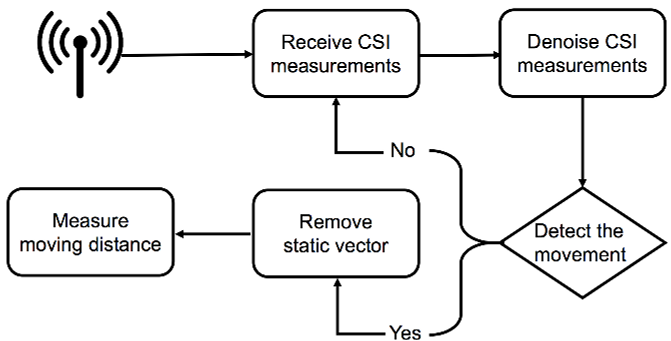 Figure 1: WiTrace processing flow for 1D distance measurement, showcasing noise filtering and static vector elimination.
2D Tracking: Solving the Initial Position Problem
Even if you know how much a path length has changed, you can't know the absolute coordinates without knowing where the hand started.
- The Fingerprint Intuition: WiTrace uses two "preamble" gestures (a horizontal push and a vertical push).
- The Logic: Since different starting positions result in different relative path length changes across the two receivers, the system treats these preambles as a unique spatial fingerprint to pinpoint the user's starting location within 3.91 cm.
Trajectory Refinement
Once tracking begins, the raw coordinates can be jittery. WiTrace applies a Kalman Filter based on the Continuous Wiener Process Acceleration (CWPA) model. This assumes the hand's acceleration changes smoothly, effectively smoothing out the "RF jitter" without the high computational lag associated with particle filters.
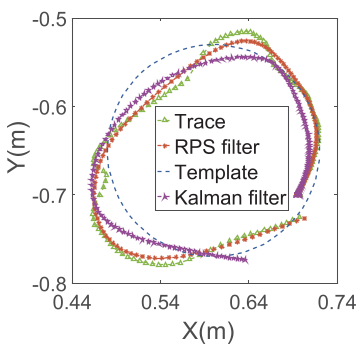 Figure 2: Real-world 2D tracking results showing a reconstructed rectangle (left) and circle (right) with high fidelity.
Experimental Performance
The authors implemented WiTrace using USRP-N210 software-defined radios, transmitting 802.11g frames at 2.4 GHz.
| Metric | Accuracy (Mean) |
|---|---|
| 1D Distance Error | 1.46 cm |
| 2D Trajectory Error | 2.09 cm |
| Initial Position Error | 3.91 cm |
| Directional Accuracy | 7.32 degrees |
Robustness Factors
- Presence of Others: The system maintains performance even when other people are walking 2 meters away, as their reflections are filtered out by the Doppler-aware ESC algorithm.
- Antenna Types: While omnidirectional antennas work well, directional antennas improve accuracy by ~56% due to higher SNR.
Critical Insight: The Value of Phase
The brilliance of WiTrace lies in its move away from CSI Amplitude (which is notoriously unstable due to multipath fading) to CSI Phase. Because the wavelength at 2.4 GHz is ~12.5 cm, a tiny hand movement of just 3 cm causes a massive ~172-degree phase shift. This physical sensitivity is what enables centimeter-level tracking.
Limitations & Future Outlook
The current system requires a preamble gesture, which might be slightly inconvenient for casual users. Additionally, it currently relies on USRP hardware for precise clock synchronization. The authors' next step is implementing this on commercial-off-the-shelf (COTS) WiFi cards (like the Intel 5300 or Atheros AR9380), which would bring this capability to every laptop and smartphone on the planet.
WiTrace bridges the gap between specialized hardware (like Google Soli) and ubiquitous connectivity, proving that the WiFi waves already bathing our rooms are high-precision sensors in disguise.