
Wizard of Oz vs. Autonomous: Does the "Man Behind the Curtain" Affect Learning?
Wizard of Oz vs autonomous: Children's perception changes according to robot's operation condition
This paper presents a comparative study of children's perceptions when interacting with a NAO robot under two conditions: a fully autonomous system and a teleoperated Wizard of Oz (WoZ) setup. It introduces a modular C++ architecture for autonomous educational interaction and demonstrates that children find autonomous robots as enjoyable and responsive as human-controlled ones.
TL;DR
Is a robot's "magic" lost once children find out it's being remote-controlled? This study compares a newly developed autonomous robotic architecture against the traditional Wizard of Oz (WoZ) method. Results show that while children enjoy both equally, discovering the teleoperation leads to a significant "intelligence penalty" in their eyes.
Background: The Wizard of Oz Problem
In Human-Robot Interaction (HRI), designers often use the "Wizard of Oz" technique—a human operator control the robot while the user thinks it is autonomous. While effective for prototyping, it avoids the hard engineering challenges of computer vision and natural language processing. This paper asks a critical question for the future of EdTech: Can an autonomous system match the "gold standard" of a human-operated one in a classroom setting?
Methodology: Building an "Autonomous Tutor"
The researchers built a modular architecture for the NAO robot to handle a geometry lesson (teaching "Faces" and "Edges").
- Speech: Processing verbal answers via Google Speech API.
- Vision: Identifying geometric shapes (cube, pyramid, sphere) using VOCUS2 and SVM classifiers.
- Interaction: A state-machine-driven dialogue that adapts to whether the child already knows a concept.
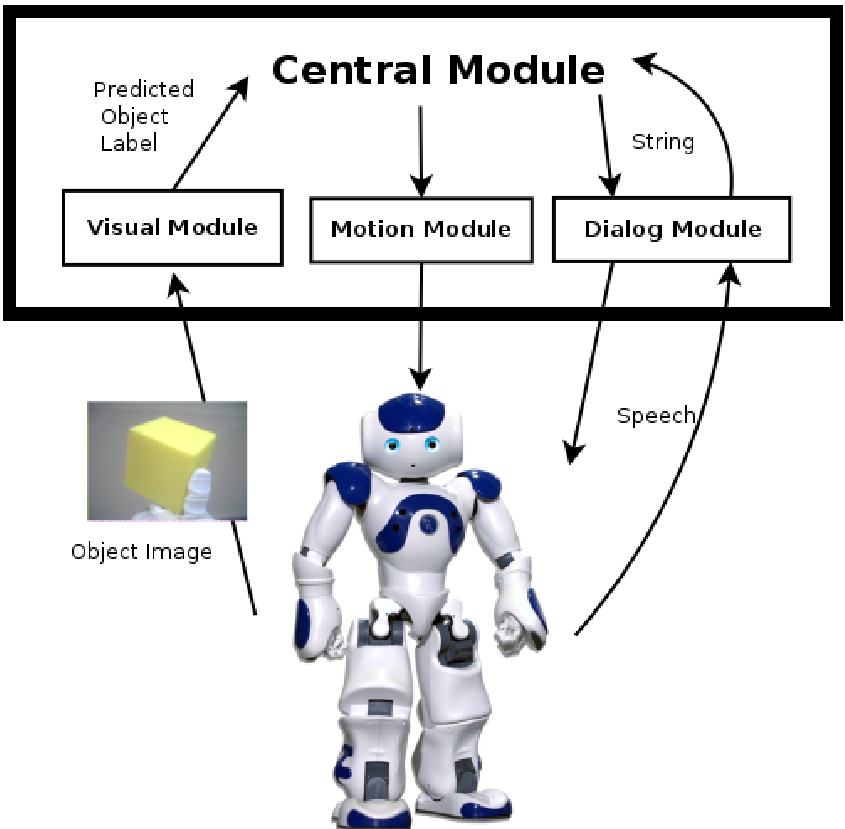 Fig 1: The system architecture managing speech, vision, and movement without human intervention.
The Experiment
82 students (ages 7-11) were randomly assigned to:
- Autonomous Group: The robot made its own decisions based on vision and speech sensors.
- WoZ Group: A hidden researcher controlled the robot. (At the end, these children were told the truth).
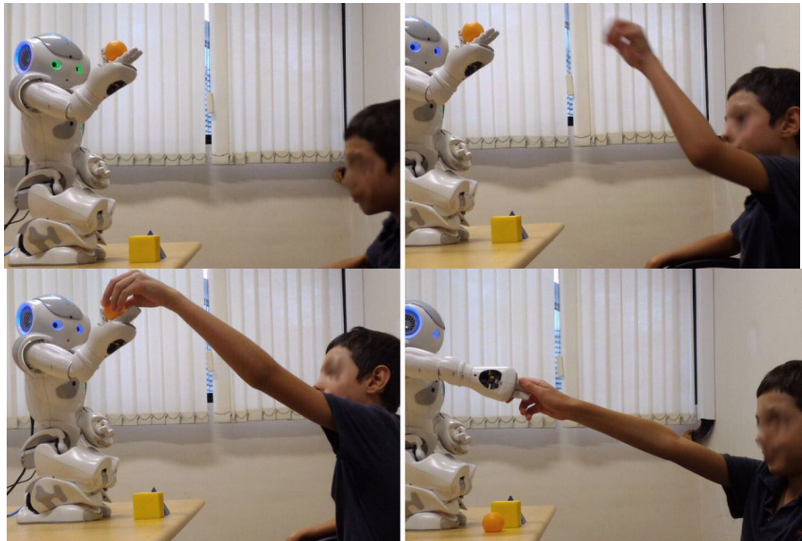 Fig 2: Real-world interaction phases—from greeting to object recognition and celebratory handshakes.
Key Insights & Results
1. The Enjoyment Parity
The data suggests that autonomy is "ready for primetime." There was no significant statistical difference in how much children enjoyed the interaction or how they perceived the response time. Even though the autonomous system occasionally suffered from lag or vision errors (92% accuracy), children viewed it as just as capable as a human-directed one.
2. The Credibility Gap
The most striking finding occurred when the "curtain was pulled back." Once the WoZ group was told a human was controlling the robot:
- Intelligence Perception Dropped: There was a statistically significant decrease in how intelligent children rated the robot.
- The "Human" Preference: 80% of children stated they would prefer a truly autonomous robot over a teleoperated one.
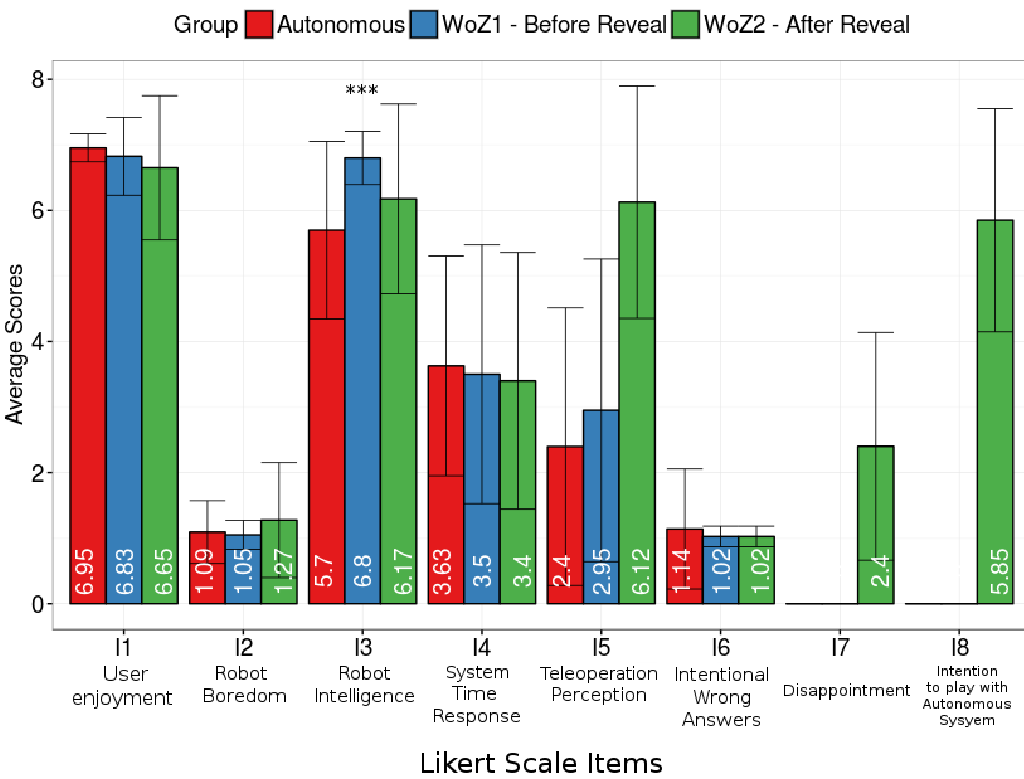 Fig 3: Comparing Autonomous (Red) vs. WoZ before revelation (Blue) and after (Green). Note the drop in "Intelligence" (I3) in the green bar.
Critical Analysis: Why This Matters
The study highlights an important psychological threshold. Children are remarkably forgiving of a robot's technical mistakes (like misidentifying a cube), treating them as "learning moments." However, they are less forgiving of being "tricked."
For the robotics industry, this emphasizes the need to move away from WoZ in production. If a robot is to be a credible tutor, its intelligence must be perceived as inherent to the machine. As the authors note, learning gains are tied to the credibility of the tutor. If the robot is just a puppet, the pedagogical "bond" may weaken.
Conclusion
This research proves that autonomous systems are reaching a level of social parity with human operators in specific educational tasks. While vision and latecy issues persist, the perception of autonomy is a key ingredient in the social value of a robot. Future work will focus on whether these autonomous interactions lead to better long-term learning outcomes compared to human-led teleoperation.