
Mapping 40 Years of Women's Health: From Reproduction to Social Well-being
Research involving women and health in the Medline database, 1965–2005: co-term analysis and visualization of main lines of research
This study presents a longitudinal bibliometric analysis of research on Women and Health in the Medline database from 1965 to 2005. By utilizing co-term analysis, Pathfinder Networks (PFNET), and Factor Analysis, the authors map the evolution of thematic research fronts across four decades, highlighting a paradigm shift from purely reproductive biology to broader socio-psychological and gender-based perspectives.
TL;DR
This research provides a comprehensive 40-year visual "biography" of women's health research (1965–2005) using the Medline database. By analyzing the co-occurrence of MeSH descriptors, the authors show a fundamental transition: medical science has moved from viewing women merely as "reproductive vessels" to recognizing the complex interplay of social environment, psychology, and gender-specific pathologies.
Background: The Evolution of a Domain
For decades, women’s presence in medical literature was largely confined to Obstetrics and Gynecology. Clinical trials often excluded women due to fears of fetal damage or hormonal complexity. However, social shifts in the 1970s and the HIV/AIDS crisis in the 80s forced a re-evaluation of how sex and gender determine health outcomes. This paper uses structural visualization to see if the "academic reality" matches these social shifts.
Methodology: The Science of Mapping Science
To distill nearly 400,000 documents into a coherent map, the authors used a robust multi-stage pipeline:
- Selection: Extraction of "MeSH Major Topics" to ensure high-precision indexing.
- Symmetry: Generation of co-occurrence matrices showing how often terms like "Breast Neoplasms" and "Mammography" appeared together.
- Refinement: Using Pathfinder Networks (PFNET) to prune the "noise" (weak associations) while keeping the backbone of the research structure.
- Validation: Factor Analysis was used to ensure that the groups seen on the map weren't just visual artifacts but statistically significant "research lines."
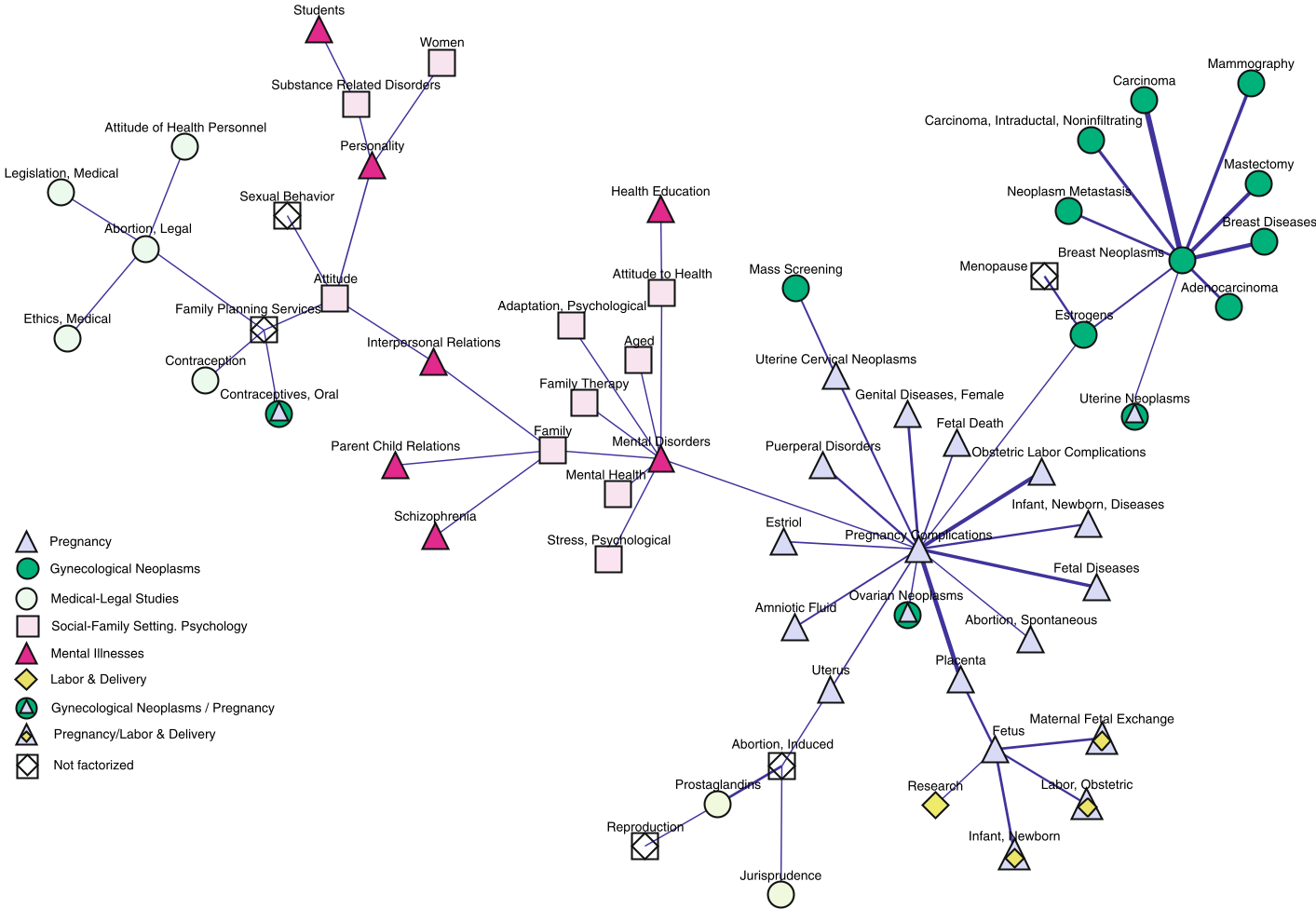 The visualization utilizes a neuron-like structure where central nodes represent high-frequency descriptors connecting various specialized sub-fields.
Decadal Shifts: Key Findings
The research breaks down history into four distinct eras:
1965–1974: The Reproductive Era
"Pregnancy" was the absolute sun of this universe, accounting for over 43% of the research variance. The focus was narrow: complications during gestation and neonate health.
1975–1984: The Rise of Oncology
The spotlight shifted to Gynecological Neoplasms (Cancer), particularly Breast Neoplasms, which doubled its presence. We also see the first hints of "Gender Studies" and workplace-related health.
1985–1994: The AIDS Crisis & Social Turn
This decade saw a massive diversification. AIDS and HIV Infection appeared as a dominant factor (20.7% variance), and "Social-Family Setting" began to displace reproduction as the central connective tissue of the research network.
1995–2005: The Quality of Life Era
Modern research has shifted toward Health Education and Psychology. Terms like "Quality of Life," "Depression," and "Health Promotion" became central, signifying a holistic view of health as defined by the WHO.
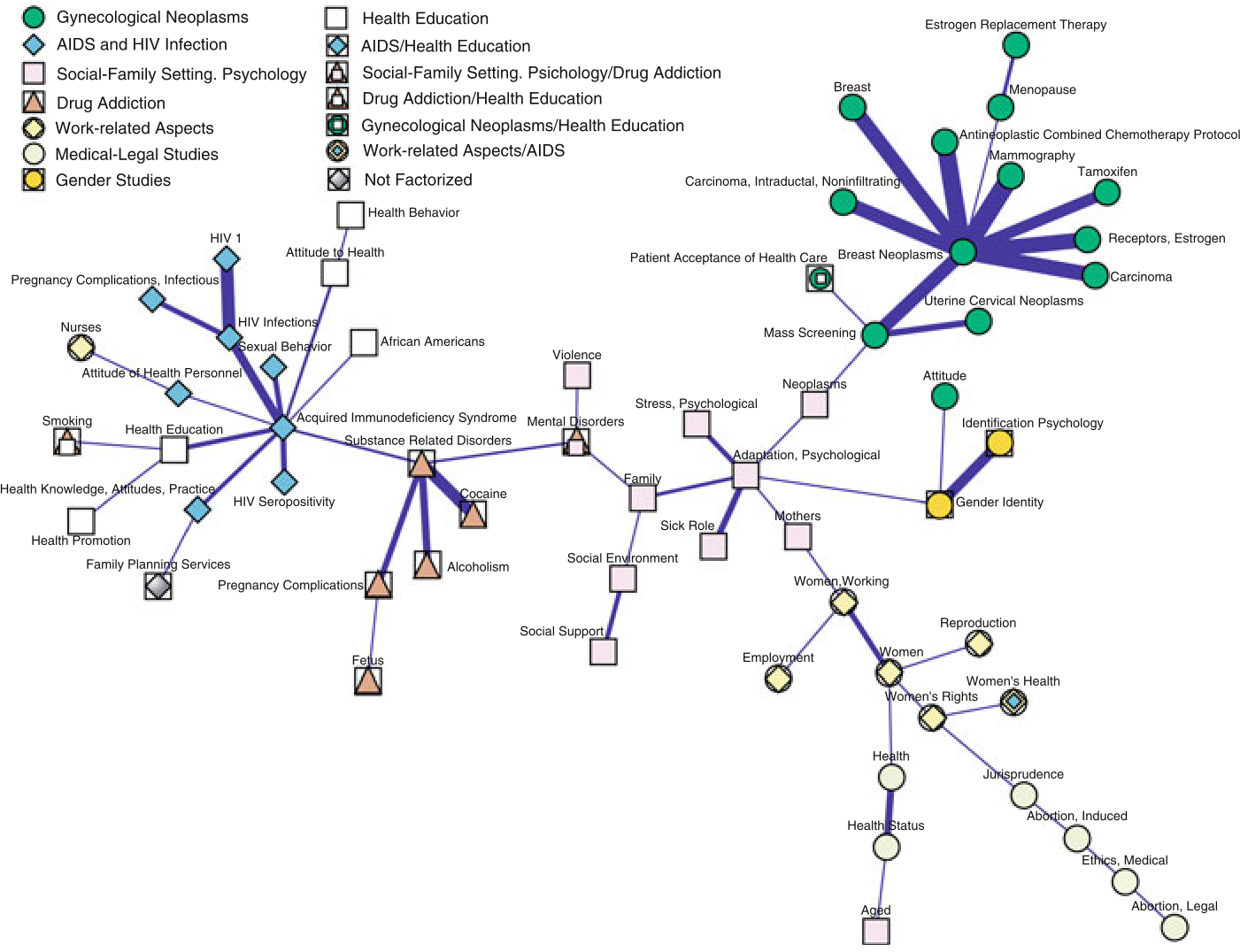 Figure 3 (1985-1994) vs Figure 4 (1995-2005) showcases the structural simplification and the shift towards social-psychological nodes.
Critical Insight: What’s Still Missing?
Despite the growth, the authors point out a glaring omission: General Pathologies. The maps still fail to show significant research clusters for heart disease or lung cancer specifically tailored to women, despite these being leading causes of mortality. The "Women's Health" label, while expanding, still largely struggles to escape the "reproductive silo."
Conclusion
This study is a testament to the power of bibliometric mapping. It transforms millions of pages of text into a visible evolution of human thought. The takeaway is clear: while we have successfully integrated a social and psychological perspective into women's health, the medical community still needs to bridge the gap between "gender-specific" research and "general medicine" to ensure women aren't left behind in non-reproductive health sectors.