
The Geometry of Culture: Using AI to Map Senegal’s Colonial Scars and Future Hope
Word embedding analysis on colonial history, present issues, and optimism toward the future in Senegal
This study utilizes GloVe word embeddings to analyze socio-cultural sentiments in Senegal by comparing a localized corpus (SnText, from Senegalese newspapers) against a standard French reference (FrText, from Wikipedia). The research effectively identifies unique cultural nuances and public priorities regarding colonial legacy, environmental crises, and national optimism.
TL;DR
Researchers have turned to Natural Language Processing (NLP) to perform a "digital biopsy" of the Senegalese mindset. By training GloVe word embeddings on localized newspaper data (SnText) and comparing the results with European French Wikipedia (FrText), the study uncovers how colonial history still stigmatizes "tradition," identifies water sanitation as a top-tier national struggle, and quantifies a surprising surge of optimism toward the future.
Background: Beyond the Limits of Surveys
In social science, people don’t always say what they think. On sensitive topics—religion, race, or the legacy of colonization—biases often reside in the subconscious. This paper poses a clever alternative: if language reflects the value system of a society, can we use the mathematical distances between words to "calculate" culture?
Methodology: Building Semantic Scales
The core innovation lies in the use of Semantic Scales. In a word embedding space, words are vectors. By taking the vector for "Easy" and subtracting "Difficult," you create a direction in 200-dimensional space that represents "Difficulty." Any word (e.g., "Poverty," "Sanitation") can then be projected onto this line to see where it sits in the collective consciousness.
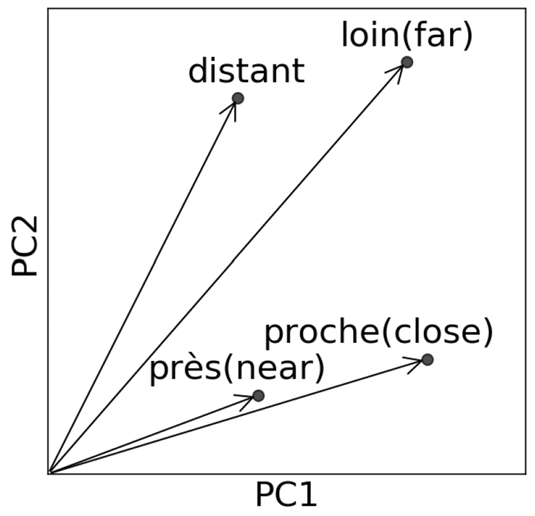 Figure 1: PCA visualization showing how antonyms define a semantic scale for measurement.
Key Insights: Three Dimensions of Senegal
1. The Colonial Ghost in the Machine
One of the most striking findings is the perception of "Tradition." Due to the French policy of assimilation, which sought to "civilize" locals by replacing indigenous culture with French values, the word tradition in Senegalese text is mathematically closer to "triste" (sad) and "désespoir" (despair). In contrast, in standard French, these associations are absent. This reveals a deep-seated, linguistic scar left by colonial education systems.
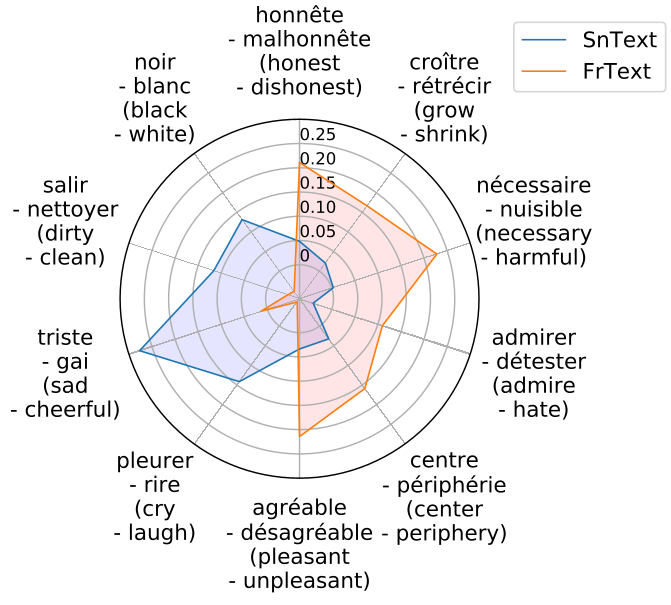 Figure 2: The projection of 'tradition' onto various sentiment scales in SnText.
2. Prioritizing Social Issues
Policy makers often struggle to know which issues the public cares about most. By measuring various problems on the <difficile-facile> scale, the researchers found that sanitation (sanitaire) and water (eau) were perceived as significantly more "difficult" than even "crime" or "corruption." This highlights the critical impact of climate change and crumbling urban infrastructure in Dakar.
3. Quantifying Optimism
Despite the historical baggage, the data reveals a "Future-Oriented" mindset. In the Senegalese corpus, the <past-present> and <past-future> scales are highly aligned with the <hatred-love> and <amateur-professional> scales. Essentially, the "Future" is mathematically synonymous with "Improvement" and "Professionalism," reflecting Senegal’s stable political transitions and rapid GDP growth (6%+ annually).
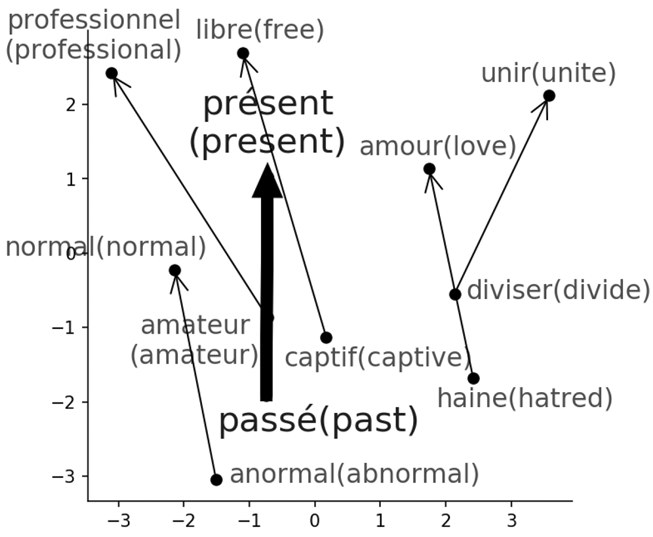 Figure 3: Geometric alignment showing the positive orientation toward the future in Senegalese text.
Critical Analysis & Conclusion
While the study is a breakthrough in "Happiness Economics," it has limitations. Using Wikipedia as a reference point for newspapers creates a stylistic mismatch (encyclopedic vs. journalistic). Furthermore, since the analysis was done in French, it might miss nuances present in Wolof, the widely spoken indigenous language.
Takeaway: This research demonstrates that AI doesn't just "see" patterns; it can "read" the soul of a nation. For global development, word embeddings offer a powerful, real-time tool to measure how societies feel about where they’ve been and where they are going.