
Elevating Legal eDiscovery: Dynamic Word Embeddings for Intelligent Document Review
Experimenting word embeddings in assisting legal review
This paper introduces a dynamic keyword expansion system for legal eDiscovery, leveraging Word2vec embeddings to assist in document review. By integrating a semantic model into a tangible user interface (TUI) called "Disco," the authors enable legal professionals to interactively discover related search terms, improving recall in responsive document identification.
Executive Summary
TL;DR: This paper tackles the "recall gap" in legal document review by replacing static keyword lists with an interactive, semantic search system. By utilizing Word2vec embeddings on a tangible touch interface, the authors allow lawyers to "attract" documents using dynamically suggested terms, significantly reducing the risk of missing critical evidence due to narrow vocabularies.
In the landscape of Technology Assisted Review (TAR), this work bridges the gap between traditional boolean searches and black-box machine learning, positioning itself as a human-centric exploratory tool.
The Problem: The High Stakes of "Missing the Point"
In legal litigation, missing a "responsive" (relevant) document isn't just a technical fail—it's a legal liability. Traditionally, attorneys rely on keyword lists negotiated between parties. However, this method is plagued by:
- Vocabulary Mismatch: The keywords attorneys use might not match the jargon, slang, or specific terminology used by the defendants (e.g., "Raptor" as a code name in Enron).
- The Bias Trap: If keywords select only a narrow subset of data to train an ML classifier, the resulting model will inherit that bias, systematically ignoring other relevant topics.
- OCR Noise: Legal archives are often scanned documents where "child" might be misread as "chiid" or "chilt," rendering search hits useless.
Methodology: Semantic Magnets and Word Vectors
The authors introduce "Disco," a smart review environment that treats words not as static strings, but as vectors in a high-dimensional space where "meaning" is defined by proximity.
1. The Embedding Engine
The system uses Word2vec (Skip-Gram) to map word relationships based on the Harris Distributional Hypothesis: words used in similar contexts share meanings. They tested three model levels:
- Generic: Trained on Wikipedia/News (Broad knowledge).
- Domain-Specific: Healthcare/Fintech specific terminology.
- Case-Specific: Trained directly on the litigation's unlabeled corpus to capture case-specific "code talk."
2. The Tangible Interface (TUI)
Instead of typing queries, users interact with "Virtual Magnets".
- Function: A magnet is "charged" with a keyword.
- Expansion: The system suggests the top 5 semantically related terms (e.g., charging a magnet with "Fastow" might suggest "LJM" or "CFO").
- Interaction: Users swipe away irrelevant suggestions or pivot to a new term, creating a fluid, exploratory search loop.
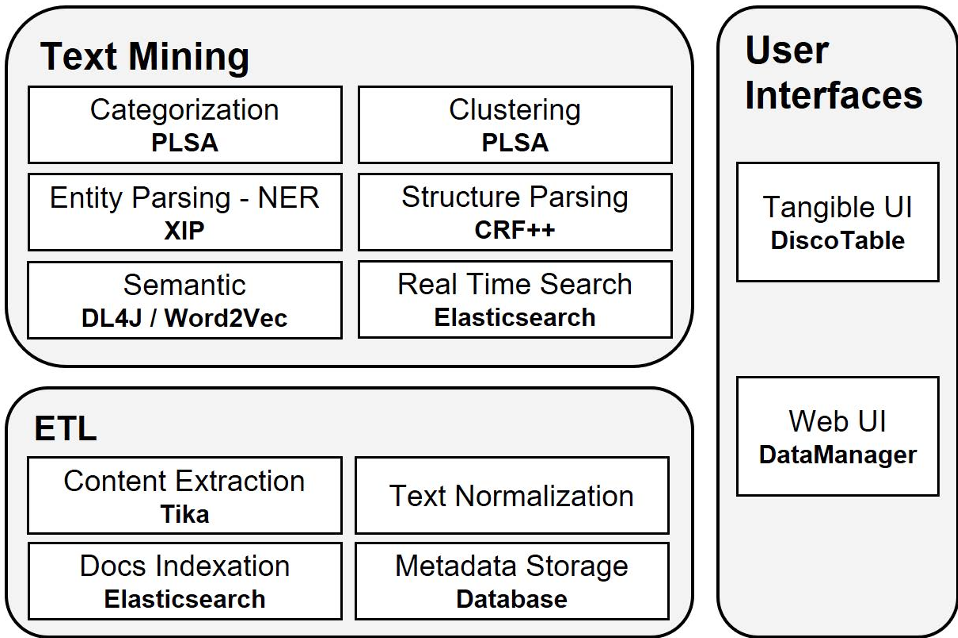 Figure 1: The Disco system architecture showing the interplay between the Tangible UI and the NLP/Semantic components.
Experimental Insights: Searching the Enron and Tobacco Archives
The authors validated their approach using two iconic legal datasets:
The Enron Case
By charging magnets with names like "Dynegy" or "Raptor", the model successfully unearthed related entities (e.g., "Osprey Trust", "ChevronTexaco") that were not in the original query but were highly relevant to the investigation.
- Observation: Stemming variations (e.g., "trade" vs. "trading") provided different recall results, highlighting why semantic models outperform simple keyword matching.
The Tobacco Litigation (TREC)
On a 7-million document corpus, the semantic model proved its worth in handling OCR noise.
- Finding: The model clustered malformed words like "chiid" and "chlld" around the root word "child."
- Result: While simple query expansion doesn't always improve precision (it can add false positives), it fundamentally aids the Early Case Assessment (ECA) phase where discovering any lead is more important than filtering noise.
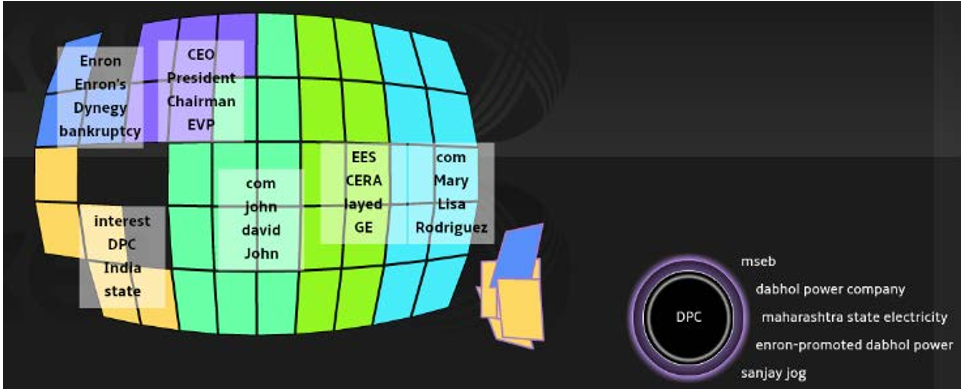 Figure 2: The "Virtual Magnet" attracting documents related to its semantic charge.
Deep Insight & Conclusion
The most counter-intuitive takeaway from this research is the value of preserving noise. In traditional NLP, we often clean and normalize text. However, in legal review, the "shrapnel" of OCR errors and inconsistent capitalization is part of the data's identity. Training embeddings on this "dirty" data allowed the system to bridge the gap between perfect queries and imperfect documents.
Takeaways for the Future:
- Human-in-the-Loop is Mandatory: Pure automation ignores the "theory of the case" that only a lawyer can build.
- Sequential Exploration: The ability to pivot from one discovered term to another is more natural for legal discovery than complex boolean logic.
- Beyond Keywords: Future iterations should move toward Sentence Embeddings to capture themes rather than just related words.
Conclusion: This work demonstrates that while ML can't replace the attorney's intuition, it can significantly sharpen their "magnifying glass" by uncovering the hidden connections buried within millions of pages of legal discovery.