
The WFH Paradox: Why We Are Working More but Achieving Less
The Impact of Work from Home (WFH) on Workload and Productivity in Terms of Different Tasks and Occupations
This study investigates the quantitative impact of Work from Home (WFH) on employee workload and productivity across various occupations during the COVID-19 pandemic. Using a nationwide survey in the U.S., the researchers found that WFH increased the average weekly workload by 3 hours while causing a productivity loss for 38% of participants, primarily due to technical inefficiencies.
TL;DR
A nationwide study from Purdue University reveals that the shift to Working from Home (WFH) has increased the average employee's workload by 3 hours per week, yet 38% of workers report a significant drop in productivity. The culprit? A "technical friction" where digital tools fail to replace the high-efficiency bandwidth of in-person collaboration.
Background: Beyond the Home Office Hype
While early WFH narratives focused on improved work-life balance and saved commute times, the reality for many was a blurred line between personal and professional space. This research moves past anecdotes to provide a quantitative analysis of how specific tasks (like coding versus site inspections) and different occupations (professors versus on-site managers) reacted to the remote shift.
The Core Conflict: Digitization vs. Physicality
The authors identify a fundamental shift in the nature of work tasks. As we moved home, tasks involving physical artifacts (printed documents, face-to-face brainstorming) were forcibly migrated to electronic platforms.
- The Workload Spike: Seven out of twelve primary work tasks saw a time increase. Electronic document review and online meetings became the new "time sinks."
- Physical Displacement: On-site occupations and researchers actually experienced a decrease in workload, not due to lack of effort, but because their primary value—lab experiments and site safety—cannot yet be replicated over Wi-Fi.
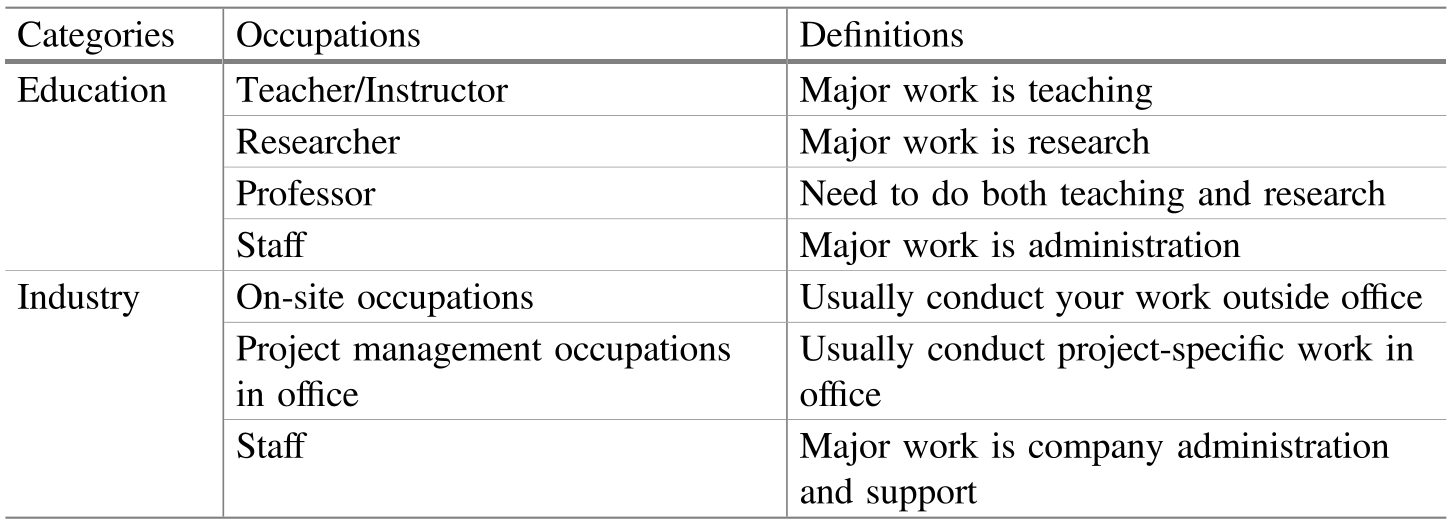 Occupational categories ranging from education (professors, staff) to industry (on-site, project management).
Methodology: Mapping the Task Landscape
The researchers categorized 774 responses across 12 tasks divided into two main categories: Listening & Speaking and Reading & Writing. This allowed them to pinpoint exactly where the productivity "leak" was happening.
Key Findings: The Efficiency Gap
The data suggests that while we are "getting better" at online meetings (productivity improved by 0.53 points), they are still fundamentally less efficient than the in-person meetings they replaced.
- Productivity Loss: 38% of participants reported lower productivity.
- The Technical Tax: Respondents cited "slower technology at home," "WIFI issues," and "lack of access to office resources" as major roadblocks.
- Distraction Factors: For many, the "home" in WFH brought childcare and household responsibilities that acted as a constant interrupt to the "flow state" required for complex tasks.
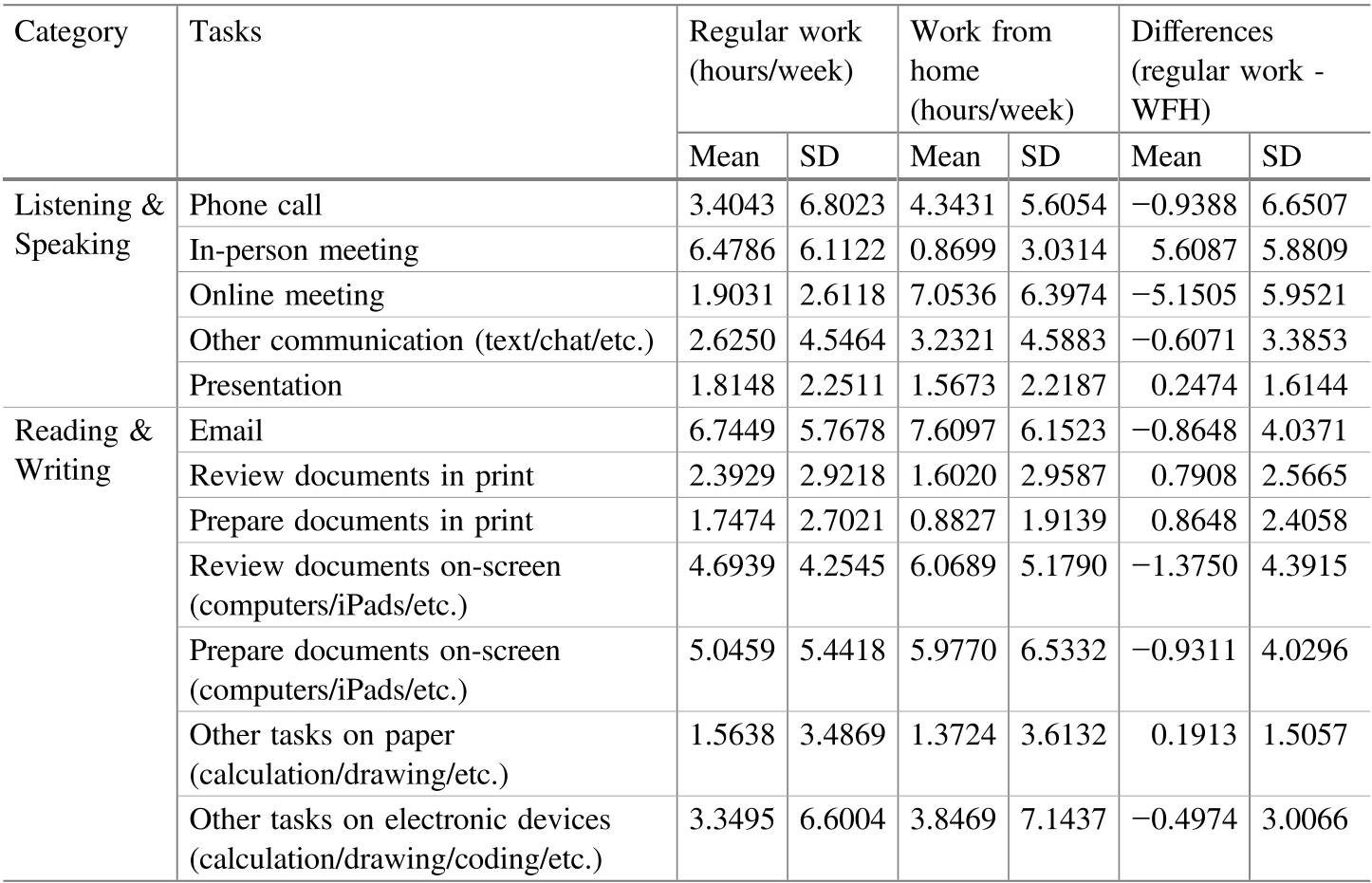 Critical data showing the migration of hours from in-person meetings to online meetings and electronic documentation.
Deep Insight: Occupational Sensitivity
The impact of WFH is not democratic; it depends heavily on your job's "Inductive Bias" toward physical versus digital space.
- Teachers/Instructors adapted best, showing a slight productivity increase (+0.26) by focusing purely on digital delivery.
- Staff and Researchers suffered most, with staff facing a 0.5 productivity drop due to the increased complexity of virtualizing administrative pipelines.
Summary & Future Outlook
The paper concludes that for WFH to be a sustainable long-term economic model, we must solve two critical "Human-Computer Interaction" (HCI) gaps:
- Communication Bandwidth: Remote tools must narrow the efficiency gap between Zoom and a physical whiteboard.
- Physical Virtualization: We need a "Remote Reality" for on-site workers—using drones, cameras, and IoT to allow safety managers and scientists to perform "hands-on" work from their living rooms.
Takeaway for Organizations: Don't mistake "more hours logged" for "more work done." The 3-hour workload increase is a symptom of technical friction, not necessarily increased output.