
Moodle meets Facebook: Bridging the Social Gap in Distance Learning
Work in progress: Extending a LMS with social capabilities: Integrating Moodle into Facebook
This paper presents a framework for integrating the Moodle Learning Management System (LMS) into Facebook to enhance social learning interactions. By leveraging Facebook's API and Moodle's REST web services, the authors create a unified "PFC UNED Mdl-Fbk" application designed to bridge formal e-learning with informal social networking.
TL;DR
Distance learning often feels like a lonely endeavor. This research paper explores a technical integration between Moodle, the global leader in open-source LMS, and Facebook, the world’s most pervasive social network. By embedding course management into a social space, the authors aim to boost student self-esteem and social leadership through "achievement visibility" and real-time social updates.
Background: The Isolation of the Distance Learner
At the National University for Distance Education (UNED) in Spain, students often live in different countries, never meeting their peers in person. Traditional LMS platforms are "destination" websites—you only go there when you have to work. In contrast, users check social networks like Facebook multiple times a day (over 80% of young Spaniards connect daily). The researchers identified a massive opportunity: What if learning updates found the student, instead of the student hunting for updates?
The Problem: The "Wall" between Life and Study
The core pain point identified is the fragmentation of digital identity. Students have a "fun/social" identity on Facebook and a "serious/student" identity on Moodle. When these two lives are isolated:
- Students lack social motivation and peer-to-peer recognition.
- Important deadlines are missed because they are buried inside a closed LMS.
- The "social leadership" aspect of learning—sharing accomplishments with acquaintances—is completely lost.
Methodology: Engineering the Social Classroom
The authors followed a structured technical pipeline to marry these two giant architectures:
- Identity Federation: Using the Facebook API to allow "Login with Facebook" within the Moodle environment, reducing the cognitive load of managing multiple credentials.
- Moodle REST Services: They built a bridge using RESTful Web Services. This allows Facebook to query Moodle for specific data (like "What courses is this user enrolled in?") without compromising the entire database.
- The Interface (PFC UNED Mdl-Fbk): A dedicated Facebook application serves as the UI. It acts as a portal where course info is displayed alongside social notifications.
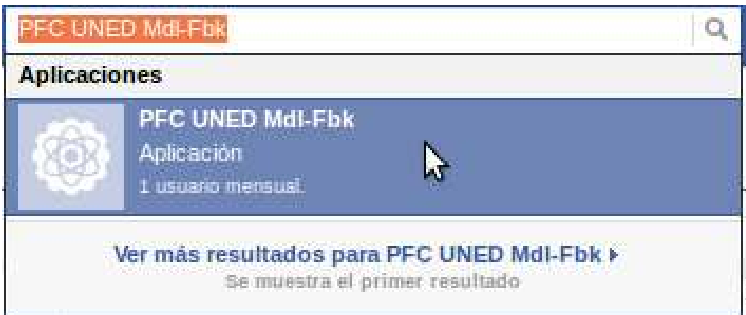 Fig 1: The application as discovered via Facebook's native search engine.
Why This Matters (The "Aha!" Moment)
The brilliance of this work isn't just in the code; it’s in the psychology. By integrating these platforms, a student who completes a difficult practical exercise can (ideally, per the authors' future plans) have that achievement shared or "liked." This creates a positive feedback loop.
From a technical perspective, using REST services ensures the integration is lightweight and scalable. Instead of a monolithic synchronization, the Facebook app fetches only what it needs, keeping the LMS backend performant.
Critical Analysis & Future Outlook
While the current prototype focuses on viewing course info and SSO, the "Future Work" section identifies a critical challenge: Data Privacy. Integrating educational data with a public social network requires strict adherence to laws like the Spanish LOPD (and now GDPR).
Limitations:
- Privacy Concerns: Many students may prefer to keep their "partying" life separate from their "learning" life.
- Platform Dependency: Relying on Facebook's API makes the system vulnerable to changes in Facebook's developer policies.
Takeaway
This paper serves as a precursor to the modern "Social Learning" movement. It reminds us that the best learning management system isn't just the one with the most features—it's the one that integrates seamlessly into the student's existing digital lifestyle.
Note: As this is a Work in Progress, the next phase will likely focus on automated wall-posts for grades and forum discussions, turning a passive LMS into an active social participant.