
Seeing the Mind: How Everyday Objects Mirror Our Emotional States
* Work performed while the author was at University College London
This paper introduces "MyMood," a mobile sensing system that utilizes Faster R-CNN and Inception ResNet V2 to quantify associations between everyday objects and emotional states (valence, tense/energetic arousal). By analyzing 3,305 in-the-wild photo-mood reports, the study establishes significant correlations between specific visual contexts and psychological intensities.
TL;DR
Researchers from UCL and Samsung AI have developed MyMood, a smartphone-based system that uses Deep Learning to prove that the objects in your immediate environment—from your laptop to your bed—are statistically linked to your happiness, stress, and energy levels. By moving beyond traditional sensors like GPS, this study turns your phone's camera into a window for computational psychology.
The Background: What’s Missing in the "Quantified Self"?
The "Quantified Self" movement has mastered tracking what we do (steps, sleep) and where we go (GPS). However, the visual context—the actual objects we interact with—has remained a "black box." Previous attempts to link vision to mood relied on Instagram photos, which are often "staged" and don't reflect daily reality. The authors of this paper argue that to truly understand mental health, we must look at the "in-the-wild" clutter of our actual lives.
Methodology: Tapping into Deep Learning
The MyMood app uses a sophisticated pipeline to bridge the gap between pixels and psychology:
- Experience Sampling (ESM): Users are prompted to log their mood (Stress, Activeness, Happiness) on a 7-point Likert scale.
- Object Detection: The app captures a photo of the surroundings. Using Faster R-CNN with an Inception ResNet V2 backbone (achieving ~80% accuracy), it identifies semantic labels (e.g., "Keyboard," "Tree," "Face").
- The "Human-in-the-loop" Twist: To filter out irrelevant background noise, users "tap" objects in the photo that they feel are relevant to their current state.
 Fig 1. From raw photo (left) to user taps (center) and final Deep Learning object detection (right).
Key Findings: Objects as Emotional Triggers
The study, involving 22 participants over 3,305 reports, revealed that our environment isn't just a backdrop; it's a mirror.
1. The Stress of Work vs. Home
The data showed a clear divide. Objects like "Computer keyboard" and "Office" were associated with a significant increase in stress (+0.66). Conversely, domestic objects like "Television" or "Furniture" signaled relaxation.
2. Context is King
One of the most profound insights was that the same object can mean different things in different places. As shown in the comparison between "Home" and "Work" contexts:
- A "Computer Monitor" at home correlates with a -1.15 decrease in stress (likely leisure/gaming).
- The same monitor at work correlates with a +0.34 increase in stress.
 Table 1. Mean emotional intensity differences associated with various object classes.
3. Arousal and Activeness
The object "Bed" was the strongest predictor of low energetic arousal (-1.23), while outdoor objects like "Building" or "Land Vehicle" were associated with being much more active and alert.
Statistical Rigor: Moving Beyond Simple Averages
The authors didn't just look at means; they employed Kernel Density Estimation (KDE) to ensure the distributions were meaningful and used the Wilcoxon signed-rank test to prove these weren't just random clusters. This academic rigor distinguishes the work from simple "app-based data mining."
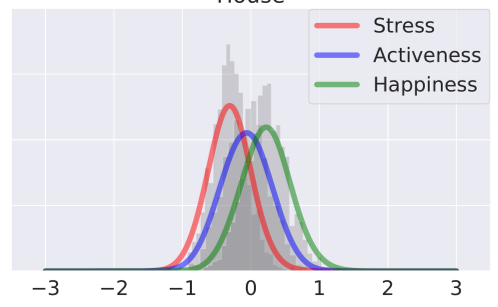 Fig 2. Estimated density functions showing how specific objects shift the "normal" mood distribution.
Critical Insight & Future Outlook
While the study is revolutionary, it faces a privacy-accuracy trade-off. Capturing photos of daily life is intrusive. However, the authors suggest that future hardware—like smart glasses moving AI processing to the "edge" (on-device)—could detect these triggers without ever sending a single image to the cloud.
Takeaway: This work paves the way for "Visual Digital Phenotyping." Imagine an AI assistant that notices your desk is cluttered with "stress-inducing" objects and suggests a walk when it detects "trees" and "sky," helping you regulate your mental health through the simple act of looking around.
Conclusion
By quantifying the relationship between our physical world and our internal states, this study highlights that our environment is a powerful determinant of well-being. Whether you are an architect designing workspaces or a developer building the next mental health app, the message is clear: the objects we surround ourselves with matter.