
SWF-TD: Maximizing Crowdsourcing Quality with Sparse Supervision
Worker Filtering with Limited Supervision in Crowdsourcing Systems
The paper introduces Semi-supervised Worker Filtering (SWF), a novel quality control mechanism for crowdsourcing that identifies and eliminates "spam" workers using a limited set of gold truths. By integrating SWF with an optimization-based Truth Discovery (TD) framework, the system provides high-precision consensus labels for ordinal tasks.
TL;DR
Crowdsourcing is a double-edged sword: it offers massive scalability but suffers from high "noise" caused by spam workers. Researchers from the University of Louisville have proposed SWF-TD (Semi-supervised Worker Filtering - Truth Discovery), a framework that leverages a small fraction of "gold truth" labels (expert-verified) to surgically remove spammers. The result? Achieving near-perfect supervision accuracy with only 40% of the expert data effort.
The "Spammer" Problem in the Wild
The central challenge in crowdsourcing isn't just "mistakes"—it's randomness. Spammers are workers who assign labels arbitrarily to collect rewards quickly. Traditional methods like Majority Voting fail miserably when spammers outnumber reliable workers. While some modern algorithms use Expectation-Maximization (EM) to estimate worker reliability, they often struggle when they don't have a "ground truth" anchor to calibrate against.
The authors argue that we don't need all the answers to find the bad actors. Like finding a needle in a haystack, you just need a few magnets (gold truths) to clear out the metallic junk.
Methodology: The Math of Randomness
The core of the SWF model is the Spammer Score.
1. Identifying the Rank-One Signature
A spammer's confusion matrix (the probability of them giving label k given true label c) looks like a "rank-one" matrix. Essentially, their output is independent of the input. The SWF model calculates the Frobenius norm distance between a worker's behavior and this random "rank-one" state.
2. The Diagonal Attribute
The authors incorporate a clever heuristic: The Diagonal Attribute. Even if a worker has a low spammer score, if their errors mostly cluster on the diagonal of the confusion matrix (meaning they are consistent but perhaps slightly biased), they are kept. This prevents the system from accidentally firing experts who are merely specialized or follow a consistent logic.
3. Integrated Framework
The process follows a tight loop:
- Initialize truths using simple majority voting.
- Estimate confusion matrices using EM, anchored by the limited Gold Truths.
- Filter workers who fall below a spammer score threshold .
- Re-calculate the final truths using an optimization-based weighted voting scheme.
 The optimization objective aims to minimize the weighted deviation between observed labels and hidden truths.
Experimental Breakthroughs
The team tested SWF-TD on synthetic data and two real-world sets: AdultContent2 (AC2) and an Image Labeling set.
- The Power of Filtering: In the Image Labeling dataset (which was heavily polluted), worker filtering alone improved accuracy by 33.6% compared to the best unsupervised baseline.
- The 40% Threshold: The most striking finding is visible in the performance curves. The authors demonstrated that the performance of the model saturates early. By the time you provide 40% of the gold truths, the accuracy is virtually indistinguishable from a model that has 100% of the gold truths.
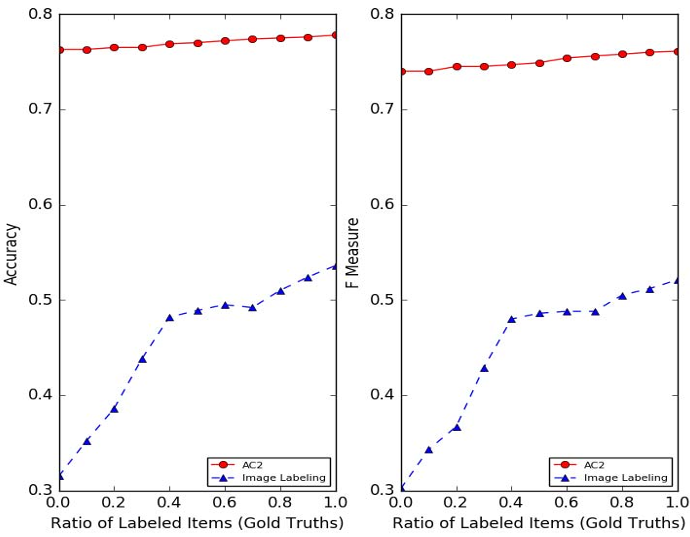 Figure 2: Accuracy vs. Gold Truth Ratio. Note the plateau after 0.4, proving the efficiency of limited supervision.
Critical Analysis & Future Outlook
The SWF-TD framework proves that quality control is more efficient than aggregation. Instead of trying to "math away" the noise of 100 workers, it is better to identify the 20 reliable ones and ignore the rest.
Limitations:
- Threshold Selection: Choosing the threshold still requires some manual trial (binary search).
- Task Type: Currently optimized for ordinal/categorical labels.
Future Work: The authors suggest moving into Numerical Labeling Tasks (e.g., estimating prices or temperatures) where the "spammer" behavior might look different. Additionally, separating "spammers" (random) from "biased" (predictably wrong) workers remains a frontier for even cleaner consensus data.
Conclusion
For industry practitioners using MTurk or CrowdFlower, the takeaway is clear: Invest in a 40% gold truth set. It provides the maximum ROI for worker filtering and ensures that your final ground truth isn't poisoned by the noise of the crowd.