
Secure Spatial Crowdsourcing: Protecting Worker Privacy via Yao’s Garbled Circuits
Towards Preserving Worker Location Privacy in Spatial Crowdsourcing
This paper presents a privacy-preserving task assignment protocol for Spatial Crowdsourcing (SC) that protects worker locations using a combination of Additive Homomorphic Encryption (Paillier) and Yao’s Garbled Circuits. The core contribution is a secure framework that computes travel costs and selects the optimal worker in the encrypted domain within a semi-honest adversary model.
TL;DR
Spatial Crowdsourcing (SC) platforms—where tasks like environmental sensing or delivery are assigned to specific locations—face a fundamental paradox: the server needs worker locations to optimize efficiency, but workers risk privacy leaks by sharing them. This paper proposes a breakthrough protocol using Additive Homomorphic Encryption and Yao's Garbled Circuits to enable "blind" task assignment, ensuring neither the server nor the service provider learns where the workers are located.
Background: The Trust Gap in Crowdsourcing
In the Server Assigned Tasks (SAT) mode of spatial crowdsourcing, a central server acts as a coordinator. Historically, the research community has focused on maximizing the Task Assignment Rate (TAR) while ignoring the fact that the SC-server might be "curious" or vulnerable to data breaches. Previous attempts at privacy—like Differential Privacy—often blurred locations so much that the server couldn't find the best worker, leading to wasted resources.
Challenges & Insights
The authors identify a critical flaw in prior work: most models assume a Trusted Third Party (TTP). In the real world, "trusted" entities are often still profit-driven or academic institutions subject to their own vulnerabilities.
The Research Insight: We don't need to trust anyone if we can mathematically hide the data. By splitting the computation between an SC-server and a semi-honest Privacy Service Provider (PSP), the system can perform complex comparisons on encrypted data.
Methodology: The "Blind" Matchmaker
The protocol operates in two primary phases:
1. Encrypted Database Construction
Each worker's device calculates its own Worker Travel Cost (WTC)—a function of distance and "Degree of Interest" (DOI). This value is encrypted using the SC-server's public key (Paillier) before being sent to the PSP.
- The Math Bit: Because Paillier is additively homomorphic, the PSP can perform certain operations on the ciphertexts, but since it doesn't have the private key, it sees only noise.
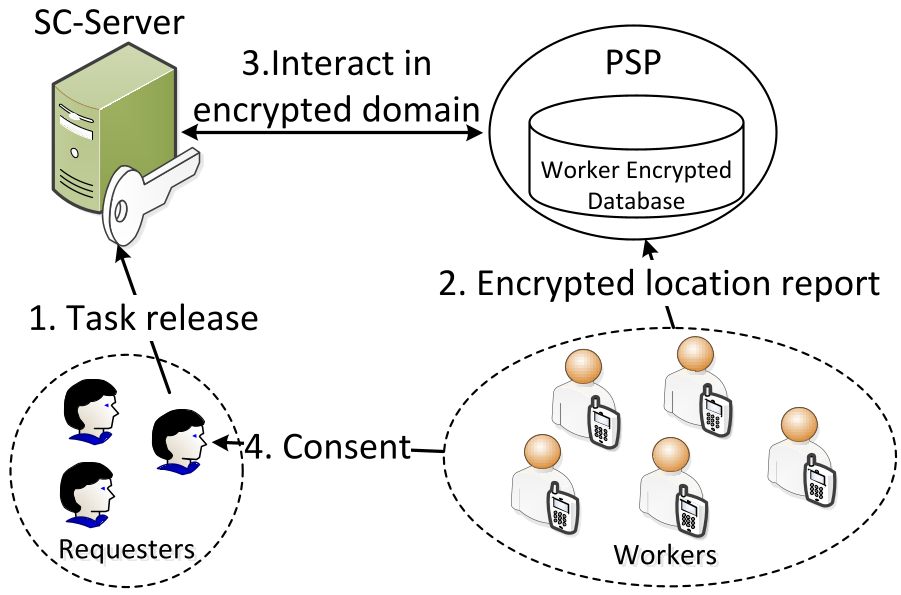 Figure 1: The proposed privacy framework involveing Requesters, Workers, the SC-Server, and the PSP.
2. Secure Minimum Selection
How do you find the smallest number in a list if you can't see the numbers?
- Masking: The PSP adds a random "blinding" factor to each encrypted cost and shuffles the list (permutation).
- Circuit Execution: The SC-server decrypts these masked values. They then both run a Yao’s Garbled Circuit (MIN-GC).
- Result: The circuit compares the values and only outputs the index of the minimum. Because of the previous shuffle and the properties of GC, the server learns which index won, but not the real cost or the identity of the others.
Experimental Validation
Using the Gowalla dataset and synthetic data (up to 10,000 workers), the authors tested the overhead of these cryptographic operations.
- Efficiency: While traditional non-private algorithms are near-instant, this secure protocol takes about 17 minutes for a massive 10,000-worker pool. For small-to-medium deployments (100 workers), it takes only 30 seconds—perfectly viable for non-real-time tasks.
- Effectiveness: Unlike Differential Privacy methods (like "Hien" in the chart below), this protocol maintains a higher Task Assignment Rate because it uses exact (though encrypted) values for its decisions.
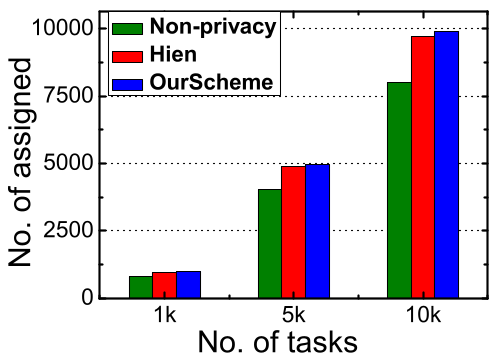 Figure 2: Runtime comparison showing the linear scale of the protocol vs. previous methods.
Critical Insight & Future Outlook
The beauty of this approach is its cryptographic rigor. By ensuring all intermediate information is "computationally indistinguishable" from random noise, the authors provide a hard mathematical guarantee of privacy that "k-anonymity" or "blurring" cannot match.
Limitations: The current protocol is tailored for single-task assignments. In a high-velocity environment like Uber or Meituan, the 17-minute latency for large pools would be a bottleneck. Future research should look into Parallel Garbled Circuits or Hardware acceleration to bring secure computation into the realm of real-time millisecond response.
Takeaway: This paper is a foundational step in making Spatial Crowdsourcing "Privacy-by-Design." It proves that we can have our cake (efficient matching) and eat it too (complete location privacy).