
Just the Right Mood: The Secret Sauce for Conversational Crowdsourcing
Just the Right Mood for HIT! - Analyzing the Role of Worker Moods in Conversational Microtask Crowdsourcing
This paper investigates the impact of worker moods on performance, engagement, and cognitive load within conversational microtask crowdsourcing. Through a study of 600 workers, the authors evaluate how two distinct conversational styles—High Involvement and High Considerateness—interact with pleasant or unpleasant worker moods to optimize HIT (Human Intelligence Task) outcomes.
TL;DR
Integrating conversational agents into microtask crowdsourcing (HITs) can significantly boost worker retention. However, a worker's mood is a critical moderator: workers in a "pleasant" mood produce 20% better quality work. By tailoring the Conversational Style (Involvement vs. Considerateness) to the worker's mood, platforms can lower cognitive load and prevent the quality drop-off typically seen in frustrated or bored contributors.
Background: Beyond the Static Web Form
Microtask crowdsourcing is the backbone of modern AI, providing the labeled data that fuels LLMs and Computer Vision models. Yet, the traditional web interface is often sterile, leading to "task abandonment" and "fatigue." This paper moves the needle by transforming the task into a dialogue. But it goes a step further: it asks if the way the bot speaks should change based on whether the human on the other side is having a good or bad day.
The Problem: The Mood-Interface Gap
Existing crowdsourcing platforms treat workers like black-box processors. Psychological research suggests that mood influences cognitive flexibility and persistence. Prior work showed that happy workers perform better on traditional web forms, but we didn't know:
- Does a "chatty" bot annoy an unhappy worker?
- Can a specific conversational style "save" the performance of a worker in an unpleasant mood?
Methodology: Designing the "Perfect" Agent
The researchers tested 600 workers across four task types (Information Finding, Sentiment Analysis, CAPTCHA, and Image Classification). They implemented two distinct agent personas:
- High Involvement: Fast-paced, enthusiastic, direct, and uses frequent questions.
- High Considerateness: Slower, uses complex syntax (more polite/indirect), and calm.
 The workflow: Mood assessment followed by demographic surveys, the conversational HIT, and a post-task cognitive load evaluation.
Key Insights: Why Mood Matters
The results confirm that mood is not just a "bonus" but a fundamental performance metric.
1. The Quality Gap
Workers in pleasant moods weren't just happier; they were significantly more accurate. In text-heavy "Information Finding" tasks, pleasant-mood workers outperformed unpleasant-mood workers by a wide margin. Interestingly, for simple image tasks, mood had less impact, suggesting that mood affects high-order cognitive processing more than simple pattern recognition.
2. Conversational Style as a Buffer
This is the paper's most sophisticated find:
- Unpleasant Mood? Use High-Considerateness. Workers in bad moods reported higher engagement and lower frustration when the bot was polite and indirect.
- Pleasant Mood? Use High-Involvement. Happy workers responded best to the "high energy" bot, leading to higher User Engagement Scale (UES) scores.
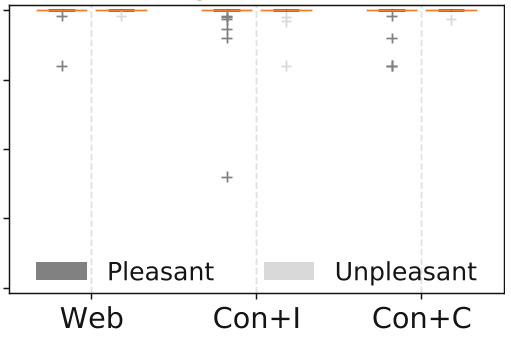 Accuracy data across conditions shows that while pleasant workers (left side of each pair) generally excel, the interface style can shift the needle for those in unpleasant moods.
3. Retention: The "Chatbot Effect"
Regardless of mood, the conversational interface outperformed the traditional web interface in terms of retention. Workers were far more likely to click "I want to do more questions" when interacting with an agent than when staring at a static HTML form.
Critical Analysis & Future Outlook
Contribution: The paper successfully bridges sociolinguistics (Tannen’s styles) with HCI and Crowdsourcing. It proves that "Conversational UX" isn't just about the interface—it's about the persona.
Limitations: The study relies on self-reported moods (Pick-A-Mood), which can be subject to social desirability bias. Furthermore, the worker pool was naturally skewed toward pleasant moods (74%), leaving a smaller sample size for the "unpleasant" category.
Future Impact: Imagine a future where Mechanical Turk or Prolific detects a worker's mood via their typing speed or initial greeting and dynamically switches the UI. If a worker seems "Tense" or "Bored," the system could pivot to a "High-Considerateness" style to reduce their cognitive load (NASA-TLX) and keep data quality high.
Conclusion
The study teaches us that in the world of human-in-the-loop AI, the "human" part is deeply emotional. By respecting the "Right Mood for HIT," we don't just get better data—we build more humane work environments for the global crowd workforce.