
Quantifying Work-Intimacy: A Formal Discovery Framework for Workflow-Based Social Networks
A Framework: Workflow-Based Social Network Discovery and Analysis
This paper introduces a formal framework for discovering and analyzing workflow-based social networks derived from organizational business operations. It utilizes an Information Control Net (ICN) model to automatically extract social relationships and employs degree centrality algorithms to quantify work-intimacy and actor prominence.
TL;DR
This research shifts the focus of workflow management from "process-centric" to "people-centric." By introducing a formal framework to discover social networks directly from Information Control Net (ICN) models, the authors allow organizations to calculate "work-intimacy" and actor prominence using degree centrality before the workflow is even executed.
Background: The Shift to People-Oriented Workflows
For decades, workflow management systems (WFMS) were viewed through a purely behavioral or informational lens—focusing on what activity follows which. However, a workflow is ultimately a "people system." The performance of a business process is inextricably linked to the social relationships and collaborative patterns of its performers.
The authors distinguish between two crucial paradigms:
- Social Network Rediscovery: Mining networks from execution logs (post-facto).
- Social Network Discovery: Extracting the "defined" social structure embedded in the workflow model itself (a priori).
This paper focuses on the latter, aiming to answer a critical organizational question: Who are the most prominent actors in a specific workflow definition?
Methodology: From ICN to SocioMatrix
The framework operates in two distinct phases: Discovery and Analysis.
1. The Discovery Phase
The core innovation lies in the transformation of an ICN-based workflow model into a Workflow-based Social Network Model (). The discovery algorithm parses the activity-role mapping () and role-actor mapping () to establish directed ties between actors.
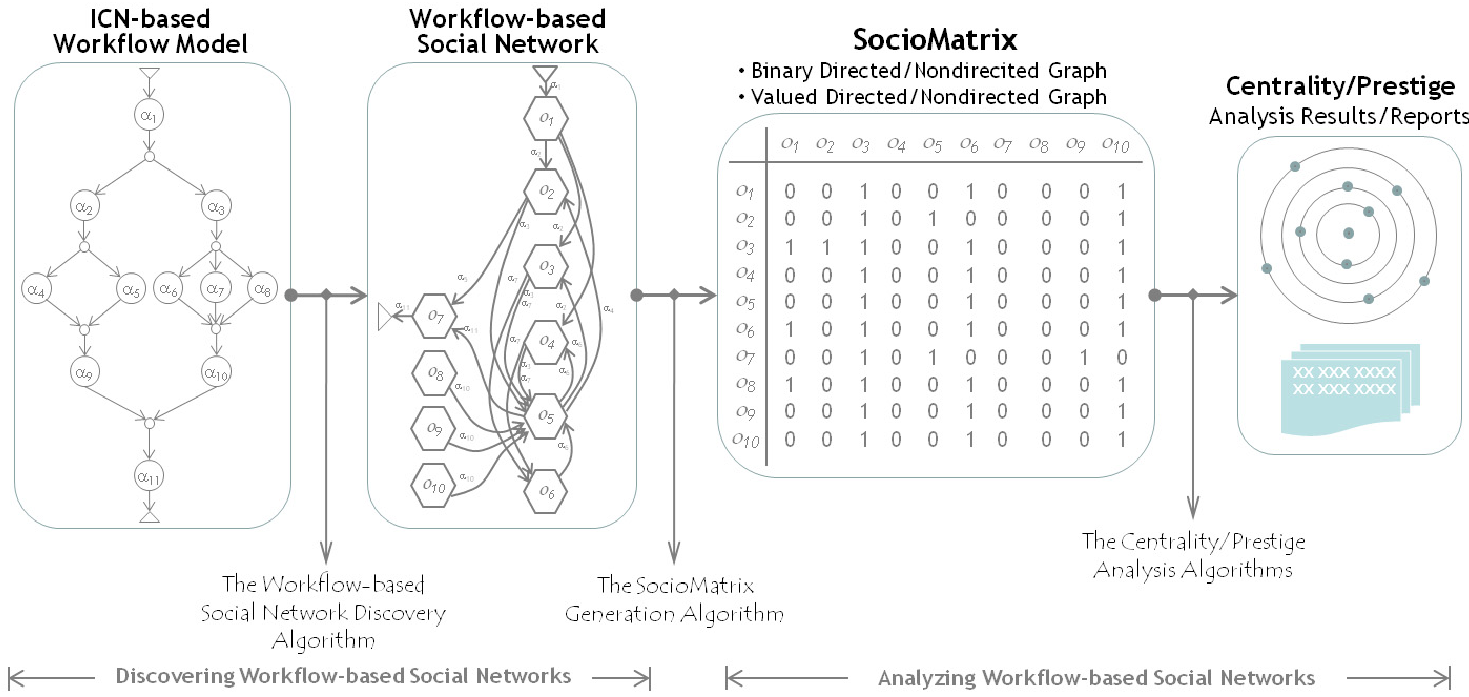
If Actor A performs an activity that is a predecessor to an activity performed by Actor B, a directed social arc is drawn. This represents "work-intimacy"—the potential for collaboration and information exchange.
2. The Analysis Phase: Degree Centrality
To turn these graphs into actionable insights, the framework converts them into SocioMatrices. These matrices serve as the mathematical foundation for calculating Degree Centrality.
The equations used are:
- Actor Degree Centrality (): The count of adjacent ties an actor has.
- Standardized Centrality (): Normalized by the number of actors to allow comparison across different workflow sizes.
- Group Degree Centrality (): An index (0.0 to 1.0) indicating how hierarchical or evenly dispersed the network is.
Experimental Validation: The Hiring Workflow
The authors applied their framework to a standardized "Hiring Workflow" consisting of 17 actors (o1 to o17).
| Measure | Metric Result |
|---|---|
| Most Prominent Actor | o5 (Centrality = 10) |
| Normalized Centrality (o5) | 0.63 |
| Group Centrality Index | 0.417 |

Interpretation: The Group Degree Centrality of 0.417 suggests the workflow is reasonably balanced but has a significant focal point. Actor o5 is clearly the "hub" of the hiring process. If o5 is overloaded or absent, the entire workflow faces a higher risk of stagnation compared to other actors. This provides a scientific basis for workload rebalancing.
Critical Insight & Future Outlook
This paper provides a rigorous mathematical bridge between Graph Theory and Organizational Management. The concept of Work-Intimacy is particularly powerful; it quantifies the "collaborative closeness" required by the design of a process.
Limitations & Future Work:
- Runtime Variance: The paper acknowledges that "defined" networks may differ from "enacted" ones due to dynamic actor selection (e.g., picking a specific person from a role group).
- Real-time Groupware: Current models struggle with "group-binding" activities where multiple people work on one task simultaneously.
- Cloud Application: The authors suggest this framework could be extended to analyze "closeness" between architectural components in collaborative cloud computing, potentially optimizing microservice latency based on "service-intimacy."
Conclusion
By formalizing the social properties of an Information Control Net, the authors have moved workflow analysis from qualitative guesswork to quantitative engineering. Organizations can now "debug" their social structures before they manifest as operational bottlenecks.