
From Reactive to Pro-active: Leveraging Machine Learning for Clinical Workload Estimation
An Empirical Analysis of Predictors for Workload Estimation in Healthcare
This paper presents a comprehensive empirical analysis of Machine Learning (ML) predictors for workload estimation in clinical departments, specifically focusing on a Thyroid study center. By evaluating six diverse algorithms against 20+ years of human expert judgment, the study establishes that ML models like Random Forest and SVM can achieve performance comparable to or exceeding experts in predicting future clinical events.
TL;DR
Resource allocation in healthcare is often a "reactive" game—managers respond to appointments as they appear. This paper explores a "pro-active" alternative: using Machine Learning to predict workload 18 months in advance. By testing six algorithms on real-world data from a Thyroid center, the researchers prove that AI can match the accuracy of a human expert with 20 years of experience, potentially saving hundreds of hours of administrative burden.
Background Positioning
In the landscape of Health Informatics, this work serves as an empirical validation study. It bridges the gap between theoretical ML capabilities and the practical, messy reality of Electronic Health Records (EHR). It shifts the focus from "how to schedule better" to the more foundational "how to predict what we are scheduling for."
The Problem: The Expert Bottleneck
Currently, clinical departments rely on the "intuition" of department heads to estimate future needs. This manual process suffers from three fatal flaws:
- Time-Intensive: Senior specialists—the most expensive and valuable resources—waste hours on spreadsheets.
- Inconsistency: Even the best expert has "off days," leading to unrepeatable results.
- Lack of Scalability: A human expert cannot generate "what-if" scenarios for ten different growth models in seconds.
The authors' insight is simple: Use common EHR data—rather than complex, niche biomarkers—to create a predictor that is highly reproducible across different hospital units.
Methodology: The Predictor Arsenal
The study extracted data from 5,941 patients (totaling 42,839 events) and categorized them into nine types, such as oncological exams, blood tests (fT3, fT4), and the resources-heavy Fine Needle Aspiration Cytology (FNAC).
Model Architecture and Strategy
The researchers treated each event type as a separate prediction task. They compared "Naive" baselines against "Advanced" ML models:
- TipOver: A simple persistence model (predicting the future will look exactly like the past).
- Mean: A density-based average.
- ML Models: k-Nearest Neighbors (kNN), Generalised Linear Models (GLM), Random Forest (RF) with 500 trees, and Support Vector Machines (SVM) with Gaussian kernels.
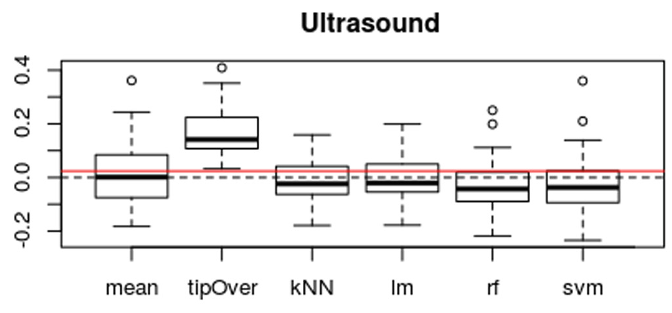 Note: Each boxplot represents the error distribution of an algorithm, while the red horizontal line represents the expert's performance.
Experiments & Results: AI vs. The Expert
The comparison revealed a fascinating nuance: Experience isn't always enough.
- The Baseline Surprise: In some "trivially easy" cases, even the simple "Mean" approach outperformed both the expert and complex ML models. This suggests that humans often overthink regular patterns that a simple average captures perfectly.
- ML Consistency: For more complex, non-linear tasks (like predicting the number of invasive FNAC procedures), Random Forest and SVM demonstrated tighter error distributions than humans.
- No Single Winner: The performance varied significantly across event types. This led the authors to propose that an Ensemble Approach (using different algorithms for different clinical categories) is likely the optimal path for a real-world deployment.
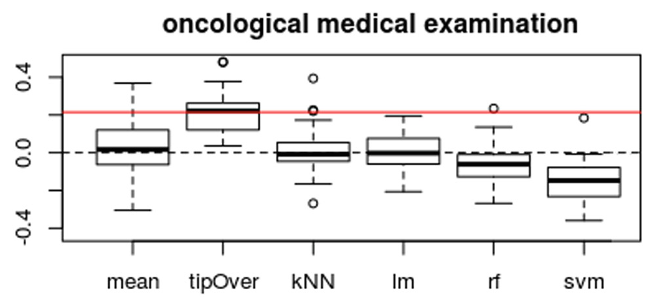 Typical performance for high-frequency events like lab exams, showing ML models achieving competitive error rates.
Critical Analysis & Conclusion
Takeaway
The paper successfully demonstrates that ML-based workload estimation is not just "as good" as human experts—it is potentially better because it is consistent, instantaneous, and scalable. By using only common EHR fields, the authors have created a "portable" method that any clinic can implement.
Limitations
- Data Silos: The study is limited to a single Thyroid center. While the variables are common, the patterns of thyroid patients might not generalize to Emergency Departments or Surgery Units.
- Interpretability: While RF and SVM are accurate, they are "Black Box" models. A department head might be hesitant to hire a new nurse based on a prediction they don't understand the logic behind.
Future Outlook
The next frontier is integrating these predictors into automated schedulers. Imagine a system that not only predicts a 20% spike in cancer screenings next quarter but also automatically adjusts the nursing shifts and lab hours to accommodate it before a single patient even calls for an appointment.