
SOFTec 2012: Reclaiming Human Connection in the Age of Perpetual Contact
Workshop on Computer Mediated Social Offline Interactions (SOFTec 2012)
This paper introduces the Workshop on Computer Mediated Social Offline Interactions (SOFTec 2012), a foundational effort to shift the Ubiquitous Computing (UbiComp) focus from remote connectivity to enhancing face-to-face social engagement. It formalizes the "SOFTec" concept, proposing a framework to leverage mobile devices, public displays, and sensor networks to catalyze physical-world interactions.
TL;DR
The SOFTec 2012 workshop (Computer Mediated Social Offline Interactions) addresses a paradoxical crisis in Ubiquitous Computing: the more we are connected digitally, the more we are isolated physically. The paper outlines a research framework for using tech—like public displays and mobile sensors—not as distractions, but as "social icebreakers" to foster real-world interactions among strangers and friends in shared physical environments.
Background: The Price of "Perpetual Contact"
In 2012, with 5.6 billion mobile device owners, the world entered a state of Perpetual Contact. However, researchers noted a disturbing trend—"Absent Presence." This refers to the phenomenon where people sharing a table or a public bench ignore those next to them to interact with far-away peers via their smartphones.
The authors argue that we must pivot. Instead of technology being a wedge driven between us, it should be the "fabric" that weaves social offline interactions back together.
Problem & Motivation: The Disconnection of Connection
Prior work in social networking (SNR) focused on the bridge between online and offline contacts but rarely addressed how to spark new or richer interactions in situ. The authors highlight two critical tensions:
- The Displacement Effect: Excessive online socializing can actually reduce the quality of offline life.
- The Interaction Gap: While we have the data to know who is near us, we lack the "social metaphors" and interfaces to turn that data into a conversation.
Methodology: The SOFTec Framework
The core contribution of this work is the categorization of the SOFTec design space. The authors suggest that creating technology for offline interaction requires a multi-layered approach:
1. The Technology Mesh
Instead of viewing mobile phones or public displays in isolation, SOFTec proposes a mesh architecture. Imagine a large public display sensing your mobile profile and displaying "common interests" to a stranger standing next to you, effectively lowering the barrier to entry for a conversation.
2. Contextual Awareness (Settings & Groups)
The intervention must change based on where it happens:
- Public Spaces: Focused on serendipity and stranger-to-stranger interaction.
- Work/Home: Focused on deepening existing bonds or facilitating serious collaborative engagement.
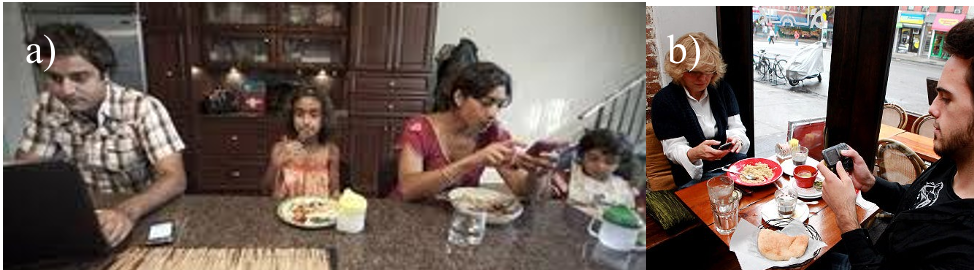 Figure 1: The "Absent Presence" in action—mobile devices creating digital walls in both home (a) and public (b) settings.
Insights from Related Work
The paper synthesizes several key precursors that serve as a foundation for SOFTec:
- Social Serendipity: Systems that display user profiles of nearby people to trigger peer-to-peer meetups.
- Autopoietic Content: Public displays (like FunSquare) that generate content based on the local environment to stimulate group discussion.
- The Sociability Paradox: Evidence shows that robust offline social lives actually reduce the pathological need for constant online scrolling, suggesting that SOFTec could be a "cure" for screen addiction.
Critical Analysis & Future Outlook
Takeaway
The real value of this workshop is the shift in perspective: Moving from User-System Interaction to User-User Interaction mediated by Systems. It treats technology not as the destination, but as the catalyst.
Limitations & Challenges
The authors acknowledge significant hurdles that remain unresolved:
- Privacy vs. Serendipity: How do we share enough social data to spark a conversation without compromising user privacy?
- Measurement: How do we quantify the "quality" of an offline interaction sparked by a computer? Is a 30-second chat between strangers a success?
Conclusion
SOFTec 2012 was a visionary call to action. As we move deeper into the era of AR headsets and AI-driven social agents, the principles laid out here—setting-specific design, social group sensing, and the tension between entertainment and serious engagement—remain more relevant than ever. The goal is simple yet profound: technology should help us look up at each other, not just down at our screens.