
The Future of Social Networking: Balancing Pervasive Connectivity with Privacy
Message from the workshop on the future of social networking
This report summarizes the "Future of Social Networking" workshop (2010), a pivotal gathering of industry leaders (Facebook, Microsoft, Yahoo!) and academic researchers. It examines the evolution of online social networks (OSNs) as catalysts for communication, recommendation systems, and socio-political mobilization, highlighting "Privacy" and "Recommendation" as the most critical research frontiers.
TL;DR
The "Future of Social Networking" workshop held in Cambridge served as a critical nexus for academia and industry to map the trajectory of social media. The event highlighted a shift where social networks are no longer just apps but foundational infrastructures that predict behavior through Homophily and raise existential questions regarding Privacy Leakage. The consensus: functionality is currently winning the trade-off against privacy, but the latter remains the biggest roadblock for sustainable growth.
Problem & Motivation: The Pervasive Adaptive Social Landscape
By 2010, social networks like Facebook and Twitter had moved beyond simple "status updates." They were proving instrumental in political movements (e.g., Tunisia and Egypt) and were becoming rich datasets for understanding human psychology.
However, a significant gap existed:
- Academic vs. Industry: Academia focused on the mathematical physics of network dynamics, while industry focused on commercial exploitation and user retention.
- Privacy Paradigm: The industry treated private data as a commodity, while users—and the security community—began to realize that their identities were being systematically leaked through social graphs.
The workshop’s motivation was to synchronize these perspectives, particularly under the SOCIALNETS project framework, which sought to use human social structures to design more agile wireless networks.
Methodology: From Homophily to Viral Rumors
The workshop featured a blend of high-level industry strategy and experimental sensing.
1. The Homophily Insight
Sharad Goel (Yahoo! Research) presented a core thesis: "Birds of a Feather Shop Together." The methodology focused on predicting user adoption by analyzing the attributes and actions of their contacts. The study suggested that if your friends interact with an ad, your likelihood of doing so increases by over 50%, validating the predictive power of the social graph over individual demographics.
2. Physical Sensing and Rumor Propagation
To bridge the gap between digital and physical, the organizers conducted a real-time experiment:
- Location Tracking: Used 20 Intel motes to detect Bluetooth-discoverable phones, mapping the physical proximity of the 100+ attendees.
- Rumor Experiment: A specific rumor ("Google is opening a new lab in Cambridge") was seeded to observe how information flows in a high-density professional social environment.
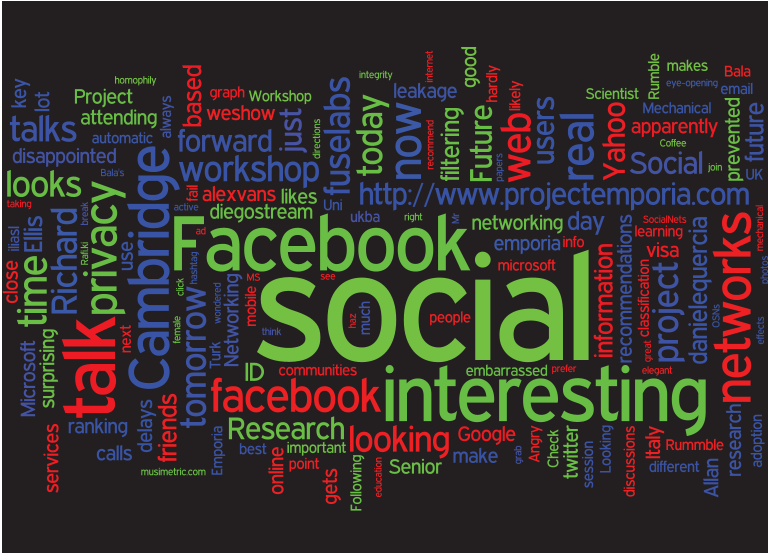 Above: A Wordle visualization of workshop tweets, highlighting "Privacy" and "Facebook" as the dominant nodes of discussion.
Key Insights from Featured Talks
The workshop hosted a diverse array of perspectives:
- Privacy Leakage: Balachander Krishnamurthy (AT&T Research) delivered a sobering talk on how PII (Personally Identifiable Information) is leaked through OSNs, emphasizing that users often unknowingly exchange their total identity for platform features.
- Real-Time Recommendations: Microsoft’s Jurgen Van Gael introduced Project Emporia, utilizing a combination of automated classifiers (Machine Learning) and human-in-the-loop validation (Amazon Mechanical Turk) to sift through the Twitter firehose for relevant news.
- System Optimization: Christos Gkantsidis showed how social graph data (email flows) could optimize physical system design, such as clustering users on geographically dislocated servers to reduce latency.
Results: The Pulse of the Community
A post-workshop survey of participants revealed a clear hierarchy of concerns. While "Recommendation" and "Community" were recognized as the primary value drivers, "Privacy" and "Security" were overwhelmingly cited as the most memorable and pressing keywords.
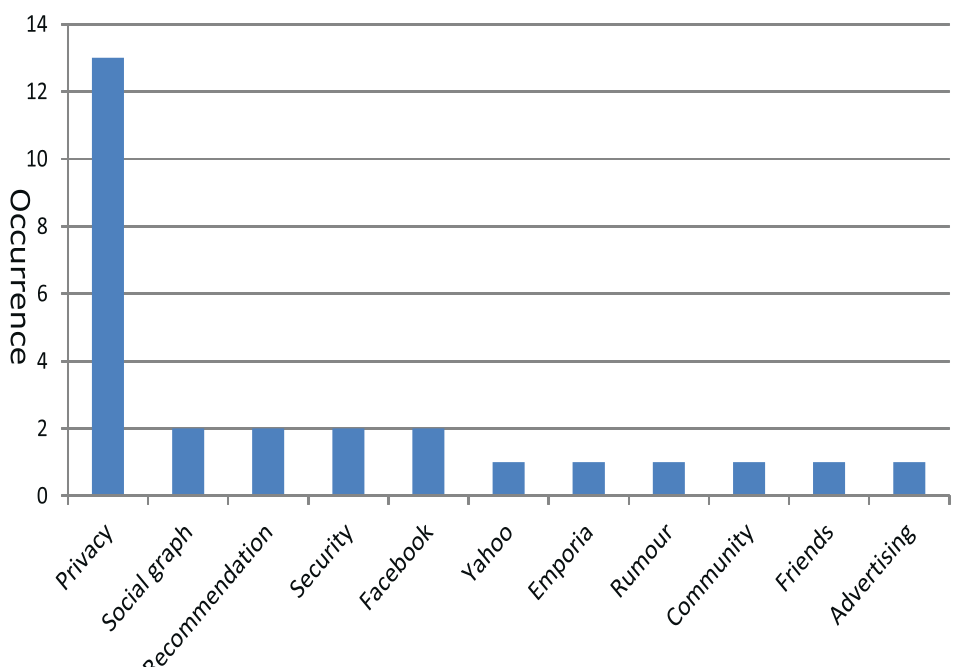 Analysis of the survey data confirmed that Privacy was not just a technical constraint, but a central theme that defined the workshop's intellectual output.
Critical Analysis & Conclusion
The Cambridge workshop was a bellwether for the decade of social computing that followed. It successfully identified that:
- Social is Spatial: The integration of geo-spatial components adds a new layer of behavioral insight and privacy risk.
- Interdisciplinary is Mandatory: Solving OSN challenges requires an intersection of Anthropology, Economics, and Computer Science.
Limitations: One notable takeaway was the failure of the workshop's own social infrastructure (Wiki/Blog) due to poor Internet connectivity—a reminder that even the most advanced social theories are tethered to the constraints of physical networking infrastructure.
Future Work: The event paved the way for a more formalized academic discipline around Social Computing, suggesting the need for a dedicated top-tier conference to handle the unique intersection of social science and system engineering.