
Inside the Child's Mind: Simulating Conceptual Change in Physics Learning
World model construction in children during physics learning
This paper introduces a computational framework using the Machine Learning system WHY to simulate conceptual changes in children (aged 12-13) learning elementary physics (heat and temperature). It successfully models the transition from "material causality" to advanced physical reasoning by differentiating between phenomenological theories and underlying causal models.
TL;DR
This seminal work explores how children build "World Models" while learning physics. Using the WHY machine learning system, researchers simulated a 12-year-old’s transition from intuitive, material-based reasoning to scientific understanding. They formalize learning not just as data acquisition, but as the deep restructuring of causal graphs.
The Problem: Beyond Simple Classification
Traditional Machine Learning (ML) models human learning as a classification task: given a stimulus, predict a label. However, cognitive scientists know that children don't just "classify"—they explain.
The "pain point" identified here is that existing AI-based student models lack a deep causal framework. When a child says "wool is warm," they aren't just applying a rule; they are operating within a personal ontology where objects possess intrinsic "hotness" or "coldness." Modern AI often ignores this "why" behind the "what."
Methodology: The Anatomy of the WHY System
The researchers chose the WHY system because it handles First-Order Logic (FOL) and distinguishes between different levels of knowledge.
1. The Three Layers of Knowledge
To bridge the gap between teaching and learning, the system represents knowledge via:
- Phenomenological Theory (P): The vocabulary and "surface" rules (e.g., "if it's a gas stove, there is a flame").
- Causal Model (C): A directed, labeled graph representing cause-effect relations.
- Heuristic Knowledge Base (KB): Mental "shortcuts" that allow for quick answers without traversing the entire causal graph.
2. Modeling "David" (The Learner)
The authors meticulously mapped 12-year-old David’s interview responses into FOL predicates. They found a striking difference between the Teacher's World Model (based on thermodynamics) and David's World Model (based on material causality).
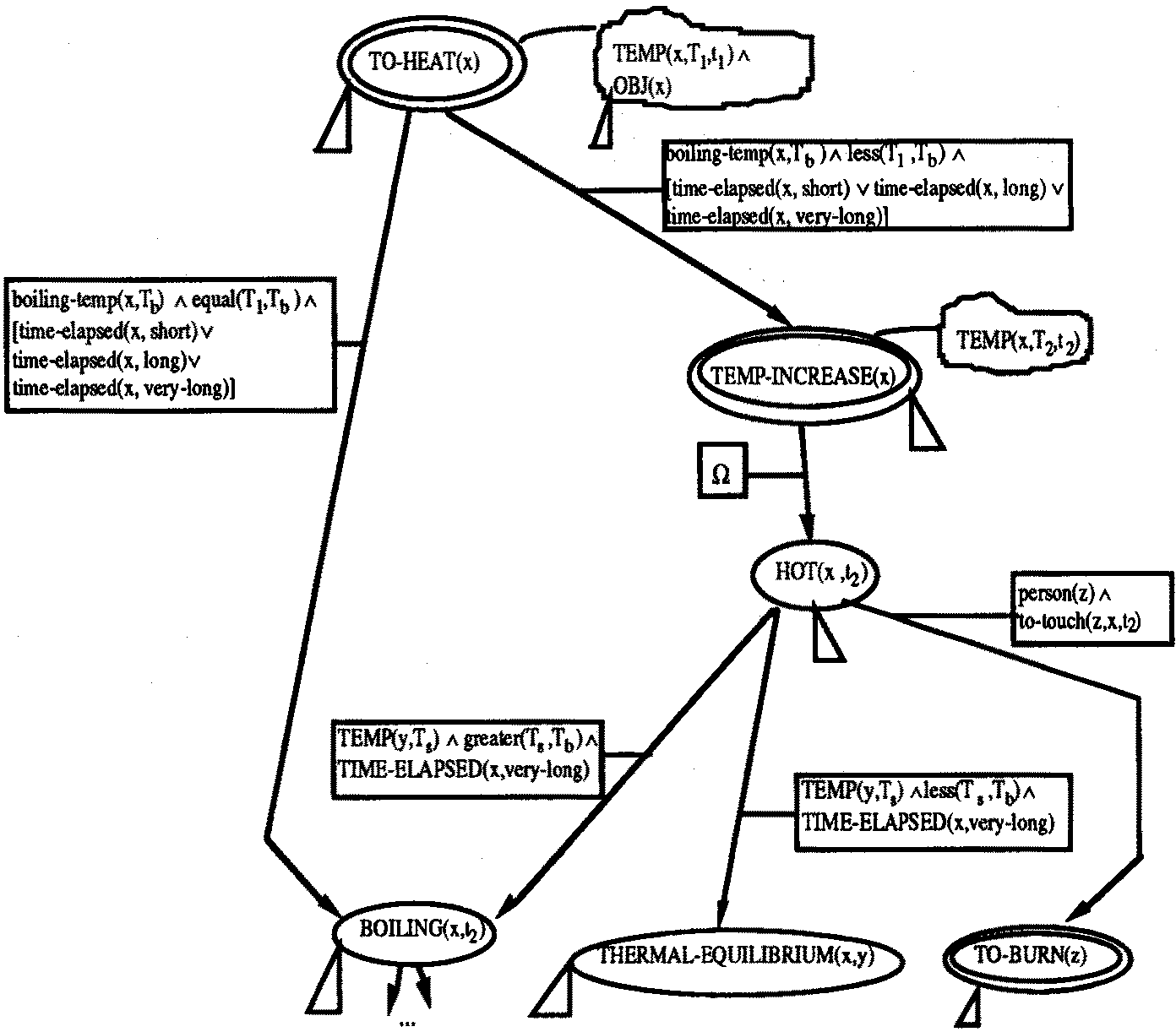 Above: The teacher's causal model for temperature increase during heating.
Experiments: Predicting Intuition
By implementing David’s initial "Aristotelian" beliefs into WHY, the system was able to:
- Replicate David's errors: It correctly "predicted" David's incorrect answers to questions about water boiling in different-sized saucepans.
- Trace the logic: It showed that David believed "a greater cause leads to a greater effect," ignoring the qualitative variable of thermal equilibrium.
David's Mental Ontology
Unlike the teacher, David’s ontology (mental taxonomy) did not link temperature to an objective measurement initially; instead, it was tied to tactile perception.
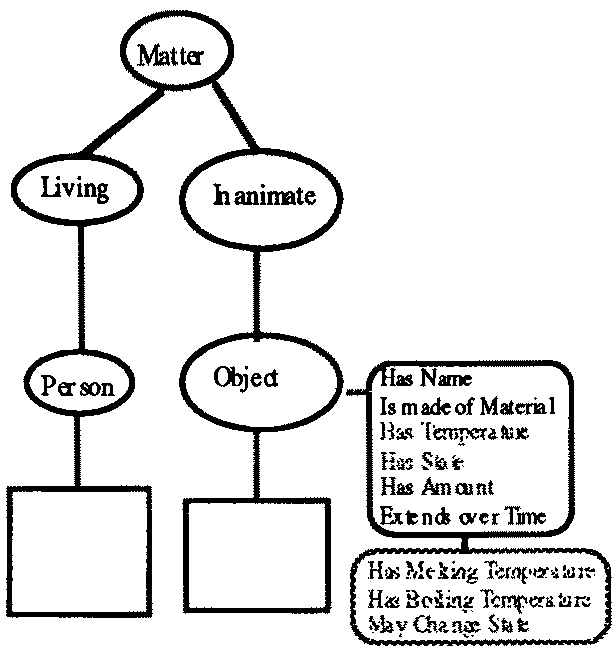 David's hierarchical view of matter, where properties like "cold" are intrinsic to the material.
Deep Insight: Three Modes of Learning
The paper's most profound contribution is the computational definition of conceptual change:
- Accretion: Adding new facts or properties (e.g., learning that aluminum is a metal).
- Tuning: Adjusting existing rules (e.g., refining the conditions under which a gas stove is considered "on").
- Restructuring: The most difficult phase. This involves rewiring the causal graph—for instance, shifting from believing "wool generates heat" to "wool is an insulator in a heat transfer process."
Critical Analysis & Takeaways
This work is a masterclass in Knowledge Representation. It honors the complexity of the human mind by refusing to treat learners as "blank slates" waiting for data.
Main Takeaway: True learning in science is the process of theory revision. For AI to become a better tutor or a better simulator of human thought, it must move beyond statistical pattern matching and embrace structured, revisable causal models.
Limitations: The system relies on manual extraction of predicates from interviews, a process that is high-effort and potentially biased by the researcher’s interpretation. Future work might automate this using Natural Language Processing (NLP) while retaining the symbolic rigor of the WHY system.