
The Architecture of Influence: Decoding Information Flow in the Twitter Ecosystem
3083_The World of Connections and Information Flow in Twitter.
This study presents a large-scale empirical analysis of information flow on Twitter, using a dataset of 54 million users and 1.7 billion tweets. The authors categorize users into three distinct tiers—Mass Media, Evangelists, and Grassroots—to analyze their specific roles in disseminating both major international news and niche social topics.
TL;DR
By analyzing nearly 2 billion social links, this study dismantles the myth that "Grassroots" movements drive most information on social media. Instead, it reveals a tripartite hierarchy: while Mass Media starts the fire, Evangelists (opinion leaders) are the oxygen that allows it to spread to the network's edges, while the vast Grassroots majority remains surprisingly passive.
Contextualizing the Digital Broadcast
Is Twitter a social network or a news wire? This paper argues it is a hybrid. Unlike Facebook or LinkedIn, where bidirectional links dominate, Twitter's unidirectional "subscriber" model creates a power-law distribution of influence. The study aims to map how information navigates this skewed topography—transitioning from elite broadcasters to the "long tail" of the internet.
Pain Points & Motivation
Before this study, "influence" was often a nebulous concept. Marketers and sociologists theorized about "The Two-Step Flow" (Mass Media → Influencers → Public), but lacked the massive datasets to prove it. The authors noticed that typical social networks (like Flickr or Orkut) had capped in-degrees, whereas Twitter allowed users to reach millions. They set out to solve a core mystery: Who is actually necessary for a story to go viral?
Methodology: The Three Tiers of Twitter
The researchers identified three distinct "phases" in the network based on follower counts, which align with sociological definitions:
- Mass Media (The Sovereigns): >100,000 followers. Think BBC or CNN. They broadcast but rarely "listen" (reciprocate).
- Evangelists (The Connectors): 200 to 100,000 followers. These are politicians, niche celebrities, and power users. They are highly social and bridge different clusters.
- Grassroots (The Masses): <200 followers. Comprising 98% of the network, they are the primary consumers but have limited individual reach.
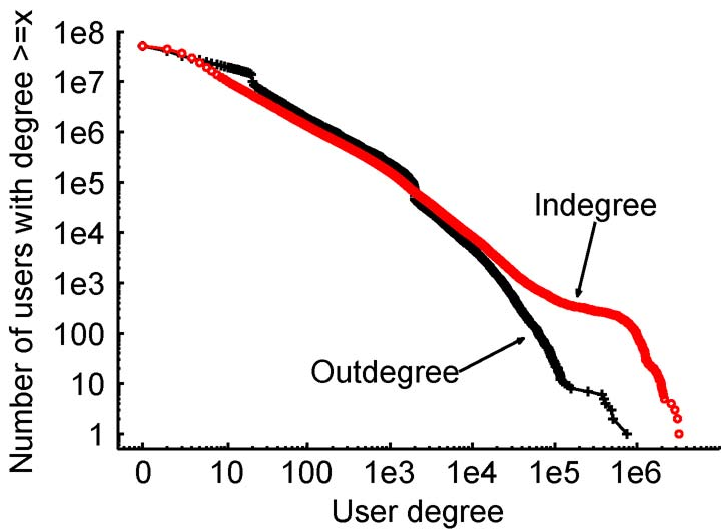 Figure 1: The cumulative distribution of links, showing the phase transitions at the 200 and 100,000 marks.
High-Level Insights into User Behavior
The study found a striking disparity in Reciprocity. Grassroots and Evangelists use Twitter for social bonding (high reciprocity), while Mass Media treats it as a pure broadcast pipe (1.84% reciprocity). However, despite their small numbers, Evangelists are the "workhorses" of the platform, producing 36% of all tweets.

Experiments: Measuring "Necessity" and "Sufficiency"
The authors tracked six major events (e.g., the Iran Election, Michael Jackson’s death) and 100 minor topics.
- Major News: Mass Media platforms are sufficient to reach 70% of the audience. If you remove them (the black line in Fig 3), the audience reach collapses, proving they are necessary for mass awareness.
- Niche Topics: For topics like "#disneyland" or "#googleapps," Mass Media disappears. Here, Evangelists become the primary drivers, often responsible for 90%+ of the reach.
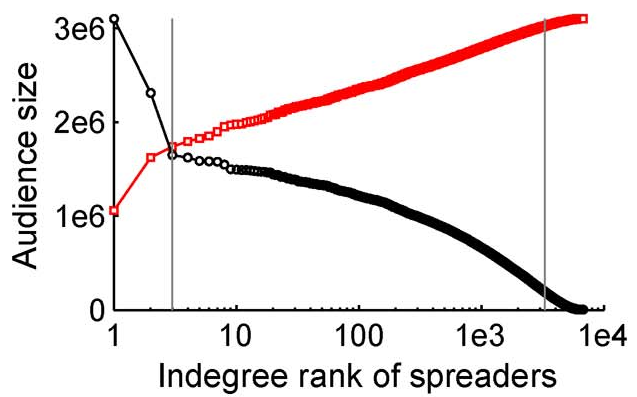 Figure 2: Analysis showing that while top spreaders (Mass Media/Evangelists) are crucial, the Grassroots' ability to sustain reach is minimal.
Dynamics: When the Flow Reverses
The most groundbreaking finding is the Reversal of Flow. Contrary to the top-down broadcast model, the researchers found that:
- Mass media are often slower than the public in reacting to breaking news (e.g., the AirFrance crash).
- Information frequently flows upward: Grassroots users discover a URL, it is picked up by an Evangelist, and finally, a Mass Media node "retweets" or reports it.
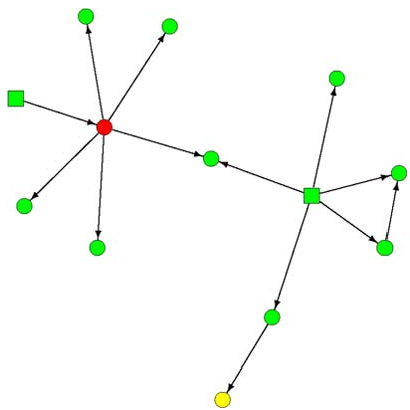 Figure 3: A propagation map from the Moldova civil unrest, showing a rare instance of an Evangelist (green) acting as the source for Mass Media (red).
Critical Analysis & Conclusion
Takeaway: This paper proves that influence on Twitter is not democratic. While everyone has a voice, actual "reach" is guarded by a small elite (Evangelists) and a tiny institutional core (Mass Media).
Limitations: The study relies on a snapshot of social links from 2009. In the modern era of "algorithmic discovery" (where the system pushes content even if you don't follow the source), the role of the follower count (in-degree) as the sole metric of influence may be slightly diminished.
Future Outlook: For designers of recommendation engines, this research suggests that identifying "Evangelists" is more valuable than tracking the absolute top-tier media if the goal is to penetrate diverse community clusters rather than just achieving raw impressions.