
WorldMemArena: Beyond Static Recall—Testing the Living Memory of Multimodal Agents
WorldMemArena: Evaluating Multimodal Agent Memory Through Action-World Interaction
WorldMemArena is a comprehensive benchmark for evaluating Multimodal Large Language Model (MLLM) agents across 461 multi-session tasks. It introduces a novel Action-World Interaction Loop framework to diagnose memory through a four-stage lifecycle: writing, maintenance, retrieval, and use.
TL;DR
As AI agents move from chatbots to long-horizon actors, their memory needs to do more than just "search." It must track an evolving world, delete stale information, and bridge the gap between sight and action. WorldMemArena is a new diagnostic benchmark that breaks memory down into a four-stage lifecycle—Writing, Maintenance, Retrieval, and Use—revealing that even the most "knowledgeable" models fail when their memory isn't dynamic.
The Problem: The "Static Recall" Trap
Current benchmarks treat agent memory like a library: can you find the book I asked for? In reality, an agent's memory is more like a workspace: some tools are old, some requirements have changed, and the "visual evidence" (what the agent sees) is often lost in translation.
Prior work primarily focuses on Retrospective QA (answering questions about the past) rather than Agentic Execution (using the past to act better now). This leaves us in the dark: if an agent fails, did it forget the information, or did it just fail to realize that the information was now incorrect?
Methodology: The Action-World Interaction Loop
The researchers at UCSB, Stanford, and ETH Zurich propose a paradigm shift: viewing memory as a loop. This loop segments memory into four observable phases:
- Observe to Write: Identifying what is actually worth keeping from a stream of observations.
- Update and Consolidate: Revising old facts (e.g., "The user moved house") instead of just piling new facts on top of old ones.
- Retrieve for Decision: Finding the relevant evidence, not just the similar evidence.
- Use and Act: Translating that evidence into a correct final action or answer.
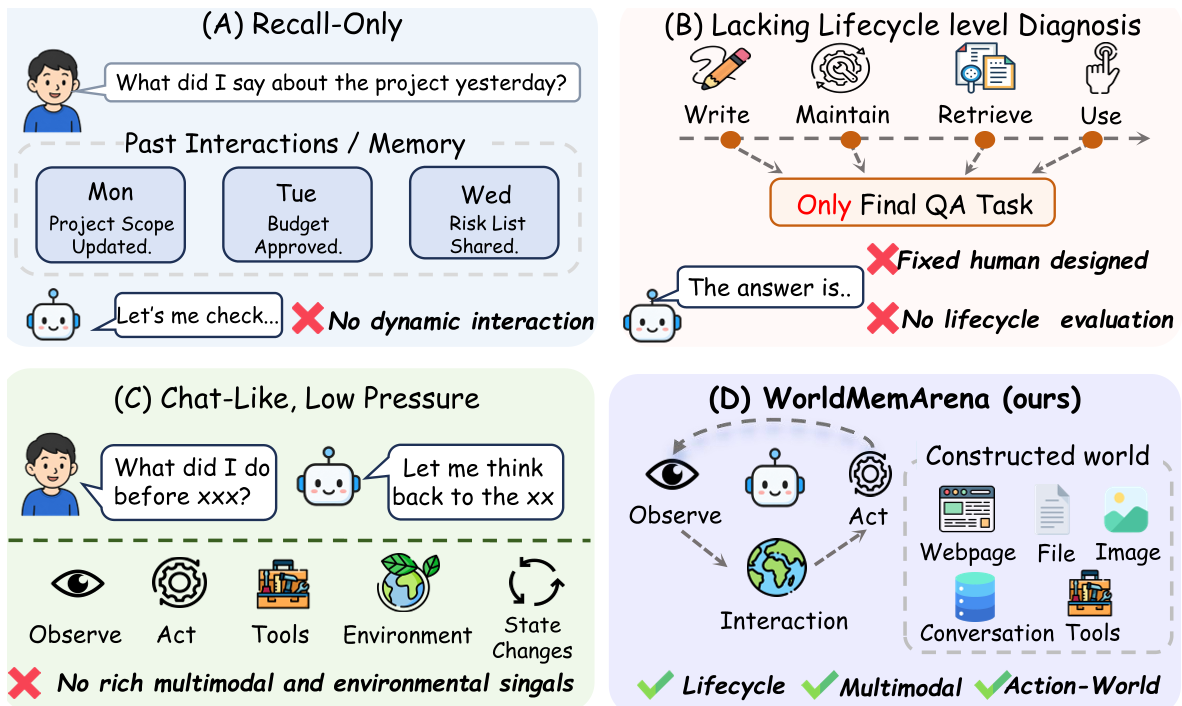 Figure 1: The Action-World Interaction Loop vs. traditional recall evaluations.
WorldMemArena: A Two-Pronged Battery
The benchmark covers 461 tasks across two regimes:
- Lifelong Evolution: Focuses on personal and task states that change over weeks or months (e.g., professional project management).
- Agentic Execution: Uses real traces from GUI and Embodied agents where the agent must learn from tool feedback and screenshots.
Key Findings: The "Storage vs. Utility" Paradox
The experiments yielded several sobering insights for the AI community:
- The Usage Gap: Storing 90% of facts (high Recall) does not lead to 90% success. Systems often fail to "surface" the right memory at the moment of decision.
- Visual Amnesia: Most multimodal systems collapse visual screenshots into basic text captions. This "text-proxy" approach loses crucial spatial and procedural details, leading to failures in complex visual reasoning.
- The Accumulation Problem: Most models use "append-only" memory. They never delete. When a world state changes, the model gets confused by conflicting "past" and "present" facts in its own context.
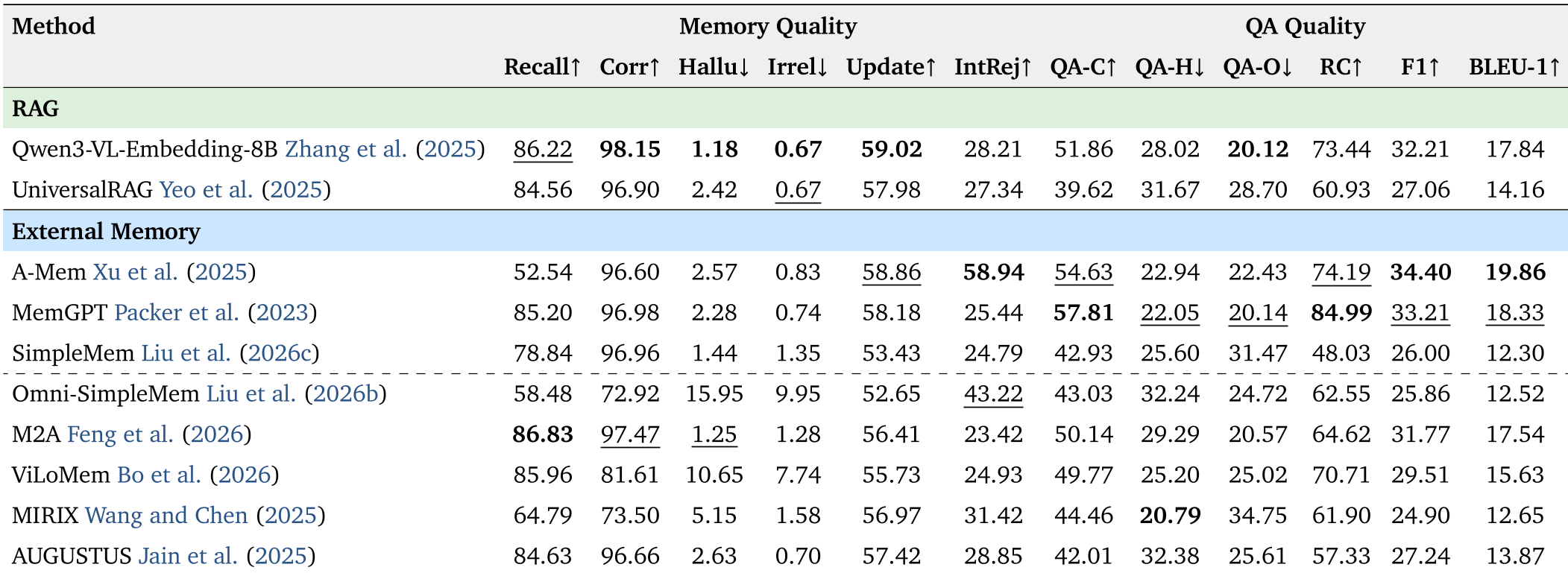 Table 2: Comparative analysis of RAG, External Memory, and Long-Context agents across the memory lifecycle.
Critical Analysis & Future Outlook
The study concludes that the industry's obsession with "longer context windows" is a bandage, not a cure.
Takeaways for Developers:
- Stop Hoarding: Agents need mechanisms for selective forgetting and conflict resolution.
- Focus on Interaction: Memory is a capability, not a database. It should be trained via end-to-end interaction goals, not just retrieval accuracy.
- Visual Fidelity: We need architectures that treat images as first-class citizens in the memory stream, rather than turning them into lossy text summaries.
WorldMemArena serves as a rigorous wake-up call: an agent is only as good as its ability to learn from the consequences of its actions. Memory is not just about the past; it's about the future.
Senior Technical Editor's Note: This paper effectively bridges the gap between traditional NLP and Agentic AI. The "Action-World Interaction Loop" is a robust mental model that researchers should adopt to avoid the "Recall-only" evaluation trap.