
OSN Worm Detection: Exploiting Social Topology for Early Warning
Toward worm detection in online social networks
The paper proposes an early warning system for detecting worms in Online Social Networks (OSNs) like Facebook and Twitter. By leveraging the "small-world" and "scale-free" topological properties of social graphs, the system uses a strategic "decoy friend" (honeypot) placement and a two-level spatial correlation scheme to identify infections with high precision.
TL;DR
Online Social Network (OSN) worms like Koobface spread through trust rather than technical vulnerabilities, making them invisible to traditional network-level scanners. This paper introduces an early warning system that embeds "Decoy Friends" into the social graph. By monitoring just 500 users out of 1.8 million, researchers can detect a worm outbreak when less than 0.13% of the population is infected, providing a critical window for containment.
The Problem: Why Firewalls Can't See Social Worms
Traditional worms (like Code Red or Slammer) are "noisy"—they scan random IP addresses, creating spikes in destination-source traffic. OSN worms are "stealthy." From a server's perspective, an infected account sending a message to a friend looks identical to a healthy user sharing a link.
The authors identify two key properties that make OSNs a "paradise" for worms:
- Small-World Effect: Short average path lengths allow worms to jump across the network rapidly.
- Scale-Free Nature: A few "hub" users have massive numbers of friends, acting as super-spreaders.
Methodology: Strategic Decoys and Correlation
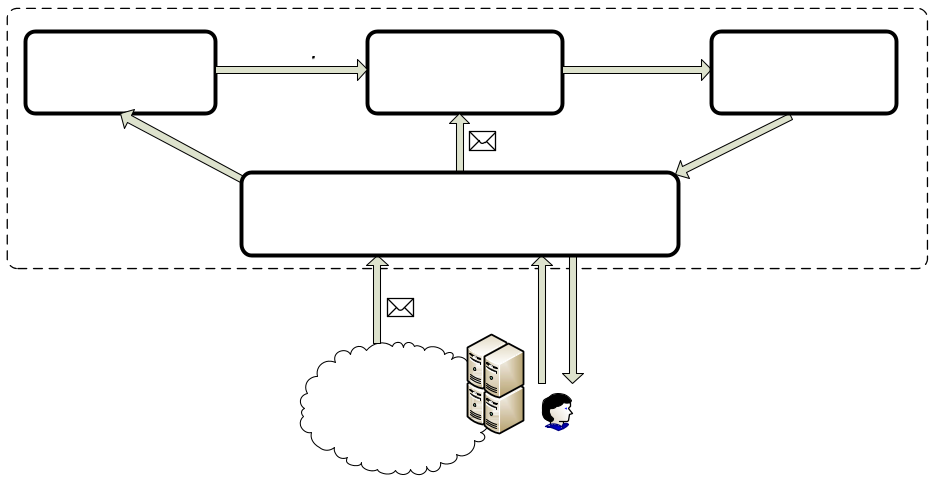
The system architecture focuses on efficiency, ensuring that the heavy lifting of monitoring doesn't degrade user experience or privacy.
1. Intelligent Decoy Placement
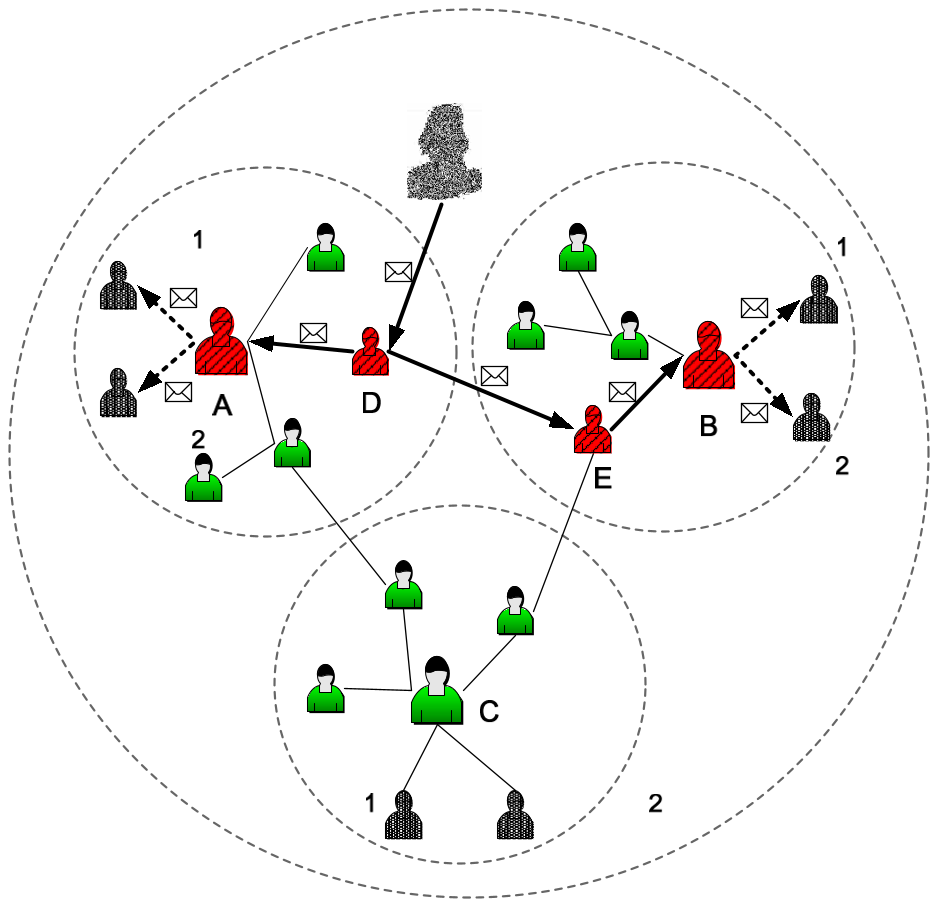
Instead of random placement, the authors formulate the Maximum Coverage Problem. They seek to find a set of users such that a 2-hop radius from these users covers the maximum possible area of the social graph. They use a greedy heuristic:
- Identify high-degree "hub" nodes.
- Assign two "Decoy Friends" (controlled honeypot accounts) to each selected user.
- When a user is infected, the worm automatically sends messages to their friends—including the decoys.
2. Two-Level Correlation
To prevent "normal" messages from triggering false alarms, the system uses two filters:
- Local Correlation: If two decoys for the same user receive similar but customized messages, it’s a high-probability infection (Scenario: Koobface's customized payloads).
- Network Correlation: If decoys across different parts of the network receive identical or highly similar content (calculated via Levenshtein Edit Distance), it indicates a global outbreak (Scenario: Mikeyy worm).
Experiments: Real-World Performance
Using a dataset from Flickr (1.8M users, 22.6M links), the researchers simulated two types of threats:
- Koobface-style: Customized messages.
- Mikeyy-style: Identical updates.
Results Highlights
- Early Warning: Both worms were caught long before they reached 0.19% of the population (the standard threshold for "early warning").
- Resilience: Even if a worm randomly targets only 10% of a user's friend list (to try and miss the decoys), the system still catches it within the early warning window.
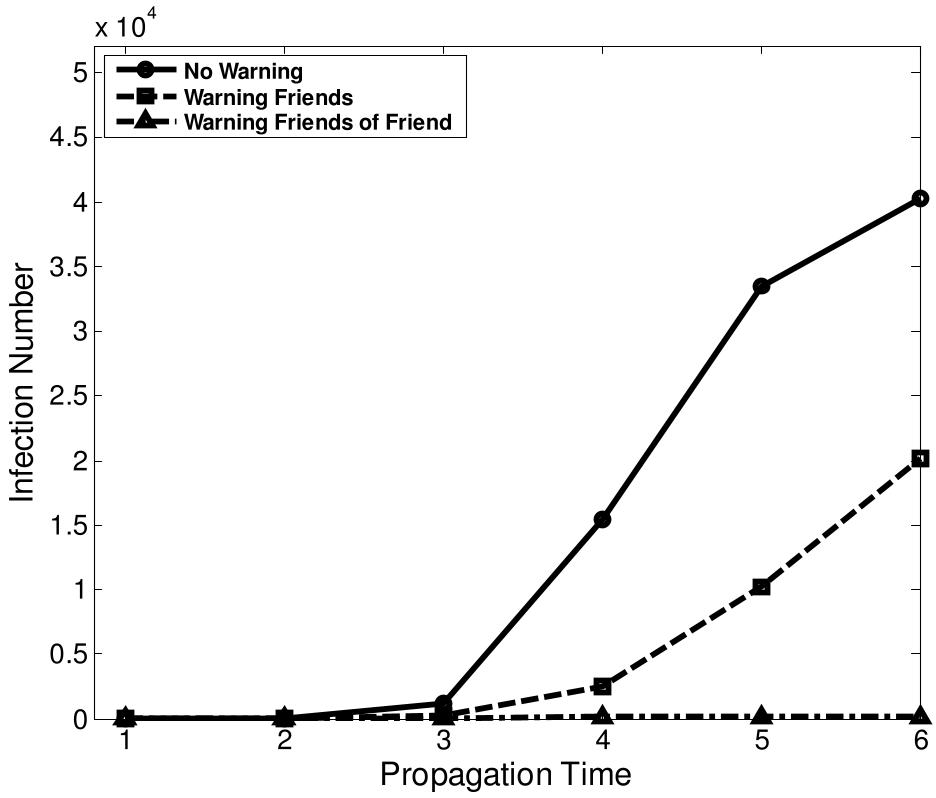
- Containment: By using decoys to send "1-hop" or "2-hop" warnings to friends of infected users, the final infection numbers were slashed by nearly 50%.
Critical Analysis & Conclusion
Takeaway: This work demonstrates that "security through topology" is highly effective in environments where content-based filtering is difficult. By placing sensors where the "hubs" are, we can monitor the pulse of the entire network with minimal overhead.
Limitations:
- User Reluctance: Users must agree to have "decoy friends" in their lists. The authors suggest incentives, but the privacy-conscious might still object.
- Social Engineering Events: A "viral" legitimate news story might mimic the propagation pattern of a worm, potentially causing false positives.
Future Outlook: As OSNs move toward encrypted messaging (like WhatsApp or Signal), detection might need to shift from centralized servers to "Decoy Clients" or edge-based correlation, making this decentralized monitoring approach even more relevant.