
Wormhole: The Pathogenic Power of Search Engines in Social Media
Wormhole: The Hidden Virus Propagation Power of the Search Engine in Social Networks
This paper introduces a novel "Epidemic Feedback Model" to quantify how search engines accelerate virus propagation in social networks. It identifies the "Propagation Wormhole" effect, where search engines create virtual shortcuts between disconnected communities, significantly surpassing the limitations of traditional network-based contagion.
In the digital ecosystem, we often view search engines as neutral utilities for information retrieval. However, a groundbreaking study reveals a darker reality: search engines act as "Propagation Wormholes," providing viruses and malware with the ability to leap across isolated communities and infect users who were previously considered "safely" disconnected.
TL;DR
This research moves beyond traditional contagion models to show that search engines create a positive feedback loop for malware. By indexing malicious pages and boosting their rankings, they create virtual shortcuts that bypass the social graph. The result? Faster infection, lower thresholds for outbreaks, and a "wormhole" effect that renders network isolation obsolete.
The Problem: The Blind Spot of Traditional Topology
Most epidemiological models (SIS, SIR) rely on a fundamental assumption: nodes can only infect their immediate neighbors. In a social network divided into tight-knit "communities" (like Facebook groups or professional circles), these structures naturally act as firewalls. If a virus hits Community A, Community B is relatively safe unless a bridge exists.
The authors argue that search engines destroy this protection. They function as a Virtual Virus Pool, gathering malicious links from across the entire web and presenting them to users regardless of their social connections.
Methodology: Engineering the Wormhole Effect
The core of the paper is the Epidemic Feedback Model. It treats the search engine's influence as a dynamic variable that changes over time based on the current infection density.
1. The Propagation Wormhole
Unlike physical edges, a "wormhole" shortcut exists in three dimensions:
- Intra-community: Jumping over multiple hops within one group.
- Inter-community: Connecting two isolated groups.
- Cross-network: Spreading a virus from Facebook to Twitter via search results.
2. The Positive Feedback Loop
The model identifies a dangerous cycle:
- As more nodes are infected, they publish more malicious out-links.
- Search engines index these links, potentially increasing their ranking.
- High ranking attracts more clicks (infections), which further populates the virus pool.
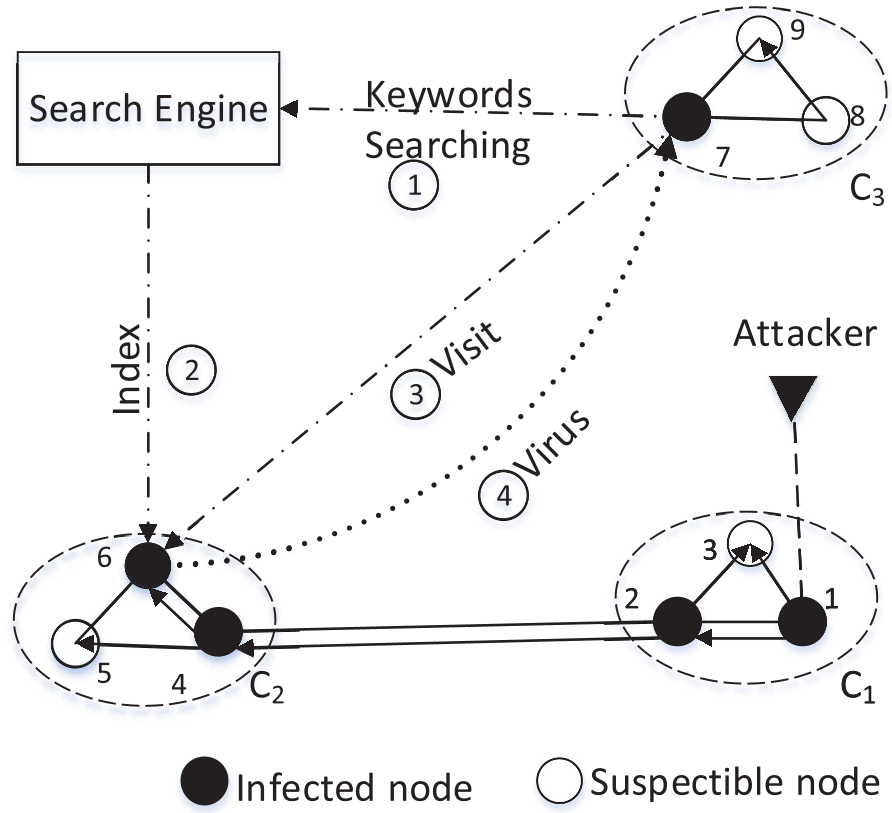 Fig 1: A conceptual view of a search engine bridging isolated communities (C3) through virtual paths.
Mathematical Proofs and Insights
The researchers didn't just observe; they proved the search engine's power mathematically:
- Infection Density (): Under search engine conditions, the stable state of infection is consistently higher.
- Epidemic Threshold (): The "tipping point" for an outbreak is lower with a search engine. A less infectious virus can cause a global epidemic if it is optimized for search visibility.
- Basic Reproduction Number (): The authors proved , meaning every infected user produces more secondary infections via search than through social sharing alone.
Experimental Results: Real-World Evidence
Testing on datasets like Weibo (mobile social) and Facebook confirmed the theory. The influence was particularly stark in "unconnected" simulated networks.
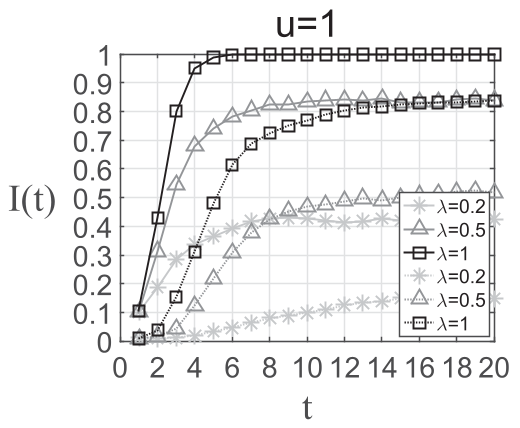 Fig 2: Growth curves showing that infection density (solid lines) with search engines reaches a higher steady state much faster than traditional propagation (dotted lines).
Crucially, in networks where communities were completely isolated, traditional models showed 0% infection for the second group. But with a search engine "wormhole," the infection density reached near 100% saturation.
Critical Analysis: Stability and Defense
The paper introduces the concept of Partial Stability. It proves that the virus can be controlled if the disappearance rate of infected nodes exceeds the growth of susceptible nodes.
The Catch: Because search engines act as a persistent pool, traditional "quarantine" (blocking social links) doesn't work. Defense must focus on "poisoning the well" (cleaning search results) rather than just fixing the social graph.
Conclusion: A New Paradigm for Security
This work demonstrates that the "connectedness" of the modern world isn't just about who we follow—it’s about what we search for. The search engine is a silent accelerator of digital epidemics. For practitioners, this means that securing a platform requires monitoring external search visibility just as much as internal user interactions.
Takeaway: The wormhole is real, and it makes our digital boundaries more porous than we ever imagined.