
X2-Search: Decoding Professional Experts through Social Contexts
X2-Search: Contextual Expert Search in Social Networks
This paper introduces X2-Search, a contextual expert search system designed to locate specialists and form teams within social networks by integrating personal skills with social connectivity. The core method utilizes a label-based grouping strategy and a Connector-Steiner Tree algorithm to minimize communication costs while satisfying complex contextual queries.
TL;DR
X2-Search is a specialized framework that transforms how we find professionals on platforms like LinkedIn. Unlike basic keyword searches, it treats expertise as a combination of individual skills and social context. By optimizing for the "Communication Cost" within a social graph, it finds not just an expert, but an expert embedded in the right professional ecosystem.
The "Isolation" Problem in Expert Search
When you search for a "Machine Learning Engineer" on a standard platform, the algorithm usually looks at the "Skills" section of a profile. However, this approach faces two critical failures:
- Context Blindness: It cannot satisfy queries like "Find a Python expert who is well-connected to UX Designers in London."
- The Sparse Profile Reality: Many high-level experts don't meticulously update their profiles. Their value is often hidden in their network—the people they collaborate with and the projects they successfully deliver within a group.
X2-Search moves from "Keyword Matching" to "Subgraph Discovery," treating the social network as a map of functional expertise.
Methodology: The Logic of Steiner Trees
The core technical challenge is finding a set of people who cover all requested labels (e.g., "Java," "Finance," "New York") while keeping their "Communication Cost" (edge weights in the social graph) at a minimum.
1. Label-based Grouping
Instead of searching the entire massive social graph (which is computationally expensive), X2-Search condenses the graph. It creates groups for each query label. If "Java" is a target skill, the system identifies all connected components of Java-savvy individuals.
2. The Connector-Steiner Tree Algorithm
The problem is modeled as a Steiner Tree Problem (a classic NP-hard problem). The goal is to find the smallest tree that connects a set of required vertices.
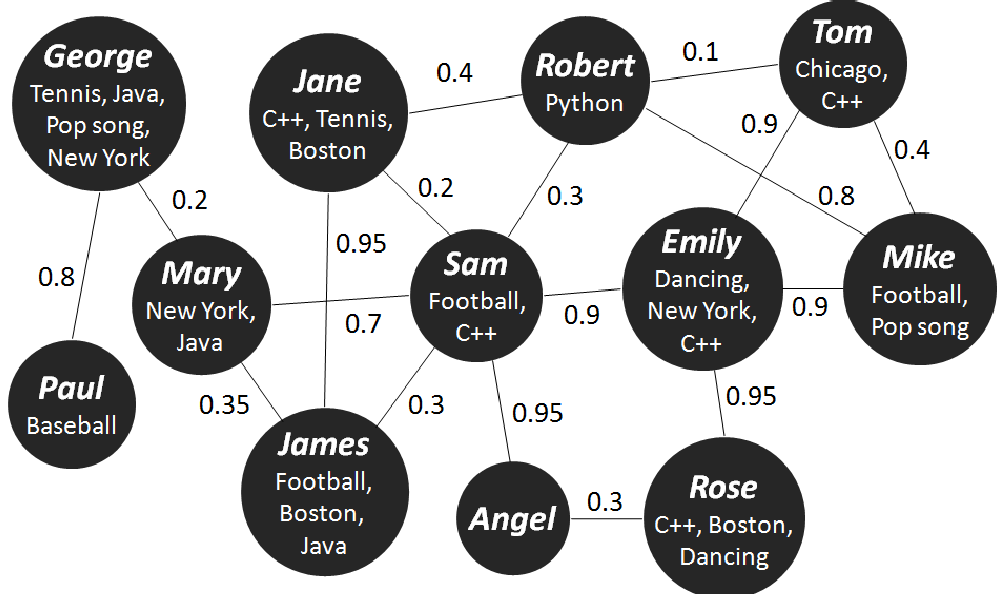 In the figure above, to find an expert in 'Java' living in 'New York' with close friends, the algorithm identifies the path with the minimum communication cost (edge weights).
The system enhances the graph by adding "Label Nodes" and connecting them to individuals. It then uses a greedy strategy to iteratively find the shortest paths between these labels, resulting in a cohesive expert team or a localized specialist.
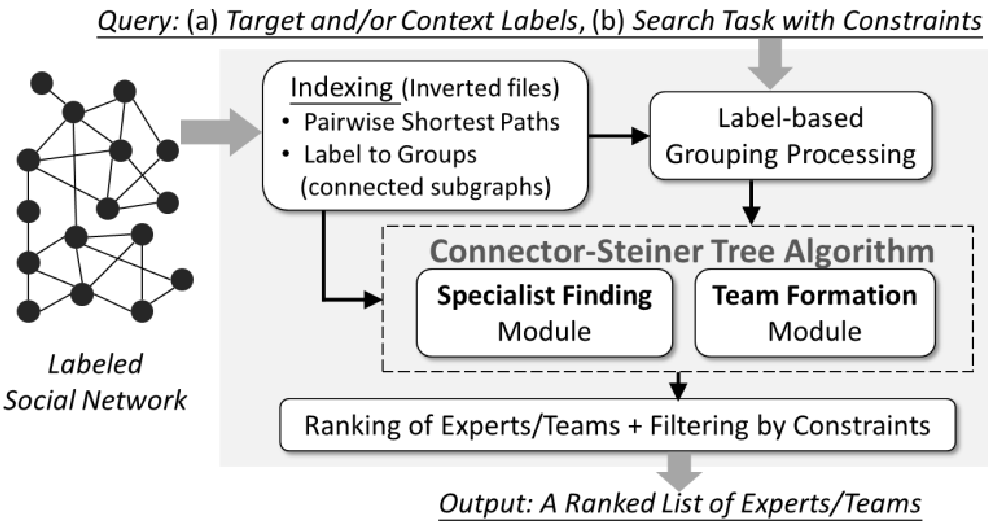 The system flow: from pre-processing pairwise shortest paths to label-based grouping and final ranking.
Experiments & Real-World Performance
The researchers tested X2-Search using the DBLP bibliography dataset (10,443 authors, 25,354 edges).
- Efficiency: The "GroupSteiner" approach outperformed the "OriginalSteiner" baseline significantly as query complexity grew. While the baseline time increased linearly/exponentially, X2-Search remained under 1 second per query.
- Effectiveness: For specialist finding, the target expert typically appeared within the top 2 results, proving that social context is a highly accurate signal for identity.
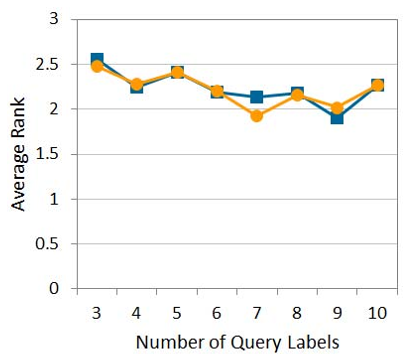 The charts show that while accuracy (AvgRank) remains stable, the time efficiency of the Group-based approach is superior.
Critical Insight: Why This Matters
X2-Search implicitly solves the Inference Problem. If a person's profile is empty, but all their co-authors are "Database Experts," X2-Search can infer that this person belongs in a database-related search result.
Limitations
- Dynamic Weights: Communication costs (edge weights) are treated as static in this model. In reality, professional relationships evolve.
- Scale: While efficient on DBLP, true global social networks (billions of nodes) would require even more aggressive pruning or distributed graph processing.
Conclusion
X2-Search shifts the paradigm from searching for attributes to searching for substructures. Whether it's a headhunter looking for a specific talent or a manager building a multidisciplinary task force, the ability to query social context alongside skills is a significant leap forward for social HR tech.