
Yalut: Reclaiming Data Privacy through Hybrid Social Overlays
Demo: Yalut -- user-centric social networking overlay
Yalut is a novel user-centric hybrid overlay for social networking that decentralizes content storage and distribution while maintaining integration with popular centralized services (C-OSNs) like Facebook and Twitter. By leveraging a peer-to-peer (P2P) architecture and a dynamic replication strategy called mTribe, Yalut provides SOTA privacy and data control without requiring users to abandon existing social platforms.
TL;DR
Yalut is a hybrid social networking overlay that allows users to keep their photos and videos on their own devices (or peer devices) while still using Facebook and Twitter to share them. By combining decentralized P2P storage with centralized social feeds, it solves the "all-or-nothing" privacy dilemma of modern social media.
Background: The Privacy-Convenience Paradox
We live in an era where social connectivity comes at the price of digital sovereignty. Centralized services (C-OSNs) like Facebook provide seamless access but exploit user data for revenue. Decentralized alternatives (D-OSNs) like Diaspora have tried to fix this but failed because people won't leave where their friends already are. Yalut enters the scene as a pragmatic middle ground: keep the friends (C-OSN), but move the data (Distributed).
The Problem: Why Decentralization is Hard
The primary barriers to decentralized social networking are:
- Network Effects: Users are locked into existing platforms.
- Availability: Mobile devices aren't always online, have limited battery, and expensive data plans.
- Complexity: Typical users cannot manage their own servers.
Methodology: How Yalut Works
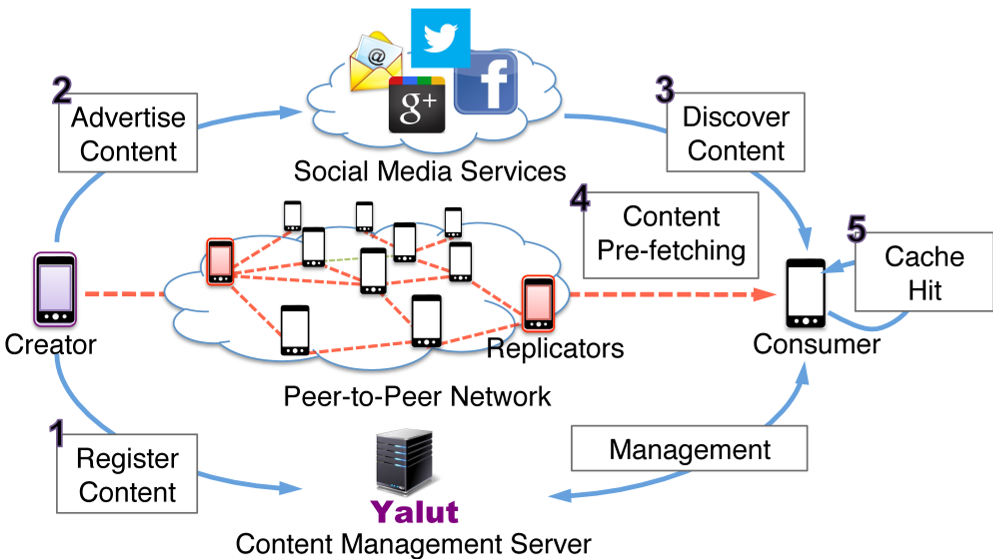
Yalut functions as an overlay. Instead of uploading a photo to Facebook's servers, a user:
- Registers the content metadata with a lightweight Content Management Server (CMS).
- Posts a link to their Facebook wall.
- When a friend clicks the link, their Yalut app fetches the content directly from the creator's phone or a designated "mTribe" of peer devices using P2P protocols.
The Content Sharing Architecture
mTribe: Intelligent Replication
To ensure content is available even when the creator's phone is off, Yalut uses the mTribe algorithm.
- Predictive Availability: It calculates the probability that at least one device in a group (tribe) will be online and on a low-cost network (like Wi-Fi) based on historical behavior.
- Optimization: The system treats replication as a "maximum cover" problem, which the authors prove is NP-Hard. They utilize a bipartite b-matching heuristic to balance availability with device battery life and storage fairness.
Experiments & Results: Efficiency in the Wild
The researchers tested Yalut across Android and Windows/Mac platforms.
- Persistence: They found that with just two replicas, content availability remains consistent without needing a central cloud.
- Resource Savings: By delaying uploads until Wi-Fi is available and using peer pre-fetching, Yalut significantly offloads cellular traffic, providing a win-win for users and network providers.
- Ephemeral Content: Unlike Facebook, where "deleting" a post often leaves a trace on servers, Yalut's ephemeral mode ensures the actual file is wiped from all peer devices once the timer expires.
Performance Insights
(Note: The paper highlights that predictive availability is the core metric for maintaining the DHT-like structure without the overhead of a traditional server.)
Critical Analysis & Conclusion
The Takeaway: Yalut's genius lies in its non-disruptive nature. It doesn't ask you to quit Facebook; it just changes where your data lives.
Limitations:
- Bootstrap Sync: The CMS remains a centralized point of failure for metadata, although it doesn't host the actual content.
- Initial Content Delivery: The first "hop" of content sharing still depends on the creator's initial bandwidth.
Future Outlook: As mobile edge computing grows, Yalut’s approach to "Predictive Availability" will be essential for distributed AI and content distribution networks where privacy is a secondary but growing requirement.
References
- MobiSys'14, June 16–19, 2014, New Hampshire, USA.
- Thilakarathna, K., et al. "MobiTribe: Cost Efficient Distributed User Generated Content Sharing on Smartphones." IEEE Transactions on Mobile Computing (2013).