
YAM++: Masterfully Bridging Semantic Gaps with Multi-Strategy Ontology Matching
YAM++ : A Multi-strategy Based Approach for Ontology Matching Task
YAM++ is a multi-strategy ontology matching framework that integrates element-level, structural, and semantic matchers. It achieves SOTA performance by combining machine learning, information retrieval, and similarity propagation, specifically ranking as a top performer in the OAEI Conference and Multifarm tracks.
TL;DR
YAM++ is a highly flexible ontology matching tool designed to solve the problem of identifying equivalent entities across different Knowledge Bases. By integrating Machine Learning, Information Retrieval, and Graph-based Similarity Propagation, it adapts to various scenarios—whether you have gold-standard training data or are dealing with completely unseen, multi-lingual ontologies. In the OAEI (Ontology Alignment Evaluation Initiative) campaigns, YAM++ consistently outperformed global competitors in precision and F-measure.
Background: Why Ontology Matching is Hard
Ontology matching is the cornerstone of the Semantic Web, yet it remains a "bottleneck" task. The difficulty stems from three main heterogeneities:
- Terminological: Different labels for the same concept (e.g., "Physician" vs. "Doctor").
- Structural: Similar concepts organized in completely different hierarchy trees.
- Lingual: Ontologies defined in different languages (e.g., French vs. English).
Most existing tools focus on a single aspect, leading to brittle performance when the context changes. YAM++ aims to be the "Swiss Army Knife" of matchers.
Methodology: The Three Pillars of YAM++
YAM++ operates through a pipeline of three specialized matchers:
1. Element-Level Matcher (The Logic Center)
This module identifies similarities based on entity annotations (labels, comments).
- The ML Approach: When training data exists, YAM++ uses classifiers like SVM or Decision Trees to learn the optimal weights for combining metrics like Levenstein or WordNet-based similarities.
- The IR Approach: If no training data is available, it treats ontology entities as documents in an information retrieval system, using an extended metric of Tversky’s Theory to calculate informativeness and similarity.
2. Structural-Level Matcher (The Context Refiner)
Once initial mappings are found, YAM++ treats the ontologies as graphs. It utilizes a modified Similarity Flooding algorithm. This process "spreads" similarity from matched nodes to their neighbors, ensuring that if two classes match, their properties and sub-classes are also likely to match.
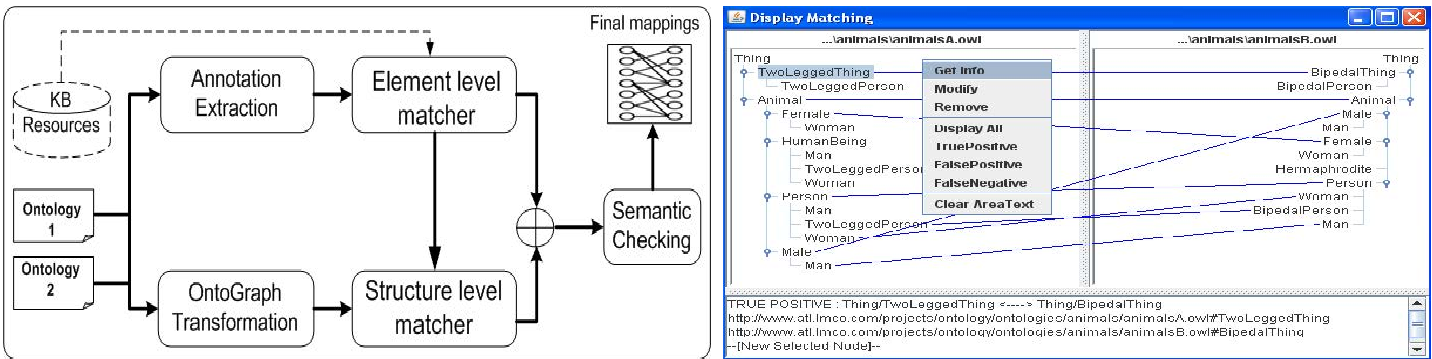 Figure 1: The YAM++ workflow showing the transition from element-level to structural-level matching.
3. Semantical Matcher (The Consistency Guard)
To prevent logical contradictions, the tool employs Global Optimal Diagnosis. This phase identifies and removes inconsistent mappings that would violate semantic constraints, ensuring the final alignment is logically sound.
Experimental Results: Setting New Benchmarks
YAM++'s performance was validated during the OAEI campaigns.
- Conference Track: YAM++ achieved an F1-measure of 0.65, taking the title of the best matching tool and beating established baselines like LogMap and CODI.
- Multifarm (Multi-lingual) Track: By integrating the Microsoft Bing Translator, YAM++ converted non-English labels into a common space before matching. It achieved an F-measure of 0.45 on cross-lingual tasks, a massive lead over competitors who often struggled to break the 0.20 barrier.
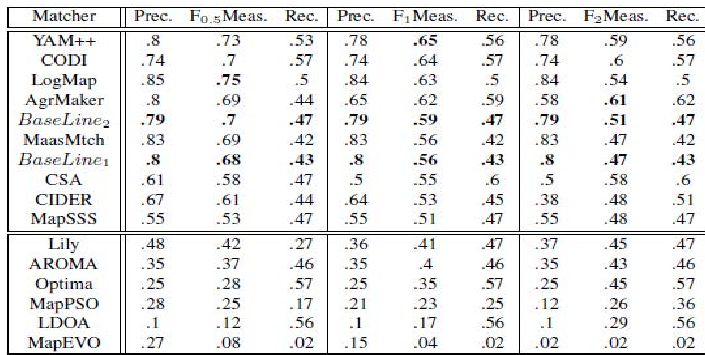 Figure 2: YAM++ ranking 1st in F-measure against other SOTA matchers on the Conference track.
Critical Insight: The Value of "Hybridity"
The core strength of YAM++ isn't just one algorithm; it is the ensemble strategy. By allowing the system to switch to Information Retrieval (IR) when Machine Learning (ML) is unavailable, it maintains robustness. Furthermore, its ability to handle multi-lingual data via translation makes it one of the most practical tools for globalized data integration.
Conclusion
YAM++ proves that ontology matching is no longer a choice between structural or linguistic analysis. By layering these techniques and adding a "semantic filter," the authors have created a framework that is both theoretically sound and empirically superior. While newer LLM-based methods may emerge, the modularity and hybrid nature of YAM++ provide a blueprint for industrial-strength data alignment.
Future Outlook: Integrating Large Language Model (LLM) embeddings into the YAM++ element-level matcher could potentially replace the need for explicit translation, further narrowing the gap in multi-lingual semantic understanding.