
Deciphering the Bar Exam: A Hybrid Approach to Legal Entailment
Answering Yes/No Questions in Legal Bar Exams
This paper presents a hybrid Question Answering (QA) system designed to solve Yes/No questions in the Japanese Civil Law bar exam. The method frames legal QA as a Recognizing Textual Entailment (RTE) task and achieves 61.13% accuracy, outperforming standard SVM-based supervised models.
TL;DR
Researchers have developed a specialized QA system to tackle the high-stakes world of legal bar exams. By treating Yes/No questions as a Recognizing Textual Entailment (RTE) problem, the system uses a clever mix of linguistic rules for negation and unsupervised machine learning for semantic matching. It manages to beat traditional supervised models, proving that in law, logic and structure are just as important as raw data.
Perspective: Why Legal QA is a Different Beast
In most QA tasks, finding the answer is about retrieval. In the legal domain, retrieval is only the first step. The real challenge lies in semantic nuance. A single word like "unless" or "not" completely flips the legal validity of a statement.
The authors identify a specific "information crisis" in law. Current systems often fall into the trap of "word overlap"—if a question and a law article share 90% of their words, a simple AI might assume they mean the same thing. In law, that remaining 10% usually contains the exception that proves the rule.
Methodology: The Divide and Conquer Strategy
The system operates on a dual-track logic designed to handle varying levels of linguistic complexity.
1. Structural Segmentation
Before analysis, the system splits both the question and the legal article into two parts: the Premise and the Conclusion. This is critical because legal articles often follow an "If [Premise], then [Conclusion]" structure.
2. The Hybrid Engine
- Rule-Based Track (The "Easy" Questions): The authors found that nearly 50% of the "No" answers in bar exams are caused by simple negations or antonyms (e.g., "Creditor" vs "Debtor"). By building a custom negation and antonym dictionary, the system solves these cases using "Negation Levels."
- Unsupervised Learning Track (The "Difficult" Questions): For cases where the logic is embedded in the syntax, the system uses K-means clustering. It extracts "Deep Linguistic Features," such as:
- Tree Structure: Comparing the root of the dependency parse tree.
- Lexical Semantics: Using the Kadokawa thesaurus to find concept codes, ensuring the system understands that "purchase" and "sale" are semantically linked.
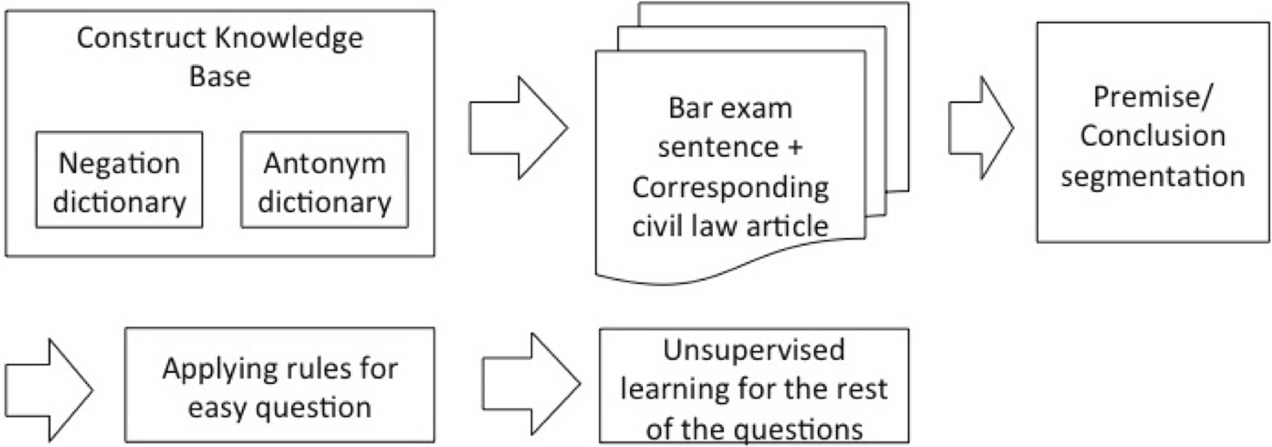 Figure 1: The system workflow, showing the split between rule-based and machine-learning paths.
Handling the "Exception" Problem
A unique insight in this paper is how it handles Exceptional Cases. Civil Law articles often contain a main rule followed by an exception (e.g., "The rule applies... Provided, however, it does not apply if...").
The system calculates a threshold-based overlap to determine if the question is asking about the general rule or the exception. If the question matches the "Exception" sentence's content words above a 0.7 threshold, the system pivots its logic to focus only on that exception.
Experimental Battle: Rules vs. SVM
The researchers tested their hybrid model against a standard SVM (Support Vector Machine).
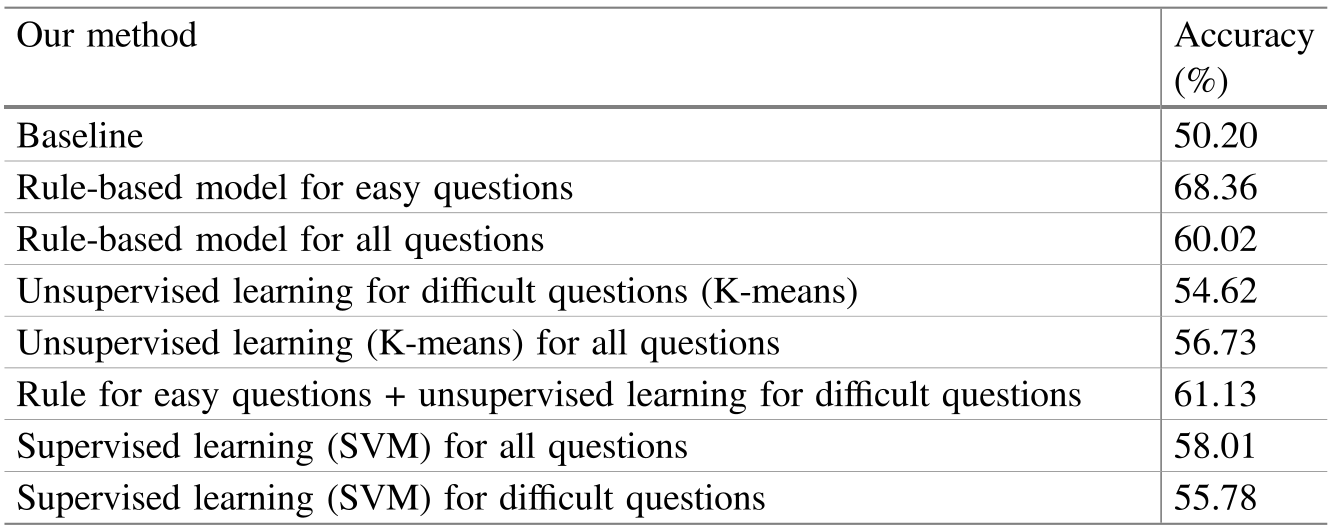 Table 4: Performance comparison. The hybrid model (61.13%) outperforms the supervised SVM (58.01%).
The results demonstrate that unsupervised clustering on top of symbolic rules is more effective for this low-data, high-logic environment than standard supervised learning.
Critical Insight: The "Paraphrasing" Wall
Despite the success, the error analysis reveals that 42.55% of failures are due to paraphrasing. Legal experts use different words to describe the same concept, and without a massive, expert-curated paraphrasing dictionary, software still struggles with the "elegance" of legal language.
The Future: Logic Programming (PROLEG)
The paper concludes by pointing toward PROLEG, a Prolog-based legal reasoning system. By converting natural language into formal logic gates (Plaintiff vs. Defendant arguments), the authors hope to eventually "solve" the reasoning gap that statistics alone cannot bridge.
Final Takeaway
This work highlights that for niche, high-precision fields like law, a "Black Box" AI approach is insufficient. The path forward lies in Neuro-symbolic AI: combining the pattern recognition of ML with the rigid, reliable logic of rule-based systems.