
Digital Security: How Attachment Styles Shape the Language of Technology in Romance
Young adults’ use of communication technology within their romantic relationships and associations with attachment style
This study investigates how adult attachment styles (anxiety and avoidance) influence the use of communication technologies—including texting, SNS, phone, and email—within romantic relationships. Analyzing data from two college cohorts (2009 and 2011), the researchers demonstrate that attachment dimensions moderate the relationship between digital communication frequency and perceived relationship quality.
TL;DR
Is a text message just a text? Not according to attachment theory. This study reveals that our digital habits are deeply rooted in our internal "working models" of relationships. While avoidant individuals use texting to maintain a comfortable level of intimacy, anxious individuals find a unique sense of security in the public and persistent nature of Social Network Sites (SNS).
The Problem: The Mystery of Channel Selection
In the digital age, we have a "buffet" of communication options: the immediacy of a phone call, the convenience of a text, the public stage of Facebook, or the distance of an email. Previous research struggled to explain why some couples thrive on constant texting while others find it suffocating. The authors argue that the missing piece is Attachment Style—the psychological blueprint we develop in childhood that dictates how we handle intimacy and distress as adults.
Methodology: Beyond Simple Frequency
The researchers didn't just ask "how much do you talk?" but "through which channel, and what is your attachment profile?" They analyzed two cohorts of college students (totaling 280 participants) to see if digital habits shifted between 2009 and 2011 and how those habits interacted with personality traits.
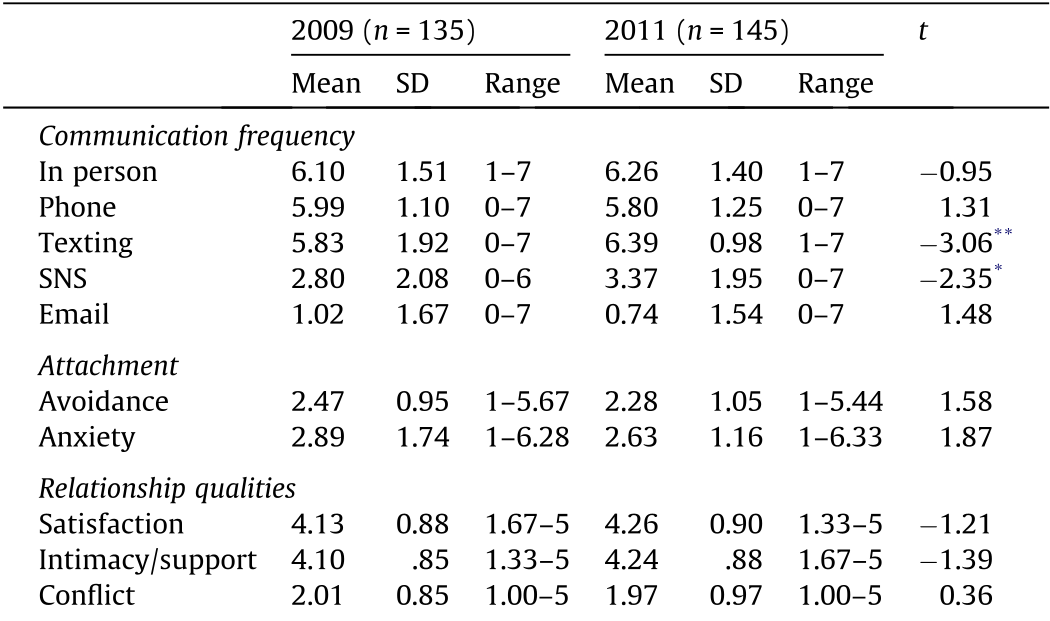 Table 1 illustrates the rise in texting and SNS usage between 2009 and 2011, highlighting the evolving landscape of digital intimacy.
The Core Insight: Attachment as a Moderator
The most striking part of this research is not what people use, but how it affects them differently.
1. The Avoidant Trajectory: Texting as a Safe Haven
Conventionally, we assume avoidant people (who fear being smothered) communicate less. While the correlations showed they use the phone less, the moderated regression revealed a surprise: for highly avoidant people, more texting was linked to higher satisfaction and intimacy. The Intuition: Texting provides a "buffered" intimacy. It allows for connection without the overwhelming physiological demands of voice cues or face-to-face intensity.
2. The Anxious Trajectory: SNS as Emotional Proof
Highly anxious individuals—those who fear abandonment—found greater intimacy and support through SNS (Social Network Sites). The Intuition: Unlike a fleeting phone call, a post on a partner's wall or a public "relationship status" provides a durable, visible record of commitment. This acts as a "security blanket" that the anxious person can revisit when feeling uncertain.
 Table 3 provides the statistical backbone of the study, showcasing the significant Interaction effects (Step 4 & 5) that prove attachment style changes the impact of technology.
Critical Analysis & Conclusion
This paper succeeds in debunking the idea that "media richness" (the idea that video/voice is always superior) applies to everyone. For those with insecure attachment, "leaner" media like texting or SNS can actually be more effective tools for relationship maintenance than the "richer" phone call.
Takeaways:
- For Researchers: We must stop looking at "average" effects of technology. The user's internal attachment model drastically changes the outcome.
- For Users: Understanding your partner's attachment style might explain why they prefer a text over a call—it might be their way of staying close without feeling overwhelmed.
Limitations & Future Work
The study is cross-sectional, meaning we cannot say for certain if texting causes satisfaction or if satisfied avoidant people just happen to text more. Furthermore, as platforms like Instagram and TikTok replace the 2011-era SNS, future research needs to examine if "ephemeral" media (like Snapchat) creates more anxiety for those who need a persistent record of support.