
Decoding YouTube's Pulse: How Recommendations, Search, and Highlights Shape Video Stardom
How YouTube videos are discovered and its impact on video views
This paper investigates the mechanisms of video discovery on YouTube, specifically analyzing how Recommendation, Search, and Highlights drive view growth. Using a dataset of over 100,000 videos, it establishes that while Search and Highlights favor popular content (rich-get-richer), the Related Video Recommendation system effectively increases view diversity by promoting niche and "lukewarm" videos.
TL;DR
A deep dive into YouTube’s discovery engine reveals a surprising truth: while Search and Homepage features favor the famous, the Related Video Recommendation system is the unsung hero of the "Long Tail," helping niche content survive. This study quantifies that while Search and Recommendations provide a steady, linear growth, "Highlights" (like being featured) offer only a fleeting spike with no lasting impact on a video's baseline growth.
Contextual Positioning
In the landscape of social dynamics, this paper serves as a vital bridge between early "popularity modeling" and modern "algorithmic impact" studies. It challenges the common tech-pessimist view that algorithms only create echo chambers or "rich-get-richer" loops, proving that graph-based recommendations can actually democratize attention.
The Mechanics of Discovery: Three Pillars
The researchers identified three primary "Referrers" that dictate the fate of a video:
- Search: Keyword-driven, intent-based discovery.
- Recommendation: The "Related Videos" sidebar driven by co-viewing sessions.
- Highlight: Sudden exposure via the homepage or external embeds (e.g., a blog post or Facebook share).
The Problem: Does Everyone Just Watch the Hits?
Prior work often viewed popularity as a monolithic metric. The authors argued that the source of the view matters more than the view itself. They suspected that "Human-curated" highlights and "Intent-based" search would favor videos that are already popular, leaving new creators in the dark.
Methodology: Measuring the "Equality" of Views
To prove this, the team used the Gini Coefficient—a metric typically used by economists to measure wealth inequality. A Gini of 0 means everyone has equal views; 1 means one video has everything.
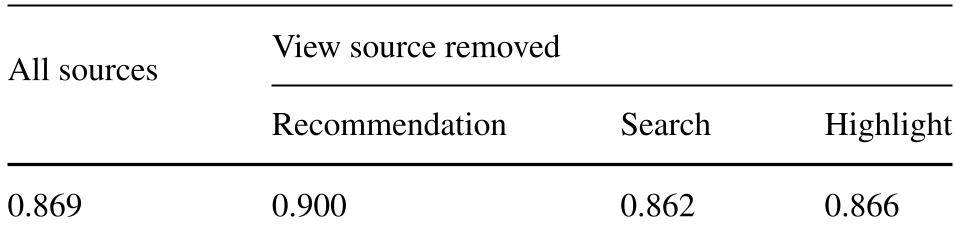
The Insight: When they mathematically "removed" the Recommendation system, the Gini coefficient increased. This means the algorithm was actively making the YouTube landscape more equal by redirecting traffic from "Hot" videos to "Cold" and "Lukewarm" ones.
The Long Run: Stability vs. Spikes
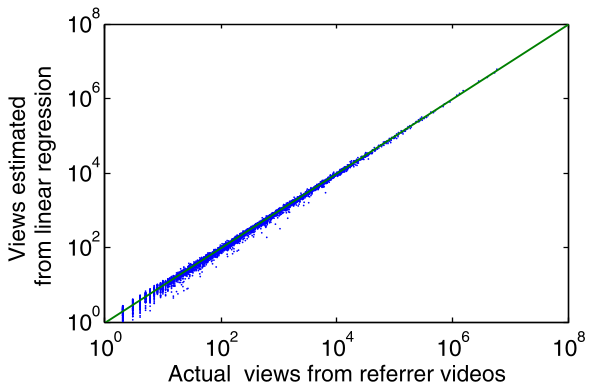
The paper introduces a fascinating contrast in temporal patterns. By tracking videos over 53 days, they applied linear regression to view growth.
1. Persistence (Search & Recommendations)
These sources are "Persistent." If a video gets 100 views/day from recommendations today, it will likely get 100 views/day next month. The growth is Linear ().
2. The Highlight Trap
Contrary to the "viral video" dream, being "Featured" or "Embedded" on a major site follows a Fast Decrease pattern. Over 90% of those views happen in the first two weeks. Most shockingly, the study found that Highlights do not increase the long-term view rate once the event ends. You don't "level up" your permanent growth just by going viral once.
Why is the Recommendation Sidebar so Stable?
The authors dug into the "Referrer Video Set." They discovered that:
- Referrer Stability: The list of videos that link to yours is incredibly stable ( change per day for older videos).
- Position Power: Being in the top 1-3 spots on a sidebar offers a Click-Through Rate (CTR) of over 10%, which drops to at the bottom.
- The Key Driver: The single most important factor for your video’s success isn't your own keyword—it's the popularity of the videos that link to you.
Critical Analysis & Takeaways
The "Recommendation as Equalizer" Paradox
This paper offers a powerful counter-narrative to the idea that algorithms are purely detrimental to diversity. Because YouTube’s related videos are based on "Co-viewing" (Users who watched X also watched Y), it creates a web of relevance that allows niche content to thrive in the "Related" section of a mainstream hit.
Strategic Implications:
- For Creators: Don't chase the "Homepage Highlight" as your only strategy. It’s a short-term sugar high. Focusing on "Related Video" SEO—getting your video suggested next to a steady, popular evergreen video—is the key to long-term sustainability.
- For Platforms: This proves that session-based local graphs (Relatedness) are better for ecosystem health than global popularity filters.
Limitations
The study is based on 2014-2016 data. Since then, YouTube has shifted from co-viewing session graphs toward deep neural networks (RNNs/Transformers) that incorporate much more "watch time" signal and cross-session history, which may have altered the "Equalizing" effect observed here.
Conclusion
YouTube is not just a search engine; it is a giant, interconnected graph. While Search gets you found by those who know what they want, the Recommendation system ensures that the "Long Tail" of human interest remains visible, preventing total dominance by a few viral giants.