
@Britney to Advertise Gangnam Style: A Cross-Network Strategy for Video Promotion
YouTube Video Promotion by Cross-Network Association: @Britney to Advertise Gangnam Style
This paper introduces a novel cross-network collaborative framework to promote YouTube videos by identifying influential Twitter "followees" (referrers). It leverages a three-stage process involving heterogeneous topic modeling and a unique user-bridged association mechanism to map YouTube content to Twitter influence, significantly outperforming traditional semantic matching.
TL;DR
How did "Gangnam Style" become a global phenomenon? A key factor was strategic promotion by Twitter influencers like Britney Spears. This paper formalizes that intuition by proposing a technical framework that automatically identifies the best Twitter "followees" to promote specific YouTube videos. By bridging the gap between YouTube's semantic content and Twitter's social graph using a shared user base, the system identifies referrers who don't just have followers, but have the right followers.
The "Broken" Internal Discovery
YouTube's internal discovery (search and front page) follows a power-law distribution: the "rich get richer," while millions of high-quality videos languish in the "truncated tail." Meanwhile, Twitter offers a fast-diffusion followee-follower structure. The challenge is: How do we link a video defined by pixels and tags to a Twitter user defined by their social network?
Current methods fail because:
- Heterogeneous Space: No direct link exists between a video ID and a Twitter handle.
- Granularity Discrepancy: YouTube is about specific topics (e.g., "K-Pop"), while Twitter followers are often categorized by general demographics.
Methodology: Bridging the Gap via Overlapped Users
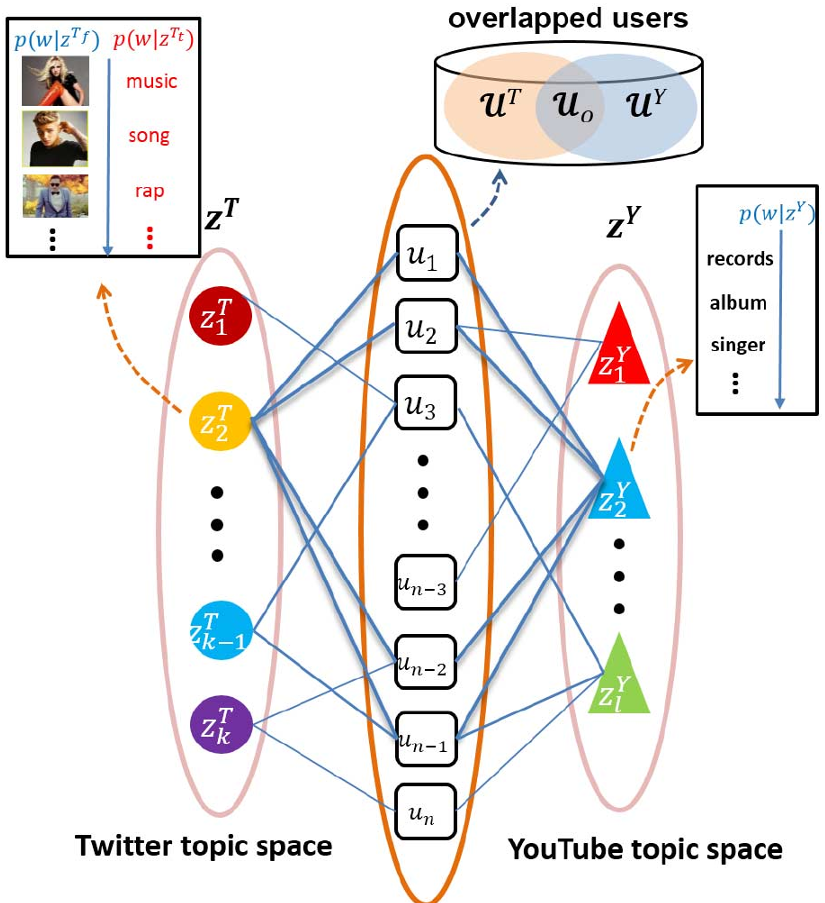
The core innovation is the User-Bridged Association. The authors noticed that many people use both platforms. If we know what a group of "overlapped users" likes on YouTube and who they follow on Twitter, we can build a bridge.
1. Heterogeneous Topic Modeling
The framework first projects both platforms into a latent topic space:
- YouTube: Uses iCorr-LDA (inverse Correspondence LDA) to link visual keyframes and textual tags.
- Twitter: Dual-track modeling. One track focuses on Semantics (what they tweet) and the other on Network (who they follow).
2. Latent Attribute Association (LA)
Instead of a simple linear mapping, the authors use Latent Attribute Discovery. They assume that a user's behavior on both platforms is driven by the same underlying attributes (age, location, interests). By forcing the representations of overlapped users to share the same coefficients in both spaces, the model learns to "translate" a YouTube interest profile into a Twitter following pattern.
Experimental Insights: Network vs. Semantics
Using a massive dataset of 2.2 million videos, the study yielded some fascinating results about how we consume social media.
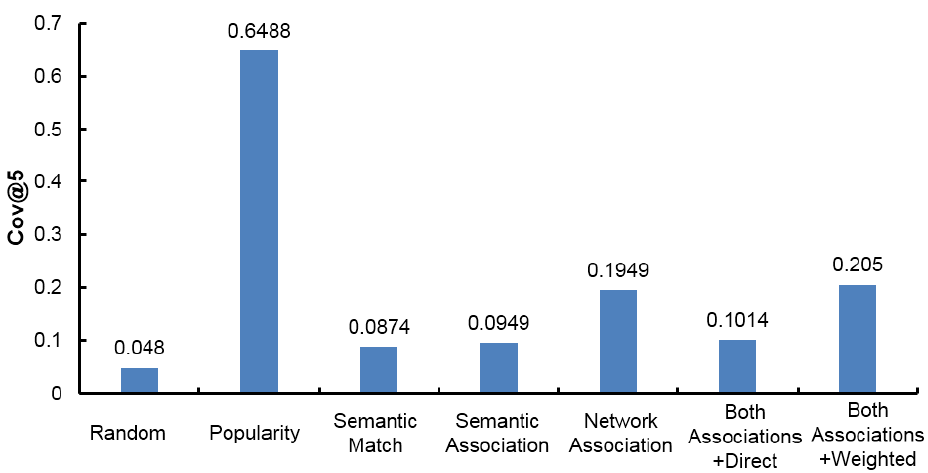
- The Power of the Graph: "Network Association" significantly outperformed "Semantic Association." This tells us that who you follow is a much more stable indicator of your interests than what you tweet. Tweets are noisy; social connections are intentional.
- Performance Gains: The "Both Associations + Weighted" model (using Ranking SVM) achieved the best balance between precision and recall (NDCG).
Critical Analysis: Why This Matters
The most impressive part of this work is its Visual-Semantic consistency. As shown in the paper's visualization, the model successfully associated game-related YouTube topics with official game developers on Twitter, and even geographic topics (German-speaking users) based on shared location.
Limitations:
- Follower Overlap: The current model evaluates followees individually. In a real campaign, hiring two influencers with 90% follower overlap is inefficient.
- Cost Dynamics: While the model includes a "virtual cost" (precision/recall balance), real-world influencer pricing is more volatile.
Conclusion
This paper moves beyond simple keyword matching. It treats the social web as a unified ecosystem where user identity bridges the gap between different content types. For marketers and researchers, the takeaway is clear: to promote content effectively, don't just look at what people are saying—look at the latent structures of who they are followed by.