
ZenCrowd: Bridging the Gap Between Machine Scale and Human Precision in Entity Linking
ZenCrowd: Leveraging Probabilistic Reasoning and Crowdsourcing Techniques for Large-Scale Entity Linking
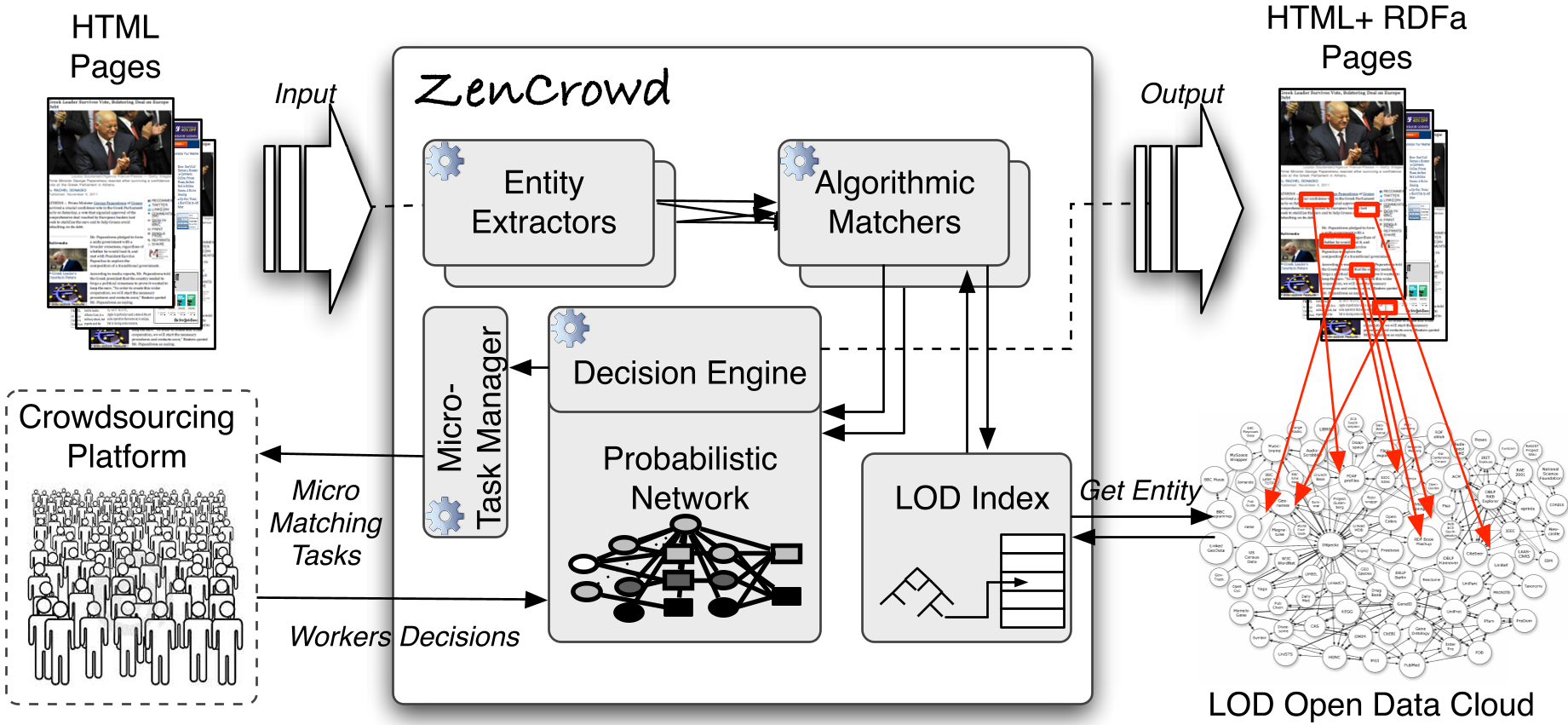
ZenCrowd is a hybrid entity linking system that combines automated algorithmic matching with human intelligence via crowdsourcing. It successfully connects natural language entities to the Linked Open Data (LOD) cloud by using a probabilistic framework to adjudicate uncertain links and assess worker reliability.
Executive Summary
TL;DR: ZenCrowd is a pioneer system in "Human-in-the-loop" AI. It addresses the entity linking problem—connecting text strings like "Fribourg" to specific URIs in the Linked Open Data (LOD) cloud—by combining automated probabilistic reasoning with micro-tasks performed by the crowd.
In the landscape of 2012, this work served as a bridge between rigid algorithmic matching and expensive manual curation. It stands as a seminal example of how to use Factor Graphs to resolve conflicts between noisy machine outputs and inconsistent human feedback.
The Core Problem: The Scalability-Precision Tradeoff
The web is moving from a "Web of Documents" to a "Web of Data." To make this transition, we need to link text molecules (entities) to a structured backbone (the LOD cloud). However, two major hurdles persist:
- Algorithmic Limits: Machines struggle with disambiguation (e.g., is "Washington" the state, the city, or the person?).
- Manual Limits: Human experts provide high quality but cannot keep up with the millions of news articles generated daily.
ZenCrowd asks: Can we use machines for the bulk of the work and selectively "summon" the crowd only when the machine is uncertain?
Methodology: High-Stakes Probabilistic Reasoning
ZenCrowd doesn't just ask the crowd to vote; it treats them as probabilistic variables within a Factor Graph.
1. The Factor Graph Architecture
The system maps three distinct entities into a unified graph:
- Links (): The candidate URIs from DBPedia, Freebase, etc.
- Workers (): Human agents with varying degrees of reliability.
- Clicks (): The observed actions taken by workers.
2. Semantic Constraints
What makes ZenCrowd unique is that it injects LOD-specific logic into the math:
- SameAs Constraints: If two URIs are linked by an
owl:sameAsrelation, the system forces them to have the same "correctness" probability. - Unicity Constraints: If a dataset (like Wikipedia) guarantees unique entries, the system penalizes configurations where more than one link from that dataset is marked as correct.
3. Fighting Spammers
The system uses an Expectation-Maximization (EM) process. It doesn't just judge the link; it simultaneously judges the worker. If a worker consistently disagrees with high-confidence links or semantic constraints, their "reliability prior" drops, and their subsequent votes carry less weight.
Experimental Insights: Does the Crowd Really Help?
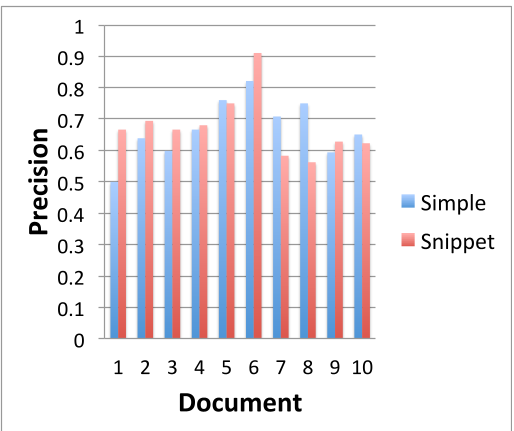
The authors evaluated ZenCrowd against 489 entities across global and local news.
Key Findings:
- Precision Supremacy: ZenCrowd achieved a precision of 0.80-0.84 with US workers, significantly higher than purely automatic methods.
- Worker Geography Matters: Interestingly, worker reliability varied by context. Indian workers were more accurate on Indian local news, while US workers excelled on global news.
- Diminishing Returns: Adding too many workers actually decreased accuracy because the pool of "good" workers is limited. The sweet spot was found to be 4-5 reliable workers.
Critical Analysis & Conclusion
Takeaway
ZenCrowd's real value isn't just in "linking entities"—it’s in the Decision Engine. By treating human feedback as a "noisy signal" rather than an "absolute truth," it creates a robust framework for managing data quality at scale.
Limitations
The primary bottleneck is latency. While the machine components take milliseconds, the "human components" take minutes or hours. This makes ZenCrowd unsuitable for real-time streaming data unless a massive, always-on crowd is maintained.
Future Outlook
In the era of LLMs, the "manual matching" performed by the crowd might soon be replaced by "LLM agents." However, the probabilistic framework proposed in ZenCrowd remains relevant: we still need a way to adjudicate between a "Base Model" (algorithmic) and an "Expert Model/Human" (micro-tasks) when they disagree.