
Zero-Coding UMAP: Empowering Marketers with Scalable Predictive Analytics
9845_Zero-Coding UMAP in Marketing A Scalable Platform for Profiling and Predicting Customer Behavior by Just Clicking on the Screen.
This paper demonstrates the Arm Treasure Data Customer Data Platform (CDP), a zero-coding solution for marketing professionals to perform large-scale customer profiling and predictive analytics. The platform enables non-experts to execute complex User Modeling, Adaptation and Personalization (UMAP) tasks through a GUI-based workflow powered by a scalable big data backend.
TL;DR
The Arm Treasure Data Customer Data Platform (CDP) bridges the gap between complex User Modeling (UMAP) and practical marketing execution. By providing a GUI-driven, zero-coding environment, it allows marketers to profile customer behavior and predict future actions (like churn or conversion) without writing a single line of code, all while maintaining enterprise-level scalability.
The Gap Between Algorithms and Application
In the academic world, User Modeling, Adaptation and Personalization (UMAP) often focuses on complex neural architectures. However, in the enterprise sector, the biggest bottleneck isn't the lack of algorithms—it's the technical barrier. Marketers, who possess the deepest domain insight, are often sidelined because they cannot navigate the complexities of Spark, SQL, or Python-based machine learning pipelines.
The author's insight is clear: to make UMAP viable for business, we must prioritize explainability, scalability, and accessibility over algorithmic complexity.
Methodology: The Architecture of Accessibility
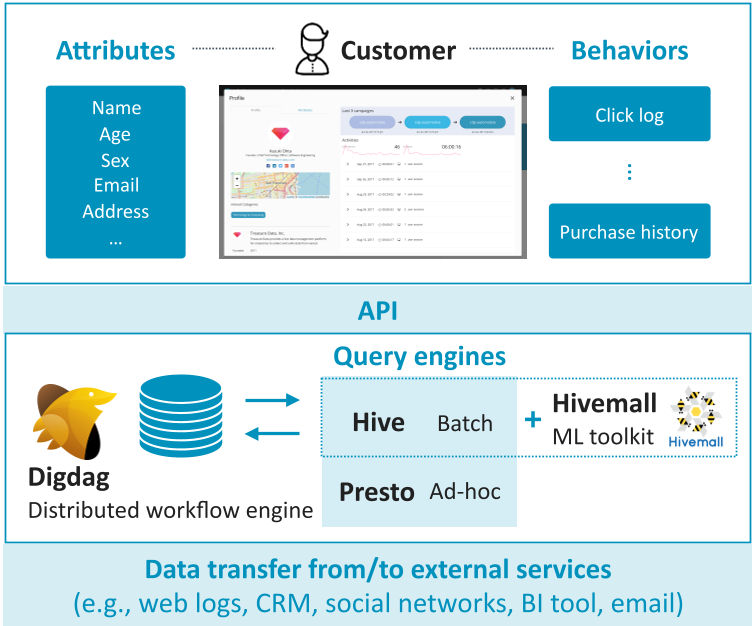
The platform is built on a robust two-layer architecture designed to handle massive data while presenting a simple facade to the user.
1. The Data Management Layer (Back-end)
The system leverages a stack of open-source big data tools:
- Digdag & Presto/Hive: For workflow orchestration and distributed query processing.
- Hivemall: A machine learning library for Spark/Hive that allows for scalable predictive modeling.
2. The Interaction Layer (Front-end)
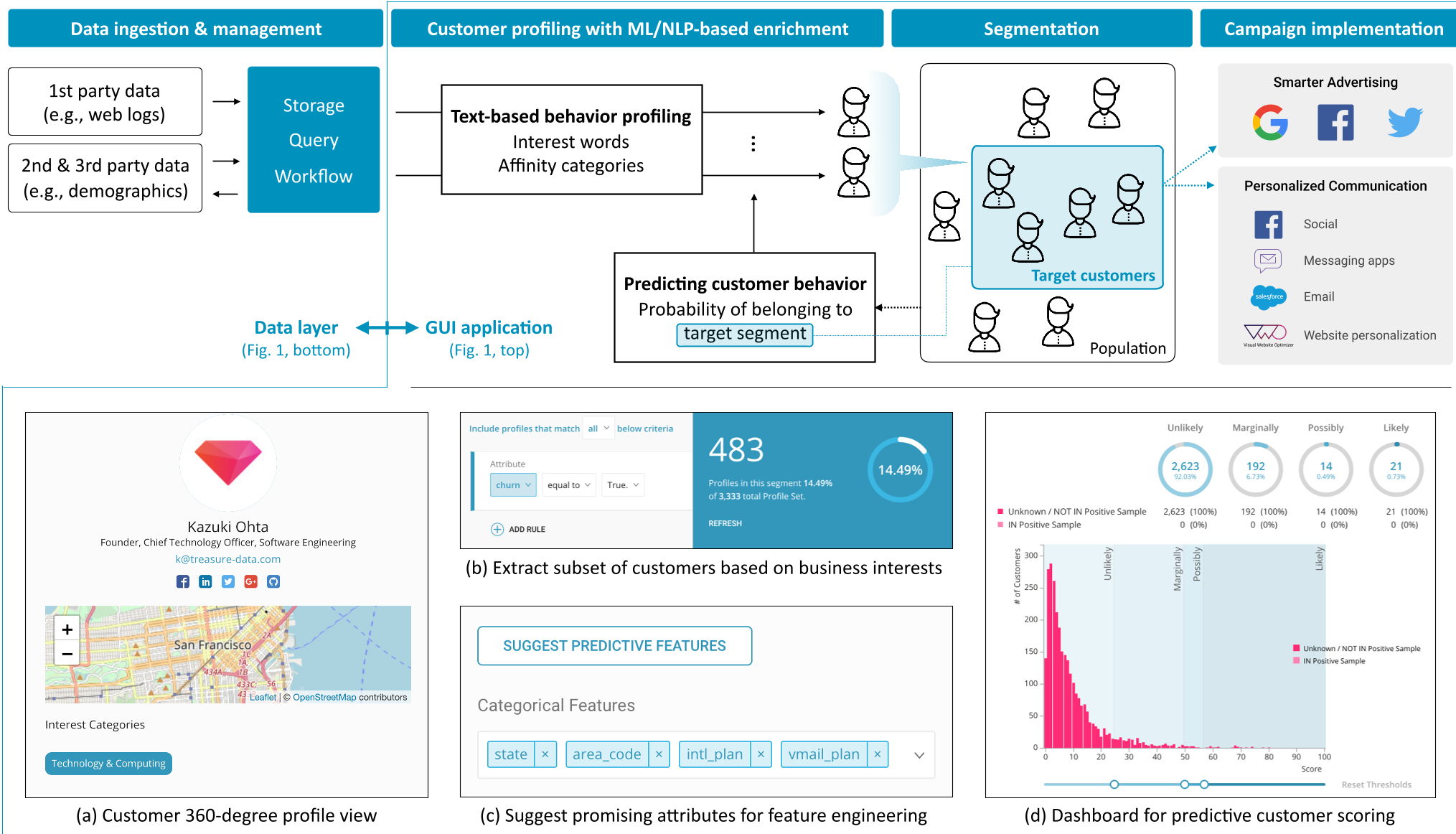
This is where the "Zero-Coding" magic happens. The platform automates three core tasks:
- Text-based Profiling: Instead of complex embeddings, it uses a deterministic TF-IDF weighting and a word-to-category mapping derived from Wikipedia to turn web page titles into "Interest Words."
- Predictive Customer Scoring: It treats behavior prediction as a binary classification problem.
- Automated Feature Engineering: The system suggests features based on single-column profiling, significantly reducing the manual labor usually required in ML projects.
Real-World Impact: From Profiles to Predictions
The workflow described in the paper moves from raw data to actionable marketing campaigns:
- Unified Profiles: Aggregating static and behavioral data into a single view.
- Segmentation: Marketers define groups (e.g., "Dormant Customers") using simple filters.
- Predictive Scoring: The system identifies customers likely to fall into a target segment before they actually do.
For instance, a marketer can identify which users are likely to stop using a service (Churn Prediction) and trigger a reactivation campaign automatically.
Critical Insight & Future Outlook
While the paper focuses on relatively "conventional" techniques like TF-IDF and binary classification, this choice is intentional. For a CDP, determinism and speed are more valuable than the marginal accuracy gains of a "black-box" deep learning model.
The true value of this work lies in its Inductive Bias toward the User. It demonstrates that "Productized AI" is as much about the interface and the data pipeline stability as it is about the underlying model.
Future Directions: The author suggests that the next frontier is making these models even more "interactive" and "explainable"—potentially moving toward topic modeling and clustering that marketers can tweak in real-time. In the age of LLMs, one could imagine this evolving into natural language interfaces where a marketer simply asks, "Show me customers interested in sustainable fashion," and the CDP handles the rest.
Conclusion
The Arm Treasure Data CDP sets a benchmark for how academic UMAP concepts can be distilled into high-value enterprise tools. By removing the coding barrier, it puts the power of predictive analytics directly into the hands of those who know the customers best.