
Bridging the Data Gap: How Knowledge Graphs Power Zero-shot and Few-shot Learning
Zero-shot and Few-shot Learning with Knowledge Graphs: A Comprehensive Survey
This paper provides a comprehensive survey of Knowledge Graph (KG)-aware Zero-shot Learning (ZSL) and Few-shot Learning (FSL). It systematically categorizes over 90 papers into paradigms like mapping-based, data augmentation, and propagation-based methods, highlighting KGs as a pivotal auxiliary information source to mitigate sample shortage.
TL;DR
Deep learning is notoriously data-hungry, but what happens when labels are non-existent or scarce? This survey explores the synergy between Knowledge Graphs (KGs) and Sample Shortage learning. By representing classes as nodes in a structured graph (WordNet, ConceptNet, or custom ontologies), researchers can transfer "wisdom" from seen to unseen categories, achieving SOTA performance in Image Classification, QA, and KG Completion.
Background Positioning: The Academic Coordinate
This work serves as a significant map of the field, moving beyond the "what" of ZSL/FSL to the "how" of structured induction. While many models view classes as independent labels, this survey treats them as part of a rich, relational ecosystem.
Problem & Motivation: Why Text and Attributes Aren't Enough
Prior work in ZSL/FSL relied heavily on attributes (e.g., "has a tail") or unstructured text (e.g., Wikipedia descriptions).
- Attributes suffer from annotation cost and lack of relational complexity.
- Text is often noisy and ambiguous.
- KGs solve this by providing formal semantics. They capture hyponyms (Is-A), part-whole relationships, and logical constraints (disjointness) that allow a model to "triangulate" what an unseen class looks like based on its neighbors in the graph.
Methodology: The Four Pillars of KG-aware Learning
The authors categorize the landscape into four technical paradigms:
1. Mapping-based Paradigm (The Alignment)
This is about finding a common "meeting ground." Models like SAE or Devise project input features (images/text) and KG-based class embeddings into a shared vector space.
- Insight: If a "Zebra" is close to "Horse" and "Stripes" in the KG space, the visual model should expect the features to be mathematically adjacent.
2. Propagation-based Paradigm (The Information Flow)
Using Graph Convolutional Networks (GCNs), models propagate classifier parameters or class beliefs through the KG.
- Architecture Insight:
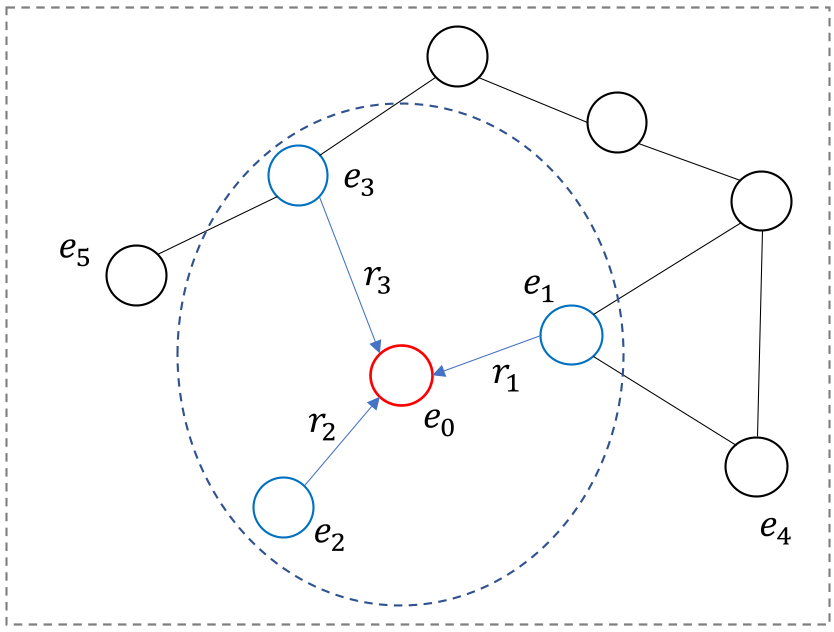 Figure: Propagating information from seen entities to unseen ones using graph structures.
3. Data Augmentation (The Hallucination)
When you don't have real samples, you make them. KG-aware GANs generate pseudo-features for unseen classes conditioned on their KG location.
- Approach: Feed the KG embedding and noise into a Generator to synthesize features that a standard classifier can then use for training.
4. Class Feature Paradigm (The Fusion)
This paradigm treats the KG as a source of "raw" features that are fused with input features (e.g., BERT text embeddings + TransE KG embeddings) before going into a final scoring function.
Experiments & Results: SOTA Across Tasks
The survey highlights that for Zero-shot Image Classification, utilizing WordNet hierarchies effectively creates "pathways" for feature transfer.
 Table: Categorization of KG-aware learning paradigms across CV and NLP.
Key benchmarks like AwA2 and ImageNet-FS reveal that:
- Graph Structure matters: Multi-relational GCNs outperform simple taxonomy-based approaches.
- Ontologies reduce bias: Adding logical constraints (like class disjointness) prevents the model from being over-biased towards frequent seen classes.
Critical Analysis & Conclusion
Takeaways
The marriage of KGs and ZSL/FSL is not just a trend but a necessity for robust AI in fields like medicine (where rare diseases have few samples) and specialized industrial contexts.
Limitations
- KG Quality: Most models assume the KG is a "perfect truth." In reality, KGs can be noisy or incomplete.
- Computational Complexity: Processing massive KGs like Wikidata alongside high-dimensional images creates a bottleneck.
Future Outlook
We are moving toward Neuro-Symbolic integration. The next step is likely the marriage of Large Language Models (LLMs) with symbolic KGs to create models that have both the "associative power" of transformers and the "logical rigor" of knowledge graphs.