
[ICLR 2025] HyperAgents: Scaling Recursive Self-Improvement Beyond Code
Hyperagents
The paper introduces HyperAgents, a framework for recursive self-improvement that integrates a task-solving agent and a meta-level modification agent into a single, editable program. By instantiating this as DGM-Hyperagents (DGM-H), the authors achieve SOTA open-ended self-improvement across diverse non-coding domains like robotics and math grading.
TL;DR
HyperAgents represent a breakthrough in the quest for "recursive self-improvement." Unlike previous systems that use a fixed "meta-agent" to improve a "task-agent," HyperAgents merge both into a single editable program. This allows the AI to not only get better at a task (e.g., math or robotics) but also improve its own ability to improve, discovering meta-strategies like persistent memory and performance tracking autonomously.
Background Positioning: This work evolves the Darwin Gödel Machine (DGM) from a coding-specific optimizer into a general-purpose, open-ended discovery engine. It sits at the intersection of Auto-ML, Meta-Learning, and Open-Endedness.
The Bottleneck of Handcrafted Meta-Logic
Most "self-improving" AI systems today are actually "half-improving." They usually consist of:
- A Task Agent: The code that actually does the work.
- A Meta-Agent: A fixed set of instructions or a frozen LLM prompt that tries to optimize the Task Agent.
The problem? The Meta-Agent's logic is never updated. If the Meta-Agent is bad at diagnosing why a robotics reward function failed, the whole system hits a ceiling. The paper identifies this as a lack of metacognitive self-modification. For self-acceleration to occur, the "optimizer" must be as plastic as the "optimized."
Methodology: The Architecture of a HyperAgent
The core innovation is the HyperAgent—a self-referential program where the task execution logic and the modification logic are one and the same.
How it works:
- The Archive: DGM-H maintains a "forest" of agent versions. It doesn't just keep the best one; it keeps a population of "stepping stones."
- Metacognitive Loop: When an agent is selected to "reproduce," it looks at its own source code, its previous evaluation logs, and its "memory" files. It then writes a new version of its entire directory.
- Self-Editing Meta-Logic: Crucial to this paper is that the agent can edit its
meta_agent.py. It can give itself new tools, better analysis scripts, or even a better "reasoning" prompt for how to evaluate its own failures.
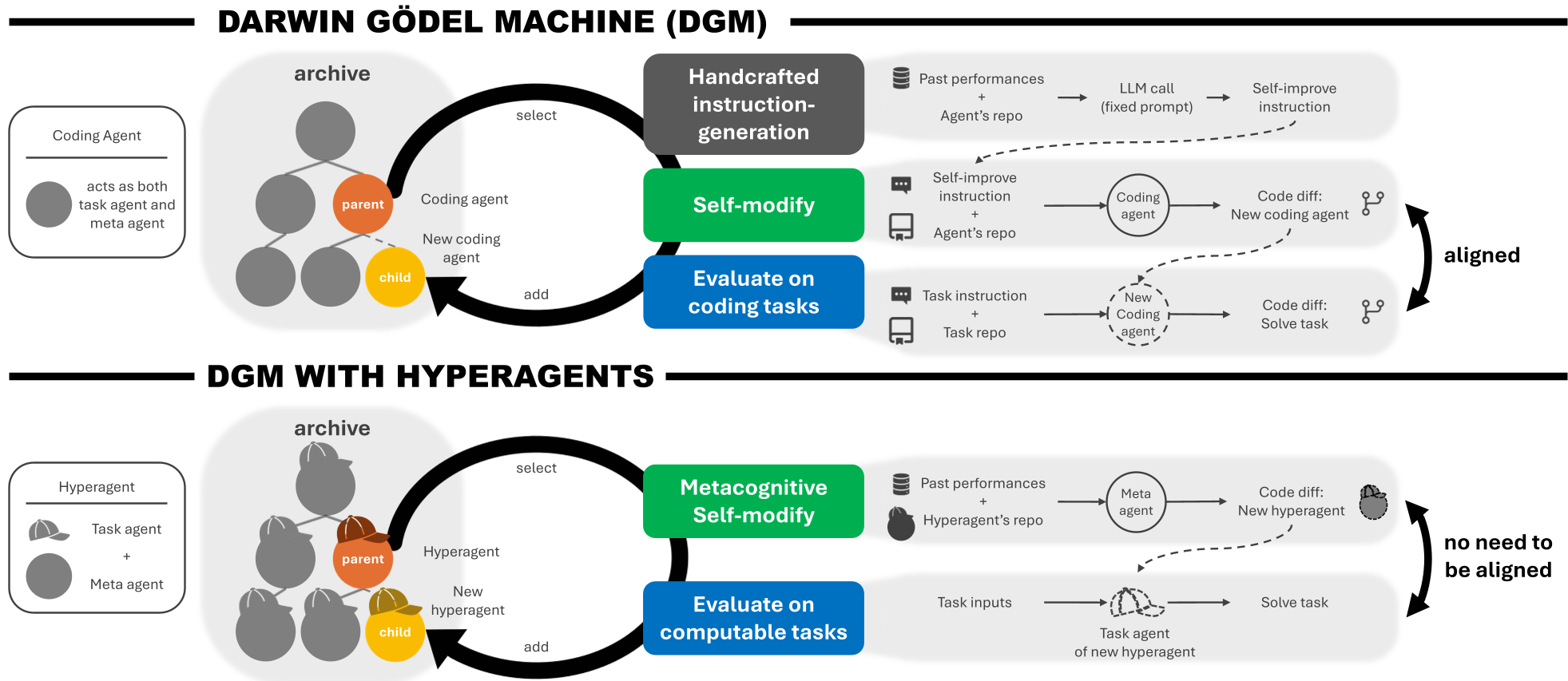 Figure 1: Evolution from fixed DGM (top) to the self-referential DGM-H (bottom).
Emergent Meta-Capabilities: Learning How to Learn
Perhaps the most fascinating result isn't the task performance, but the infrastructure the agents built for themselves. Without being told to, the HyperAgents developed:
- Persistent Memory: A
memory.jsontool to store "lessons learned" across generations (e.g., "Gen 55 was too harsh, need to balance critiquing with fairness"). - Performance Trackers: Automated Python classes to graph their own success rates and detect when a new edit caused a regression.
- Bias Detection: Logic to identify if they were "collapsing" into always rejecting or always accepting papers.
Experimental Results: True Cross-Domain Transfer
The authors tested DGM-H on Paper Reviewing, Robotics (Genesis simulator), and IMO-level math grading.
Key Highlight: The Transfer Test To prove the agents learned general improvement skills, the authors took a HyperAgent optimized for Robotics and dropped it into a Math Grading task.
- The Result: The "Robotics-optimized" meta-logic was significantly better at improving a math grader than the original "out-of-the-box" meta-logic. It had learned the process of improvement.
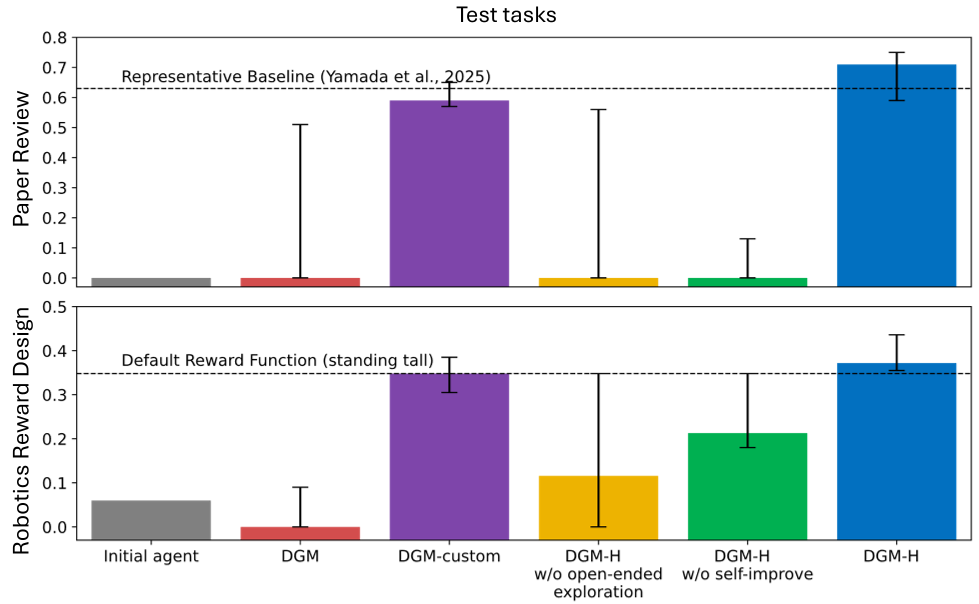 Figure 2: Consistent performance gains across diverse domains compared to non-self-referential baselines.
In the math domain, the agent discovered a 4-category classification rubric that boosted accuracy on the IMO-GradingBench from 56% to 60%, outperforming human-designed prompts.
Critical Analysis & The Path to Superintelligence
While the results are impressive, the authors are transparent about limitations:
- Fixed Outer Loop: The "Parent Selection" (deciding which agent to branch from) was mostly fixed. When they allowed the agent to modify parent selection, it recreated classic algorithms like UCB (Upper Confidence Bound) but didn't drastically exceed human-tuned versions yet.
- Safety: Recursive self-modification is the textbook definition of a safety risk. The paper emphasizes the use of sandboxing and resource limits.
Conclusion
HyperAgents prove that open-ended self-improvement isn't just for coding anymore. By allowing an AI to own its "improvement machinery," we move closer to systems that can autonomously conduct research and engineering, potentially leading to a "self-accelerating" takeoff in AI capabilities—contingent on our ability to keep them safely sandboxed.