
This Letter presents a novel approach to reconstruct the scale-invariant inflationary bispectrum shape $S(x, y)$ directly from Cosmic Microwave Background (CMB) data using a logarithmically-binned estimator. Applying this method to Planck PR4 maps, it enables high-resolution measurements across the full triangle configuration plane, achieving an efficient comparison between theory and observation in milliseconds.
TL;DR
Researchers have developed a "Shape-Space" reconstruction tool that allows us to see the three-point correlation function of the early universe in 2D. Instead of waiting hours to test a single inflationary model against Planck data, this new framework can test over 20,000 models in under a second. While no new particles were definitively found, this opens a high-speed "collider" for the very early universe.
Perspective: From Template Matching to Shape Reconstruction
In the study of Cosmic Microwave Background (CMB), we search for Primordial Non-Gaussianity (PNG)—the subtle "non-randomness" in the early universe's heat map. Traditionally, scientists used a "key and lock" approach: they would pre-calculate a theoretical "key" (a template) and see if it fits the data.
The problem? There are thousands of possible "keys" (models of inflation), and checking each one is computationally grueling. This paper flips the script by reconstructing the Shape Function $S(x, y)$ directly. This is akin to moving from trying every key in a lock to simply taking a high-resolution 3D scan of the lock itself.
The Problem: The Curse of Dimensionality & Scale Invariance
The bispectrum $B_\zeta(k_1, k_2, k_3)$ depends on three momenta, creating a massive 3D configuration space. However, many theories of inflation are scale-invariant, meaning the physics only depends on the ratios of the triangle sides ($x = k_1/k_3, y = k_2/k_3$).
Previous methods (like KSW estimators) were optimized for specific models but were "blind" to the general morphology of the data. If a signal existed that didn't match a pre-defined template, we might miss it.
Methodology: Logarithmic Binning in Shape-Space
The author utilizes the PolySpec package to implement a logarithmically-binned estimator. By working in log-space, the estimator naturally captures the "Squeezed Limit" ($x \ll y \approx 1$), which is the holy grail for detecting massive particles during inflation (the Cosmological Collider).
Architecture of the Estimator
The core innovation lies in the projection of 3D configurations into a 2D plane through the assumption of de Sitter symmetry.
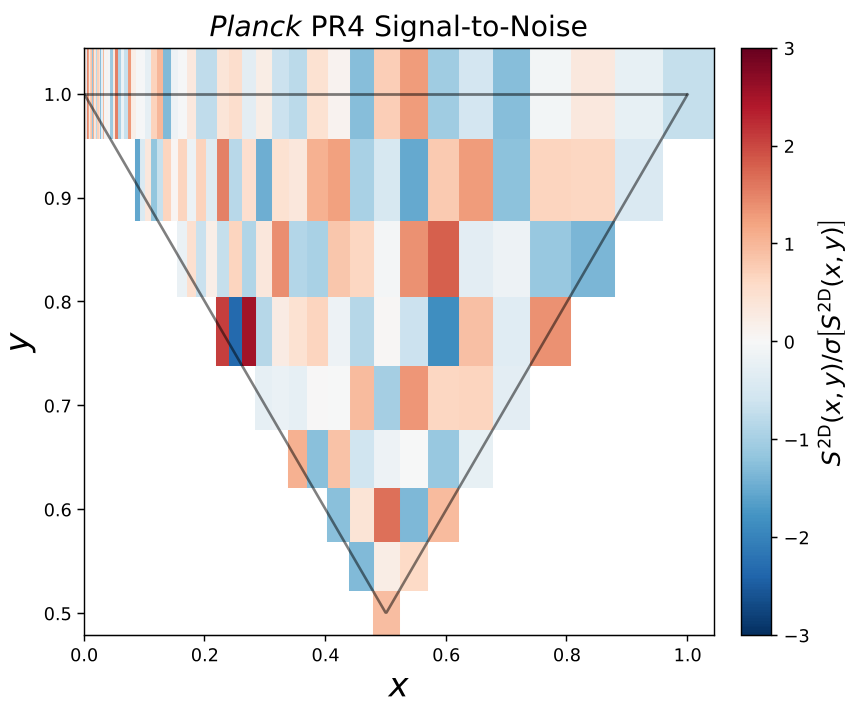 Fig 1: The signal-to-noise ratio (top) and the empirical error (bottom) of the reconstructed 2D shape from Planck PR4 data. The similarity in error magnitude across the plane demonstrates the robustness of the binning strategy.
Experimental Results: The Final Verdict on Planck
The application to Planck PR4 data represents the most comprehensive model-independent constraint on scale-invariant PNG to date.
- Visual Consistency: The reconstructed maps show mostly noise, with a $\chi^2$ of 175.9 for 171 degrees of freedom—consistent with the standard $\Lambda$CDM model.
- Cosmological Collider Search: The author used these measurements to constrain the exchange of massive particles with spin 0, 1, and 2.
- Efficiency: While calculating the 171 triangle configurations once for the data took several hours, testing the 20,000+ theoretical models against those configurations took a mere 0.6 seconds.
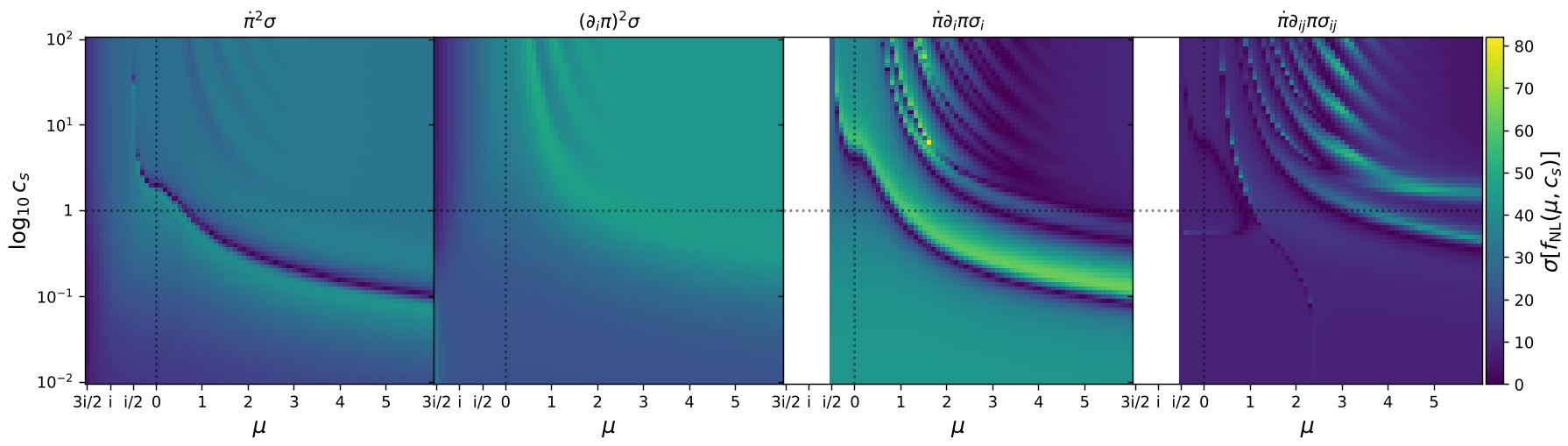 Fig 2: Constraints on theoretical templates as a function of mass ($\mu$), sound speed ($c_s$), and spin. The "ridges" and "peaks" show the sensitivity of the Planck data to different exchange interactions.
Deep Insight: Why it Works
The "magic" here is the use of exact bootstrap methods for the templates. Previous studies used simplified approximations for "collider" oscillations. This paper uses the full, wavy, non-factorizable shapes.
The fact that the binned estimator matches optimal specialized estimators within 10% suggests that we haven't lost much "information" by compressing the data into bins. This 10% sacrifice is a small price to pay for a thousand-fold increase in interpretability and speed.
Conclusion & Future Outlook
This Letter provides the tools to move toward a "Particle Spectrograph" of the early universe. By providing a common "shape-space" for all experiments:
- Simons Observatory & CMB-S4: Will use this to zoom into the squeezed limit with much lower noise.
- Large-Scale Structure: Could potentially use the same bins to combine galaxy surveys with CMB maps.
The inflationary paradigm is no longer just a set of equations; it's a data-driven map we can now visualize and interrogate in real-time.