
[CVPR 2026] VideoSeek: Toward Human-Like Efficient Video Reasoning via Logic-Guided Seeking
VideoSeek: Long-Horizon Video Agent with Tool-Guided Seeking
VideoSeek is a long-horizon video agent designed for efficient video-language understanding. It replaces exhaustive frame parsing with a "think–act–observe" loop that actively seeks answer-critical evidence using a multi-granular toolkit, achieving SOTA performance on benchmarks like LVBench and Video-MME while using significantly fewer frames.
TL;DR
VideoSeek is a breakthrough long-horizon video agent that mimics human behavior by "seeking" rather than "watching" everything. By leveraging a think–act–observe loop and a multi-granular toolkit, it outperforms massive models and dense-parsing agents on benchmarks like LVBench and Video-MME while consuming as little as 1/300th of the frames used by competitors.
Problem & Motivation: The "Dense Parsing" Bottleneck
In the race to conquer long-form video understanding, the industry has hit a wall: Computational Cost. Most current SOTA models attempt to "brute-force" video understanding by densely sampling frames (e.g., 2 FPS) and feeding thousands of tokens into a context window.
The authors of VideoSeek observe an interesting paradox: Over 80% of questions in long-video benchmarks can be answered by seeing less than 5% of the frames. Humans don't watch an hour-long movie to find a specific detail; we skip, skim, and zoom. VideoSeek was born to bring this "Logic Flow" navigation to AI agents.
Methodology: The Think-Act-Observe Loop
VideoSeek treats video understanding as a trajectory-based reasoning problem. Instead of a single-pass inference, it operates in a loop:
- Thought: The LLM (GPT-5) analyzes what it knows so far and what is missing.
- Action: It selects a tool from its specialized toolkit to get more evidence.
- Observation: The tool returns new visual data, which is added to the "memory" (trajectory).
The Multi-Granular Toolkit
The secret sauce lies in its three-tier tool design:
<overview>: Rapid scan of the whole video (e.g., 16 frames) to build a storyline map.<skim>: Low-cost probing of 10-minute intervals to check for relevant events.<focus>: High-resolution (1 FPS) inspection of short clips to find fine-grained evidence (like a specific face or text).
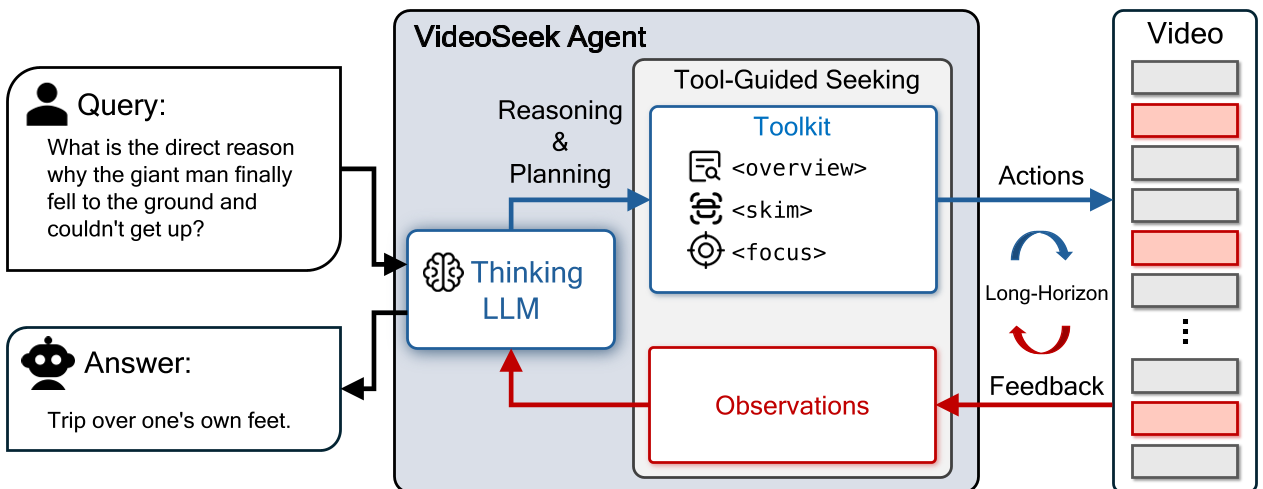 Figure 1: The agentic loop guides the model from a global overview to specific, answer-critical moments.
Experiments: SOTA with Sparse Vision
The results on LVBench and Video-MME are striking.
- Efficiency: On LVBench (with subtitles), VideoSeek achieved 76.7% accuracy using only 27.2 frames. For comparison, the DVD agent used 8,074 frames to achieve a similar 76.0% score.
- Reasoning Power: Even without subtitles, VideoSeek improved upon GPT-5 by +8.3 points while using only 24% of the frames.
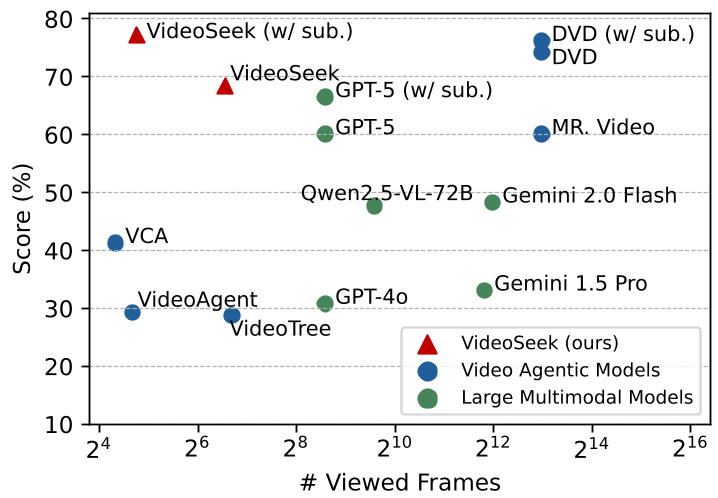 Figure 2: Accuracy vs. Frame Usage. VideoSeek (the red triangle) sits at the top-left corner, signifying high accuracy with ultra-low frame consumption.
Critical Insights: Why Does It Work?
- Logic Flow is Key: When subtitles are available, VideoSeek's frame usage drops further while performance increases. This suggests the agent uses the "textual storyline" as a map to navigate the visual space.
- The "Thinker" Matters: Swapping GPT-5 for smaller models like
o4-miniorGPT-4.1led to massive accuracy drops (up to -15.4 points). An agent is only as good as its ability to plan and judge sufficiency. - Intermediate Reasoning: Analysis shows that the gains aren't just from "choosing better frames" but from the accumulated reasoning within the conversation history, which acts as a structured memory.
Conclusion & Future Outlook
VideoSeek demonstrates that Active Seeking is the future of scalable video AI. By moving away from greedy, dense parsing, we can handle hour-long videos on standard hardware.
Limitations: The authors admit the agent might struggle with "surprising moments" (e.g., a car crash that happens without any logical buildup) because it relies on predictable logic flows. However, as a framework for long-form understanding and multimodal assistants, VideoSeek sets a new standard for efficiency and intelligence.