
The paper introduces AAC (Architecturally Admissible Compressor), a differentiable landmark selection module for the ALT (A*, Landmarks, Triangle inequality) shortest-path framework. By using a row-stochastic Gumbel-softmax architecture, it yields an admissible heuristic for any parameter setting, matching state-of-the-art expansion reduction while enabling end-to-end training.
TL;DR
AAC (Architecturally Admissible Compressor) is a novel neural module that makes the selection of "landmarks" in A* search differentiable. Unlike previous neural heuristics that "hope" to be admissible through loss penalties, AAC is admissible by architecture. It guarantees optimal paths at any point during training and reduces to a classical, efficient ALT heuristic at deployment, achieving up to 1.5x speedups in real-world road networks.
The Problem: The Admissibility vs. Differentiability Paradox
In the world of shortest-path planning, ALT (A*, Landmarks, and Triangle inequality) is a gold standard for admissible heuristics. It precomputes distances to key "landmarks" to provide a lower bound on travel costs.
However, the field has been split into two camps:
- Classical Algorithms: Use Farthest-Point Sampling (FPS) to pick landmarks. They are provably safe (admissible) but "blind"—they don't adapt to specific traffic patterns or query clusters.
- Neural Methods: Learn powerful heuristics backpropagated from data. They are adaptive but "unsafe"—they often overestimate distances, leading to suboptimal paths, and enforcing admissibility usually requires clunky loss-function "hacks" that aren't 100% reliable.
Methodology: Admissibility by Construction
The author, An T. Le, asks: Can we make selection itself differentiable and admissible by architecture rather than by loss?
AAC solves this by posing selection as a row-stochastic compression problem. It starts with a large pool of "teacher" landmarks and uses a Gumbel-softmax layer to learn which ones are most useful.
The Secret Sauce: AAC relies on a classical insight from Judea Pearl (1984): any convex combination (a weighted average where weights sum to 1) of admissible heuristics is itself admissible. Because AAC's selection matrix is row-stochastic, the output is guaranteed to be a valid lower bound—no matter how messy the training or how unexpected the query.
 In directed graphs, AAC uses dual matrices to handle forward and backward distances independently.
Experiments: Hitting the "FPS Ceiling"
The paper introduces a rigorous matched-memory protocol, comparing AAC to the industry-standard FPS-ALT by ensuring both use the exact same number of bytes per vertex.
Key Findings:
- The FPS Ceiling: On road networks, the standard FPS strategy is remarkably hard to beat. The paper proves (Theorem 5) that FPS achieves near-optimal coverage, leaving only about 1-4% of "headroom" for any neural selector to improve upon.
- Speed Advantage: Even when AAC expands slightly more nodes than FPS, it is often 1.2x to 1.5x faster in wall-clock time. This is due to its contiguous memory layout, which plays nicely with modern CPU caches.
- Zero Violations: Across 1,500+ queries and multiple datasets (DIMACS, OSMnx), AAC recorded zero admissibility violations, even during early training or after training divergence.
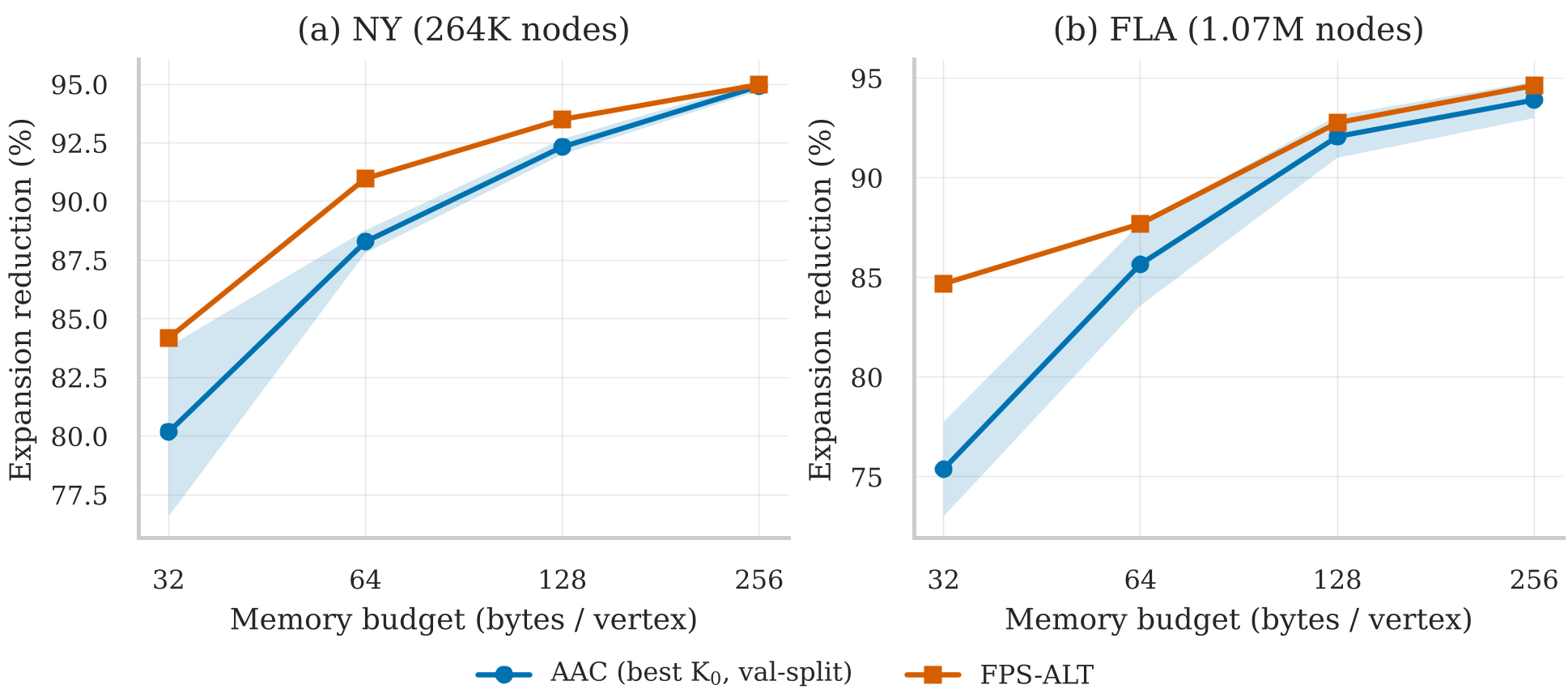 Pareto frontier showing AAC tracking the FPS-ALT performance curve closely while remaining differentiable.
Deep Insight: Training Drift
A fascinating finding in the paper is the "Binding Constraint." It turns out the architecture could perfectly replicate FPS, but standard training often drifts away from the optimal FPS subset. This suggests that the next frontier in neural search isn't just about different model types, but better initialization and optimization strategies that respect the geometry of the search space.
Conclusion
AAC provides a "best of both worlds" solution. It gives researchers a differentiable pathway to integrate search heuristics into larger neural pipelines (like Warcraft terrain cost prediction) while giving engineers the "peace of mind" of a hard-coded admissibility certificate.
As AI moves deeper into safety-critical domains like autonomous robotics and logistics, architectures that are "Safe-by-Design" like AAC will likely become the new standard.