
The paper introduces a numerical bootstrap framework for contracting tensor networks beyond one dimension by casting the process into a convex optimization problem. Using translationally invariant Matrix Product States (MPS) as a proof-of-principle, the authors utilize Second-Order Cone (SOC) and Semidefinite Programming (SDP) relaxations to obtain certified lower and upper bounds on physical observables.
TL;DR
Researchers have developed a new numerical bootstrap framework that transforms the notoriously difficult task of tensor-network contraction into a convex optimization problem. Unlike traditional methods that provide a single "best guess," this approach yields certified lower and upper bounds, providing a rigorous "safety net" for calculating physical observables in complex quantum systems.
Context: The Approximation Dilemma
In the world of quantum many-body physics, Tensor Networks (TNs) like Matrix Product States (MPS) and Projected Entangled Pair States (PEPS) are essential tools for representing high-dimensional wavefunctions. However, a fundamental wall exists: while 1D networks are easy to contract, higher-dimensional networks with loops are exponentially hard to solve exactly.
Current SOTA methods, such as Corner Transfer Matrix (CTM) or Tensor Renormalization Group (TRG), are "approximate." They work brilliantly in practice but offer no mathematical guarantee of how far the result is from the ground truth. This paper asks: Can we trade the search for a single approximate value for a guaranteed range of possible values?
Methodology: The Bootstrap Intuition
The authors propose a "dual" perspective. Instead of trying to find the exact state of the "environment" (the part of the network surrounding a site), they define the space of all possible valid environments.
1. From Linear Maps to Optimization
The contraction is viewed as a positive linear map that propagates boundary conditions toward the center. Since any physical boundary state must be positive semidefinite (), the environment at the target site is constrained. We can then find the minimum and maximum expectation values of an operator by optimizing over this set.
2. Relaxation: SOC and SDP
Since the exact set of boundaries is too large to handle, the authors use relaxations:
- SOC (Second-Order Cone): A simpler geometric constraint (like a Bloch ball) used when the MPS is in a canonical form.
- LMI (Linear Matrix Inequality): A more general constraint used for non-canonical forms, solved via Semidefinite Programming (SDP).
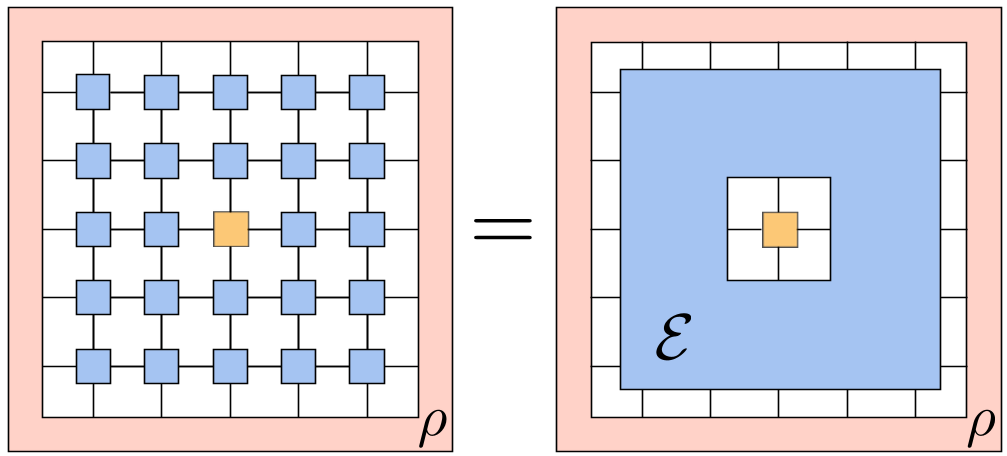 Figure 1: Illustration of how the surrounding tensor network acts as a linear map on boundary conditions.
Key Results: Tightening the Noose
The framework was tested on translationally invariant MPS. The results demonstrate that as you include more "layers" of the network (increasing ), the bounds on the observable expectation values shrink rapidly.
- Geometric Convergence: In the canonical case, the "Bloch ball" of allowed states evolves into a tiny hyper-ellipsoid, pinpointing the exact value.
- Precision: For random MPS at bond dimension , the upper and lower bounds converge to the true value as the system size increases.
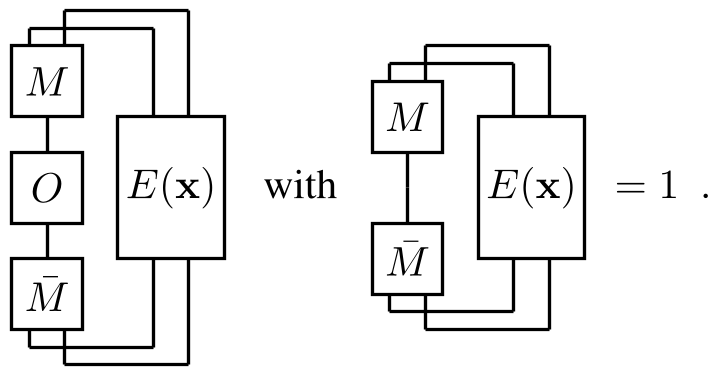 Figure 2: Numerical bounds for a random MPS. The gap between the maximum and minimum certified values vanishes as the boundary distance increases.
Critical Insights & Future Outlook
The beauty of the Numerical Bootstrap is its additivity. You can combine different constraints (spatial, symmetry-based, etc.) to further tighten the bounds.
Limitations
- Non-uniqueness: The method fails to provide tight bounds for states like the GHZ state, where the expectation value depends inherently on the choice of boundary conditions (breaking of ergodicity in the transfer matrix).
- Computational Cost: While polynomial, SDP is significantly heavier than simple power-method contractions.
The Path Forward
The ultimate frontier is extending this to 2D PEPS. The authors have laid the groundwork by showing that "marginal-problem-like" conditions can define the environment. If scaled successfully, this could lead to the first "certified" library of quantum phases, where every simulation comes with a rigorous error bar—a holy grail for computational condensed matter physics.
Conclusion
This work represents a vital bridge between rigorous mathematical optimization and practical numerical physics. By shifting from "point estimation" to "set estimation," we gain the ability to trust numerical results in regimes where exact solutions are impossible.