
The paper introduces "AI-Holography," a novel framework that applies discretized analogues of holographic string dualities (AdS/CFT) to AI tasks. By mapping particle trajectories on edge-labeled graphs (like Cayley graphs) to discrete strings on dual polygons, the authors demonstrate that complex word metrics and graph diameters can be computed as geometric areas and lattice point counts (Ehrhart quasi-polynomials).
TL;DR
This research establishes a formal bridge between theoretical physics and AI by proposing AI-Holography. It posits that AI tasks (like pathfinding or language modeling) are equivalent to predicting particle trajectories on graphs, which admit a dual description as discrete strings on geometric shapes. By applying the "Complexity = Volume" principle, the authors prove that computing hard combinatorial distances is equivalent to measuring the area under a dual curve.
Background: The Latent Space as a Holographic Bulk
In the second superstring revolution, the AdS/CFT correspondence revealed that a gravity theory in a bulk (AdS) is dual to a gauge theory on its boundary (CFT). CAYLEYPY-4 takes this intuition to the AI domain.
- Boundary (Graph Side): Particles moving on Cayley graphs (representing tokens in a text or moves in a game).
- Bulk (String Side): Discrete strings moving inside planar polygons.
The core insight is that embeddings—the latent representations we use in LLMs—are actually holographic images. Finding a "good embedding" is equivalent to finding a tractable dual string description where "semantic similarity" becomes a simple geometric measurement.
Implementation: Complexity = Area/Action
The authors utilize the guiding principle from Susskind and others: Complexity = Volume. In graph theory, the complexity of a state is the length of its shortest path from the identity (word metric). In the dual holographic world, this length is exactly the area under the corresponding lattice path (the "string").
The Lehmer Code and ROC Curves
The paper uses the ROC curve (a standard ML metric) as a prime example of a holographic string. A binary vector (graph node) maps to a monotonicity lattice path (string) in a rectangle. The area under the ROC curve (AUC), which measures model quality, is dual to the Mann-Whitney U-statistic, which represents the particle's "gate complexity" on the graph.
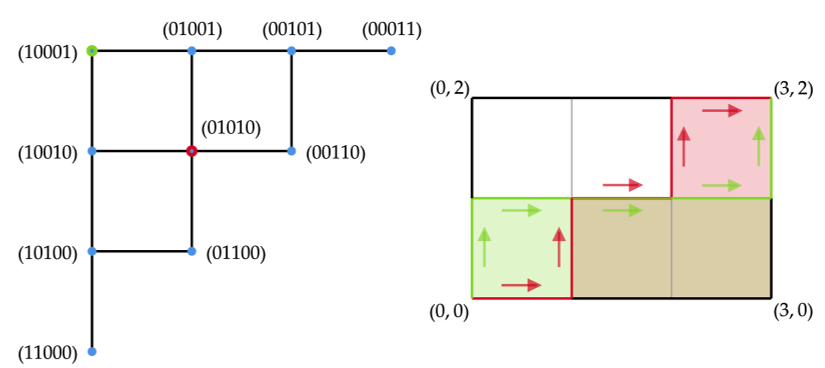 Figure 1: Mapping graph vertices (left) to lattice paths in a polygon (right) where distance equals area.
Methodology: The CayleyPy AI Pipeline
Determining these dualities is non-trivial. The authors developed a high-performance AI library, CayleyPy, to solve this:
- Brute Force: BFS for small $n$ to identify the "God's number" (diameter).
- Pattern Recognition: Identify the "longest elements" (states farthest from the origin).
- AI Pathfinding: Use RL and neural heuristics to find optimal paths for $n > 30$.
- Quasi-polynomial Fitting: Fit the generated data to Ehrhart quasi-polynomials, which count lattice points in scaled polygons.
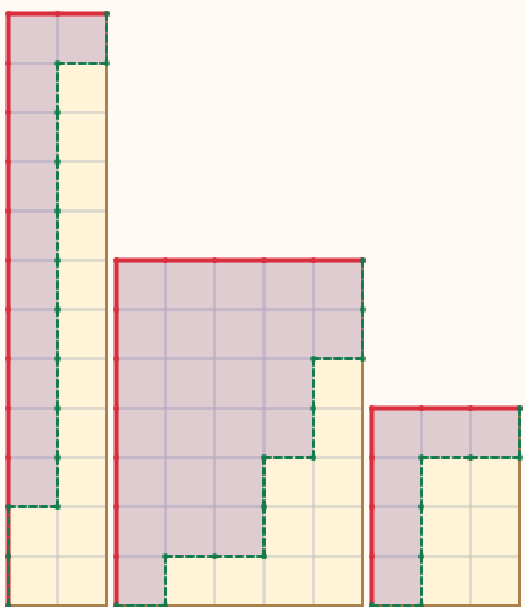 Figure 2: Multiset permutations mapped to a union of rectangles. The bubble-sort distance between states is exactly the area difference between their dual polygons.
From Particles to Conformal Field Theory (CFT)
The paper goes beyond simple geometry. It proves that the graph Laplacian of these Cayley graphs is identical to the Hamiltonian of the Heisenberg XXX spin chain.
- In the large $n$ limit, these systems converge to a Conformal Field Theory (CFT).
- The authors conjecture that the spectrum of conformal dimensions in the AI model is equal to the spectrum of the Laplacian on the dual polygon.
- This provides a rigorous way to think about LLM "attention" and "context" as physical interactions between spins in a chain.
Critical Analysis & Conclusion
Impact
The value of this paper lies in its movement toward a First-Principles Theory of AI. Instead of treating neural networks as black-box approximators, it frames them as physical systems obeying holographic laws. The discovery that diameters are quasi-polynomials provides a powerful tool for estimating the computational limits of any discrete system (like Rubik's cube or protein folding).
Limitations
Currently, the "Planar Polygon" duality is proven only for certain classes of $S_n$ graphs. Natural languages (English) or complex games (Go) likely require higher-dimensional dual objects (3D or more) and perhaps non-Euclidean metrics.
Future Outlook
The authors suggest that we should stop trying to "fire the linguist" and instead "bring linguists together with string theorists." By incorporating the structural constraints of string theory into AI architecture, we may build models that learn with higher efficiency—matching the orders-of-magnitude faster learning speed of the human brain compared to current LLMs.