
This paper introduces a standardized phase-fixing framework for spin-weighted spheroidal functions (SWSFs), essential for black-hole perturbation theory. It proposes the Spherical-Limit (SL) phase-fixing scheme as a universal default to resolve inherent phase ambiguities, ensuring consistency across the Quasinormal Mode (QNM) and Total-Transmission Mode (TTM) spectra within the Kerr geometry.
TL;DR
In the realm of black-hole perturbation theory, the Spin-Weighted Spheroidal Functions (SWSFs) are the "alphabet" used to describe how fields ripple around a rotating black hole. However, these functions have a hidden "phase ambiguity"—they can be rotated in the complex plane without changing their fundamental nature. This paper by Cook and Wang argues that we've been too sloppy with this phase. They propose a new standard, the Spherical-Limit (SL) scheme, which ensures that these functions remain mathematically smooth and physically consistent, providing a much-needed foundation for the next generation of gravitational wave astronomy.
Background: Why the Phase Matters
When a binary black hole merger occurs, the final remnant black hole "rings" like a bell. This ring-down signal is composed of Quasinormal Modes (QNMs). To extract physics from these modes (like the black hole's mass and spin), researchers use SWSFs.
While the amplitude of these modes is widely studied, the phase contains untapped information about the progenitor system (e.g., the mass ratio or initial spins). If our mathematical basis (the SWSFs) has jumping or discontinuous phases, we cannot reliably extract this physical information.
The Problem: The "Default" is Broken
Most researchers rely on built-in numerical solvers like Mathematica’s Eigensystem. These solvers pick a phase based on which component of a vector is largest.
The authors demonstrate that this "largest component" can change abruptly as the black hole's spin ($a$) or the mode frequency changes. This leads to discontinuities—sudden, non-physical jumps in the data—and a failure to satisfy basic mathematical symmetries.
Methodology: The Spherical-Limit (SL) Fix
The authors propose a "Return to Roots" approach. At the limit of zero rotation ($c=0$), SWSFs become standard Spin-Weighted Spherical Harmonics, which have well-defined, real properties at the equator.
核心机制 (Core Mechanism):
- Normalization: Ensure the integral of the function's magnitude squared is 1.
- Equatorial Alignment: Force the function $S(x; c)$ to be real at the equator ($x=0$).
- Sign Matching: If the function is naturally zero at the equator, shift the requirement to its derivative.
- Sequence Tracking (PSL-C): Instead of re-calculating the "best" label at every step, the algorithm "follows" the mode as the parameters evolve, ensuring the phase doesn't flip by 180 degrees unexpectedly.
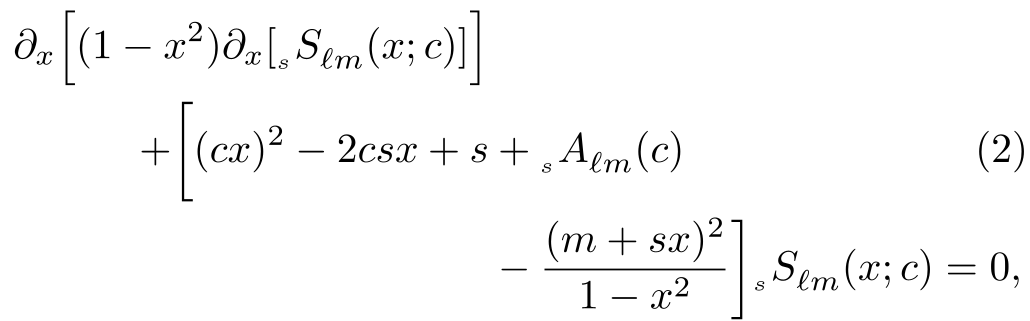 The Angular Teukolsky Equation: The foundation for defining SWSFs.
Experiments: Crossing the "Eigenvalue Graveyard"
The paper tests this scheme on high-overtone modes ($n=31$) and Total-Transmission Modes (TTMs). These are historically difficult because their "eigenvalues" (labels) cross each other frequently.
Key Result: Smoothness Guaranteed
By using the PSL-C (Continuous) choice, the authors show that even when eigenvalues cross, the expansion coefficients of the functions remain perfectly smooth. This is a massive improvement over the "Default" (Math) or even the previous "CZ" (Cook-Zalutskiy) schemes.
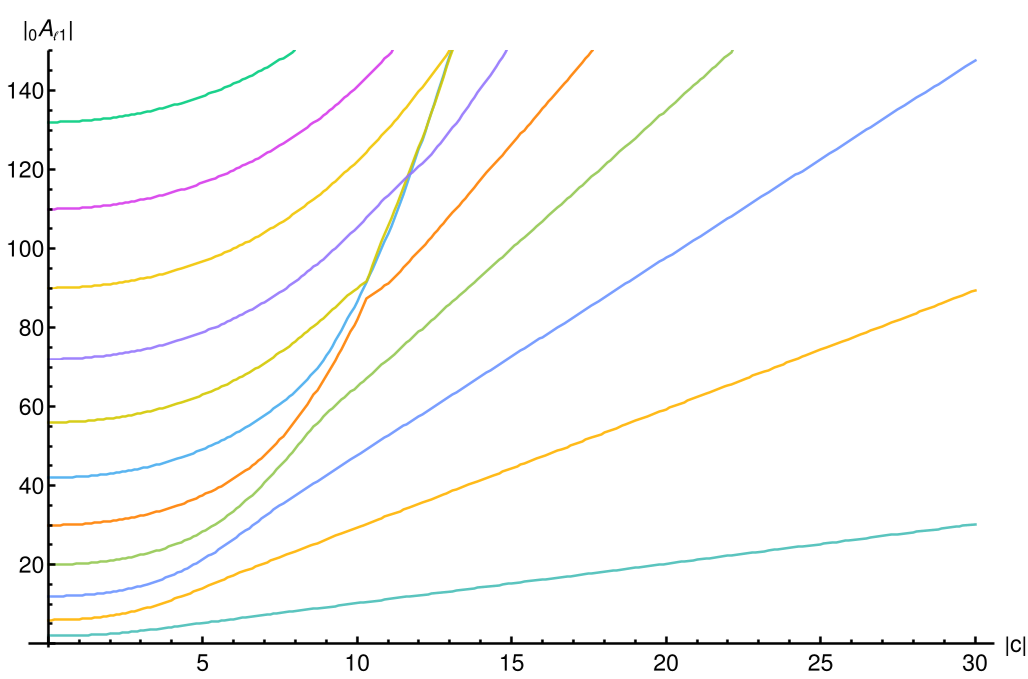 Figure: Eigenvalue crossings for $s=0, m=1$. Notice how sequences intertwine as $|c|$ increases—tracking these is vital for phase consistency.
Conclusion and Future Impact
This work is more than just mathematical housekeeping. By standardizing the phase:
- Interpretable Results: It allows different research groups to compare "phase differences" in ring-down signals accurately.
- Better Data: The authors released a massive HDF5 library of 5,000+ mode sequences, ready for use in LIGO/Virgo/KAGRA data analysis.
- Symmetry: The PSL-C scheme is shown to preserve fundamental symmetries ($s o -s$, $m o -m$) that previous methods violated.
Takeaway: As we enter the era of high-precision gravitational wave spectroscopy, the "phase" is no longer an optional luxury—it's a requirement. The SL scheme is the new gold standard for SWSFs.
Resources
- Code:
SWSpheroidalMathematica Paclet. - Data: Publicly available on Zenodo [10.5281/zenodo.16801267].