
The paper develops a rigorous mathematical framework using algebraic topology and number theory to analyze (co)homological invariants in quantum Low-Density Parity-Check (qLDPC) and Locally Testable Codes (qLTC). It introduces a method to construct explicit logical representatives and compute cup products in sheaf codes, ultimately proving that nearly-good qLDPC codes can support Θ(N) parallel, constant-depth non-Clifford logical gates like CCZ.
Executive Summary
TL;DR: Researchers from Tsinghua University have cracked a major theoretical bottleneck in quantum computing by providing a systematic framework to calculate the (co)homological invariants of sheaf codes. By combining graph lifts, commutative algebra, and Artin's primitive root conjecture, they show that nearly-good qLDPC codes can support a linear number of parallel, constant-depth, non-Clifford logical gates (like CCZ).
Academic Positioning: This work moves beyond the "existence proofs" of good qLDPC codes. It sits at the intersection of Algebraic Topology and Quantum Error Correction (QEC), shifting the focus from code parameters (rate/distance) to the explicit construction of the logical operation space.
1. The Moving Target: Why are Non-Clifford Gates Hard?
In the quest for fault-tolerant quantum computation, staying "good" isn't enough. A code is only as useful as the gates you can run on it. While we recently discovered "good" qLDPC codes (linear distance and constant rate), implementing non-Clifford gates (essential for universal QC) remains the "holy grail."
The problem lies in the complexity of the underlying complexes. In CSS codes, qubits and stabilizers are mapped to cells in a complex. Logical gates correspond to cup products—topological intersections of these cells. In advanced "sheaf codes," where local classical codes are assigned to each cell, the algebra becomes so dense that we couldn't even "see" the logical representatives, let alone compute their intersections.
2. Methodology: Lifting Invariants and Polarized Representatives
The authors tackle this by viewing sheaf codes through the lens of graph lifts and covering spaces.
2.1 The Inductive Lifting Sequence
Instead of building a massive code from scratch, the paper proposes starting with a constant-sized Hypergraph Product (HGP) code. They use a specific sequence of "abelian lifts" to expand this small seed into an infinite family of high-dimensional expanders.
Crucially, they prove that if a small code supports a logical gate induced by a (co)homological invariant, every larger code in the lifted family inherits that same gate.
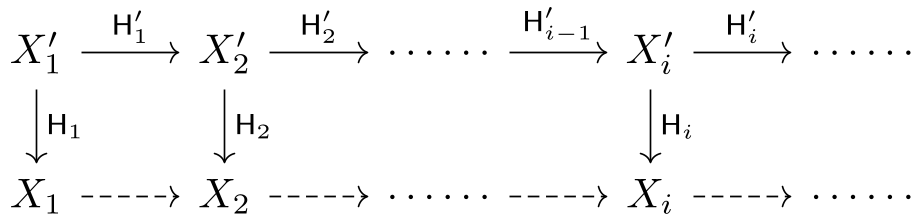 Figure 1: The commutative diagram showing the lifting from HGP codes (top) to high-dimensional expanders/sheaf codes (bottom).
2.2 Polarization through Artin's Conjecture
How do you ensure these logical gates are "addressable" and don't overlap in a messy way? The authors introduce Polarized Logical Representatives. By invoking Artin’s primitive root conjecture (backed by the Generalized Riemann Hypothesis), they prove that for specific prime-length lifts, the logical operators can be "diagonalized."
This means the "topological intersections" (cup products) land on unique, disjoint cubes in the complex, allowing for Θ(N) parallel gate actions.
3. Key Results: Cup Products and Code Parameters
The paper provides the first comprehensive calculation of cup products within the sheaf code framework.
 Equation: The multi-index delta function indicates that the cup product of logical representatives results in a single, addressable t-dimensional cube.
Experimental Comparison (Theoretical Bounds):
| Feature | Standard HGP Codes | Standard Sheaf Codes | This Work (Lifts/Sheaves) | | :--- | :--- | :--- | :--- | | Distance | $O(\sqrt{N})$ | $\Theta(N)$ | $\Theta(N / ext{polylog } N)$ | | Non-Clifford Gates | Possible, low rate | Opaque/Unknown | Linear & Parallel (Θ(N)) | | Circuit Depth | Constant | Constant | Constant (Fault-Tolerant) |
4. Deep Insight: From Sheaves to Product-Expanding Codes
The "magic" happens when you combine Reed-Solomon local codes with high-dimensional expanders. The authors show that the tensor product of these local codes determines the existence of "cycles" ($\xi$) that define the invariant form. This allows them to bypass the Singleton bound limitations that usually plague high-rate codes trying to implement high-order gates.
5. Critical Analysis & Future Outlook
Limitations: The most powerful results (Theorem 1.1) rely on the Generalized Riemann Hypothesis (GRH). While GRH is widely accepted, the "worst-case" behavior of these codes without such number-theoretic regularity remains an open question.
Future Work: This framework opens the door to Magic State Distillation with constant space overhead and almost-logarithmic time. It also provides a bridge to the quantum PCP (Probabilistically Checkable Proofs) conjecture, as the fault-tolerant structures developed here are exactly what's needed to survive the noise levels inherent in PCP proofs.
Conclusion: By proving that we can "lift" logical properties from tiny codes to massive ones, Li et al. have provided a blueprint for building universal, fault-tolerant quantum computers that are not just theoretically "good," but practically "addressable."