
The paper introduces a "conformal bridge" method to evaluate the light transform of QCD correlation functions at higher perturbative orders. By continuing the theory to the Wilson-Fisher fixed point, the authors successfully map local four-point correlation functions to collider correlators (specifically the charge-charge correlation, QQC) at two loops in the back-to-back limit.
TL;DR
Researchers have developed a novel analytical "bridge" that allows the use of Conformal Field Theory (CFT) techniques to solve complex problems in Quantum Chromodynamics (QCD). By shifting the theory to a specific mathematical state called the Wilson-Fisher fixed point, they simplified a two-loop calculation for collider observables that was previously obstructed by the breaking of conformal symmetry in 4D.
Context: The Conformal Crisis in QCD
In the world of high-energy physics, there is a persistent gap between correlation functions (the abstract theoretical descriptions of field interactions) and collider correlators (what we actually measure at the LHC or LEP).
Ideally, we use a tool called the Light Transform to link them. In a perfectly symmetrical (conformal) world, this is elegant. However, QCD—the theory of the strong force—is inherently "messy" beyond the simplest level. As soon as you add loops (quantum corrections), the coupling constant "runs" (scales with energy), destroying the conformal symmetry and causing the Light Transform to break down with mathematical divergences.
The Problem: When Symmetry Breaks
Prior to this work, evaluating the light transform of a four-point correlation function in QCD at two loops was considered nearly impossible using standard CFT machinery. The lack of symmetry meant the correlator depended on six complex variables, and the detector limit triggered logarithmic divergences that didn't exist in simpler theories like $\mathcal{N}=4$ Supersymmetric Yang-Mills.
Methodology: Building the Conformal Bridge
The authors' "Aha!" moment came from the Wilson-Fisher fixed point. By moving from 4 dimensions to $d = 4 - 2\epsilon$ dimensions, they found a critical value where the QCD $\beta$-function becomes zero.
1. The "Variable Drop"
At this fixed point, a miracle occurs: Variable Drop. The renormalized correlation function $R$ simplifies from a function of many spatial variables to a function of just two conformal cross-ratios ($u, v$).
$$R(u, v, \vec{a}, \epsilon^*) \equiv R^{ ext{conf}}(u, v)$$
2. The Sequential Light-Cone (SLC) Limit
The authors focused on the "back-to-back" limit—where particles fly off in opposite directions. They inserted a model architecture that factors the correlation function into jet functions and Wilson loops.
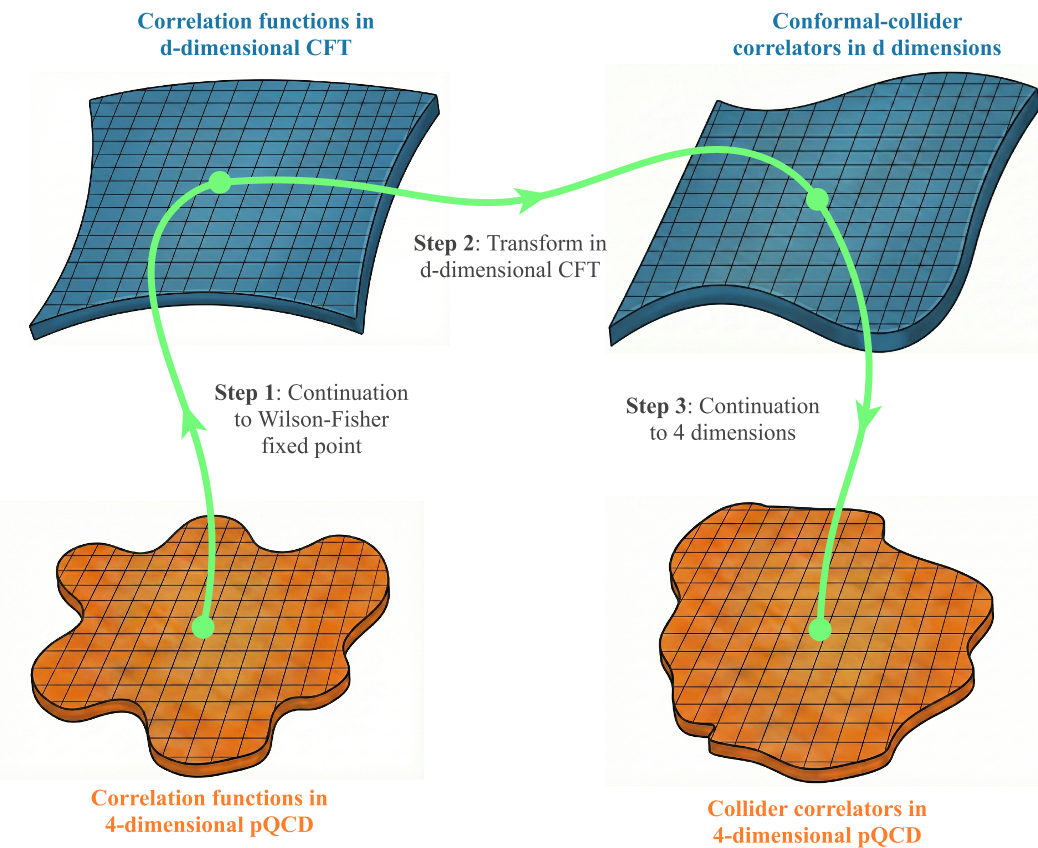 Figure 1: The three-step process: (1) Evaluate CF at the fixed point, (2) Perform Light Transform via CFT, (3) Continue back to 4D using lower-order data.
Two-Loop Results and Validation
The ultimate test was reproducing the Charge-Charge Correlation (QQC). Using the Mack-inspired Mellin representation, the authors mapped the logarithms of the cross-ratios to "plus distributions" (mathematical structures used to handle infrared physics).
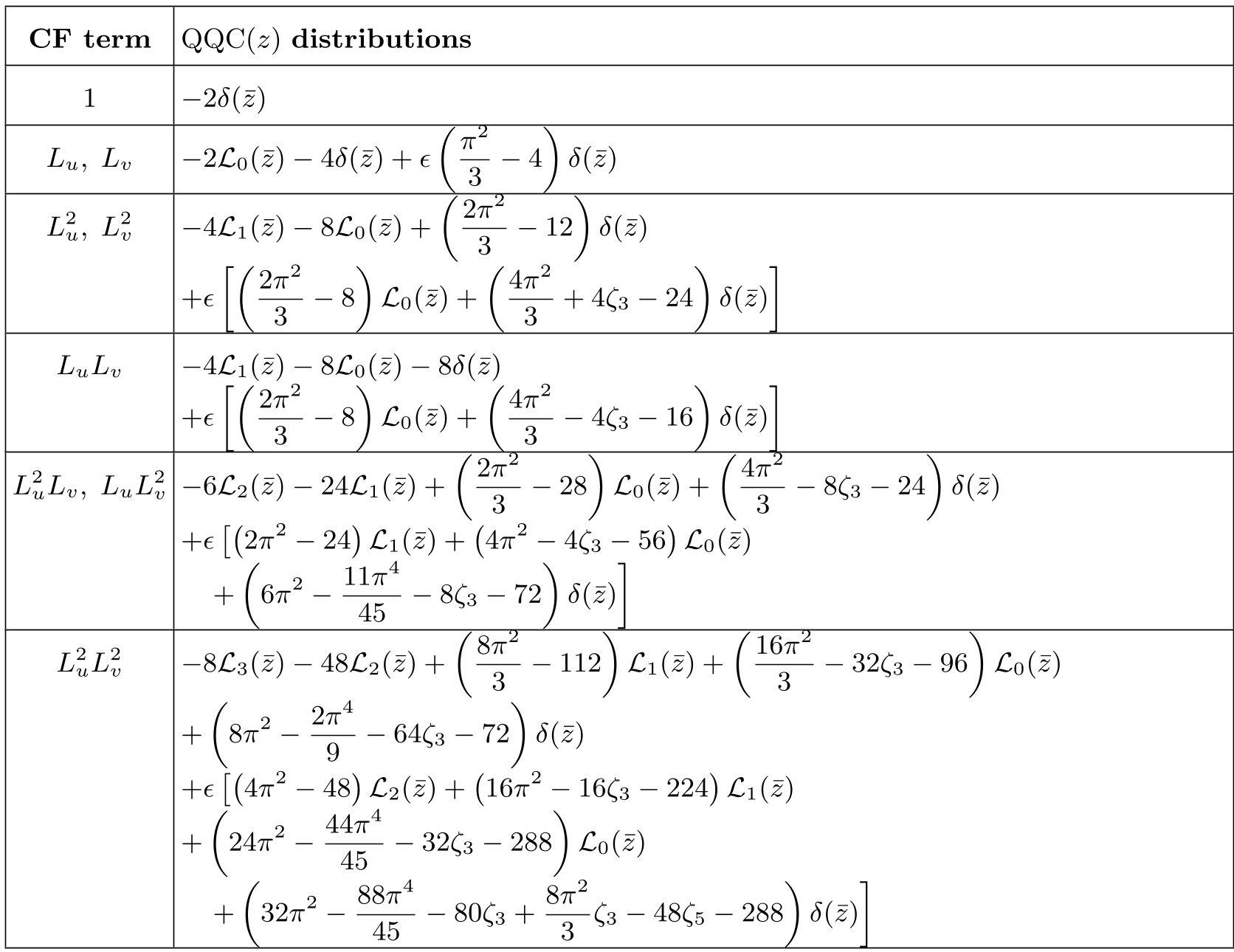 Table I: Mapping between Correlation Function (CF) terms and QQC distribution results.
The Outcome: The 4D calculation matched the results from Soft-Collinear Effective Theory (SCET) exactly. This proves that the "conformal bridge" isn't just a theoretical curiosity—it’s a rigorous, consistent mathematical tool for full QCD.
Critical Insight & Future Outlook
This work proves that even though 4D QCD isn't conformal, it "remembers" its conformal origins. We can use that memory as an organizing principle.
- Advantage: It bypasses the need for massive scattering amplitude evaluations.
- Limitation: Currently verified for the SLC (back-to-back) limit; extension to more complex geometries like the "small angle" or "energy energy" correlators remains for future study.
- Impact: This opens a new frontier for precision physics at future colliders, allowing us to extract more information from the "shower" of particles created in high-energy impacts.
Conclusion
By treating the $4-2\epsilon$ dimension not just as a regularization trick but as a physical destination (the Wilson-Fisher point), the authors successfully applied the "heavenly" mathematics of Conformal Field Theory to the "earthly" reality of QCD colliders.