
This paper introduces a nonperturbative tensor-network framework using Matrix Product States (MPS) to compute cosmological correlators in de Sitter space. It specifically tests the "in-in = in-out" proposal by gluing expanding and contracting Poincaré patches, achieving controlled numerical evidence for the correspondence in 1+1D $\phi^4$ theory and proposing a resolution for perturbative singularities in light fields.
TL;DR
Researchers have developed a nonperturbative framework using Matrix Product States (MPS) to calculate cosmological correlators in de Sitter (dS) space. By simulating 1+1D $\phi^4$ theory, they've provided the first robust evidence that the computationally efficient "in-out" patching method matches the standard "in-in" results, even in "light-field" regimes where standard perturbation theory fails. However, there's a catch: the "mathematical" simplicity of the in-out method comes at the cost of massive entanglement growth, making it a prime candidate for future quantum computers.
Background: The Price of Doubled Propagators
In inflationary cosmology, we typically use the in-in formalism (Schwinger-Keldysh) to calculate observables. It’s a "double-contour" approach: you evolve a state forward from the past to the moment of observation, and then back again. This doubling makes even tree-level calculations a headache.
Recently, a proposal suggested we could use a standard in-out formalism by "gluing" an expanding dS patch to a contracting one. While this looks like flat-space physics on paper, the transition through the gluing point ($\eta=0$) is mathematically singular. Does this proposal hold up when the math gets "heavy" and nonperturbative?
Methodology: Spacetime as a Tensor Network
The authors map the $\phi^4$ scalar theory onto a 1D lattice of anharmonic oscillators.
1. The Regulator Challenge
To avoid the coordinate singularity at $\eta=0$, they introduce a regulator $\eta_0$: $$\Omega_{\mathrm{reg}}(\eta) = \frac{1}{H \sqrt{\eta^2 + \eta_0^2}}$$ This allows the simulation to pass through the "big crunch/bang" of the glued patches without the numbers blowing up.
2. Algorithmic Dualism
They utilize two distinct approaches to ensure accuracy:
- Approach A (TDVP): Uses an adiabatic switching profile for the coupling $\lambda$.
- Approach B (TEBD): Keeps the coupling constant, which is better for probing the extremely small $\eta_0$ (highly singular) regimes.
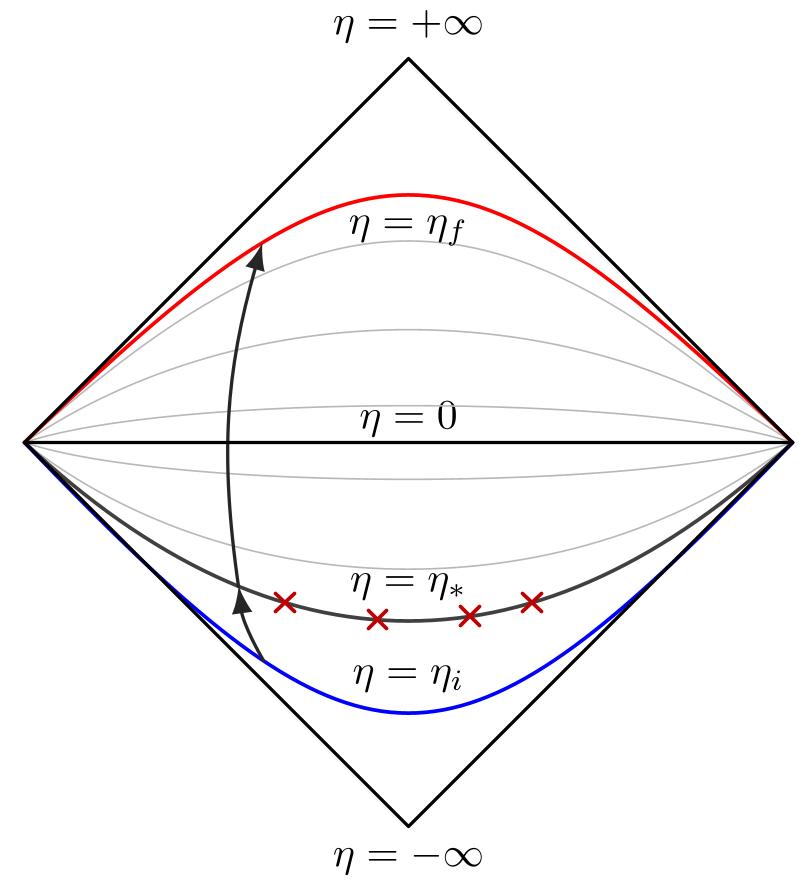 Figure 1: Comparison of the single-patch in-in evolution vs. the glued-patch in-out evolution.
Key Insight: The Entanglement Bottleneck
One of the most profound findings isn't just that the two methods match, but how they differ in their computational "cost."
In the in-in setup, entanglement actually decreases toward late times. Why? Because as the universe expands, the effective mass and potential become "stiff," trapping the wavefunction and making it look more like a simple tensor product.
In the in-out setup, once you pass the gluing slice into the contracting patch, entanglement skyrockets.
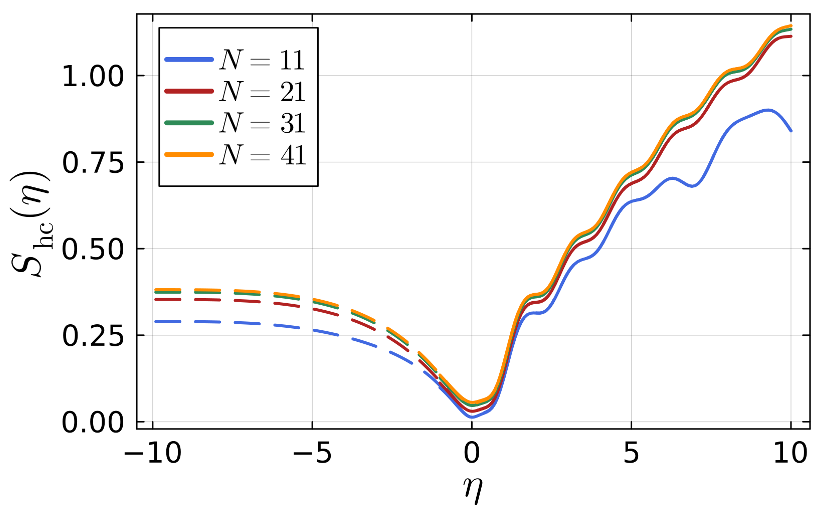 Figure 2: Entanglement entropy ($S_{hc}$) for the bra-state (in-out) vs ket-state (in-in). The in-out branch (solid line in right panel) shows significantly higher entanglement.
Results & Discussion
The Light-Field "Catastrophe" Resolved
For light fields ($m^2 < 3/16 H^2$), perturbative in-out integrals diverge. However, the MPS data shows that nonperturbative interaction effects actually "soften" this singularity. The "real relative error" between the two methods converges to small values (often <1-5%) as the bond dimension $\chi$ increases.
Scaling to 3+1D
The authors demonstrate that by using spherical reduction, they can treat the s-wave sector of a 3+1D universe as an effective 1+1D problem. By matching the "Mukhanov-Sasaki" effective mass, they proved that the same MPS techniques can validly simulate 3+1D physics with "spectral clumping" (where interactions are diluted by the $1/r^2$ spherical measure).
Conclusion: A Roadmap for Quantum Hardware
While MPS works well for heavy fields, the rapid entanglement growth in the light-field in-out formalism creates a "classical bottleneck." This suggests a clear division of labor:
- Tensor Networks: Ideal for in-in calculations and heavy-field benchmarks.
- Quantum Computers: Necessary for the high-entanglement "bra-histories" of light-field in-out correlators.
This work establishes a rigorous, nonperturbative foundation for the next generation of cosmological simulations, proving that the way we mathematically frame the universe (in-in vs in-out) has a direct, measurable impact on the "quantum complexity" of the calculation itself.