
The paper investigates the diagrammatic coaction of cosmological wavefunction coefficients for conformally coupled scalars in a Friedmann-Robertson-Walker (FRW) background. Focusing on a two-site chain model, the authors derive an elegant decomposition of twisted integrals into subtopologies and cuts, establishing a systematic algebraic framework for these observables.
TL;DR
Theoretical physicists have found a new way to simplify the "Wavefunction of the Universe" by breaking it down into smaller, algebraic pieces. By applying the concept of Diagrammatic Coaction to a two-site scalar model in an expanding (FRW) universe, this paper demonstrates that complex cosmological integrals can be systematically decomposed into simpler "sub-diagrams" and "cuts," mirroring the elegant structures found in particle scattering amplitudes.
Background: Cosmology meets Particle Physics
In the "Cosmological Collider" program, researchers treat the early universe as a giant particle accelerator. The observables are correlation functions—essentially the "echoes" of primordial fluctuations. Calculating these is notoriously difficult because, unlike standard particle physics, the expanding universe lacks time-translation symmetry. This leads to nested time integrals that are hard to solve and even harder to understand intuitively.
The Problem: The Analytic Fog
While we can sometimes compute these integrals using brute force or differential equations, we often lose sight of the Analytic Structure.
- Prior work has focused on "what" the result is (often involving Multiple Polylogarithms, or MPLs).
- The gap lies in "why" these functions appear and how they relate to the underlying topology of the Feynman-like diagrams used in cosmology.
In flat-space QFT, we use a tool called Coaction ($\Delta$) to map a complicated function into a tensor product of simpler functions. This paper asks: Can we do the same for the expansion of the universe?
Methodology: Twisted Integrals and Coaction
The authors represent the wavefunction coefficients as twisted integrals. By converting time integrals into energy-space integrals, they map the problem onto the geometry of hyperplanes.
The Core Mechanism
For a 2-site chain diagram (two vertices connected by an edge), the coaction $\Delta$ effectively "unpacks" the integral. It identifies:
- Left Entries: The "subtopologies" or the "parent" integrals.
- Right Entries: The "cuts," or the residues taken at specific singularity boundaries.
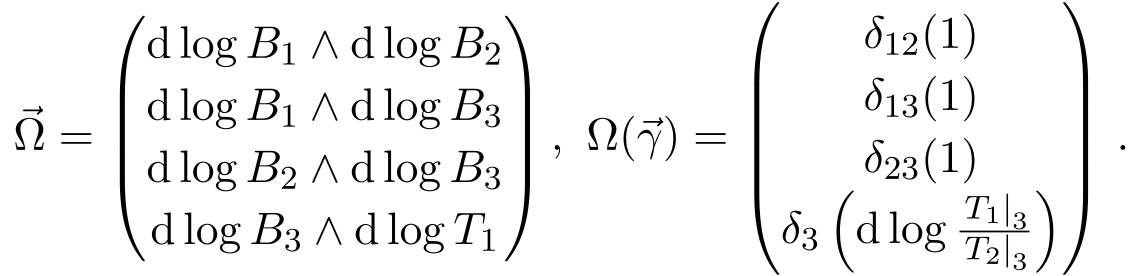 The image shows the choice of basis for the twisted cohomology, essentially defining the 'coordinates' for the wavefunction's algebraic structure.
The Diagrammatic Interpretation
One of the paper's most striking contributions is Figure 4.2 (conceptualized), where the algebraic operation of coaction is mapped directly to visual diagram manipulation:
- Overlapping circles (tubings) represent the poles being analyzed.
- Dashed lines represent "cuts," where a propagator is put "on-shell" (in the cosmological sense).
(Note: This refers to the diagrammatic representation in Section 4.2 of the paper where the coaction acts on the 2-site chain).
Results: A Perfect Match
The authors rigorously tested their theory against the 2-site FRW correlator. By expanding the results in terms of the FRW twist parameter $\epsilon$, they verified that:
- Weight-0 and Weight-1 levels ($O(\epsilon^{-1})$ and $O(\epsilon^0)$) cancel correctly.
- Weight-2 and Weight-3 symbols match perfectly with the integrated results computed via other methods like
HypExp. - The property of Coassociativity $(\Delta \otimes id)\Delta = (id \otimes \Delta)\Delta$ holds, ensuring the algebraic structure is robust.
Critical Insight & Outlook
This "Prelude" provides the mathematical hardware needed to tackle more realistic (and complex) cosmological models.
Why it matters: It suggests that the "Physics of the Big Bang" isn't just a collection of random equations, but follows a rigid, beautiful algebraic structure similar to the $N=4$ SYM theories that revolutionized our understanding of Gluon scattering at the LHC.
Limitations: The current study is limited to conformally coupled scalars (massless-like). Extending this to massive particles is the "holy grail," as massive particles carry the distinctive signatures of new physics in the early universe. The authors note that massive cases introduce "unphysical redundancies" in the basis that still need to be solved.
Takeaway
We are moving closer to a "Symbolic" understanding of the early universe, where we can read the history of cosmic expansion through the algebraic properties of its wavefunction.