
This study investigates the mid-spectrum eigenstate entanglement entropy of 1D Bose-Hubbard models, encompassing translationally invariant, disordered, and particle-number non-conserving variants. By generalizing a mean-field approach to bosonic systems with a local cutoff , the authors derive the leading volume-law coefficient and benchmark it against numerical Exact Diagonalization (ED) and the U(1) Page formula.
TL;DR
Researchers from the J. Stefan Institute have decoded the entanglement structure of highly excited states in bosonic systems. By extending the mean-field theory to models with a local bosonic cutoff, they have identified how symmetries—or the lack thereof—shape the "volume-law" and subleading terms of entanglement entropy. Their findings suggest that while the "bulk" entanglement is robust, the "fine print" ( terms) reveals deep truths about energy conservation and particle fluctuations.
Background: Why Bosons?
In the quest to understand how quantum systems thermalize (the Eigenstate Thermalization Hypothesis or ETH), Entanglement Entropy (EE) serves as the ultimate barometer. While we have a clear picture for fermions (where a site is either empty or full), bosons are more "social"—multiple particles can occupy a single site. This adds a new dimension to the Hilbert space, defined by the local cutoff .
The Core Challenge: The Subleading Term
The famous "Page Curve" predicts that for a random state, entanglement scales with the volume of the subsystem. However, physical Hamiltonians aren't just random matrices; they have symmetries (like particle conservation) and constraints (like energy conservation). The key question is: Do these constraints leave a universal mark on the entanglement?
Methodology: The Grandcanonical Shortcut
The authors circumvent the complexity of the "Canonical" Hilbert space by introducing random grandcanonical pure states.
Starting with:
They derived a generalized volume-law coefficient . This mathematical framework allows us to predict the "maximal" entanglement for any bosonic density and any truncation .
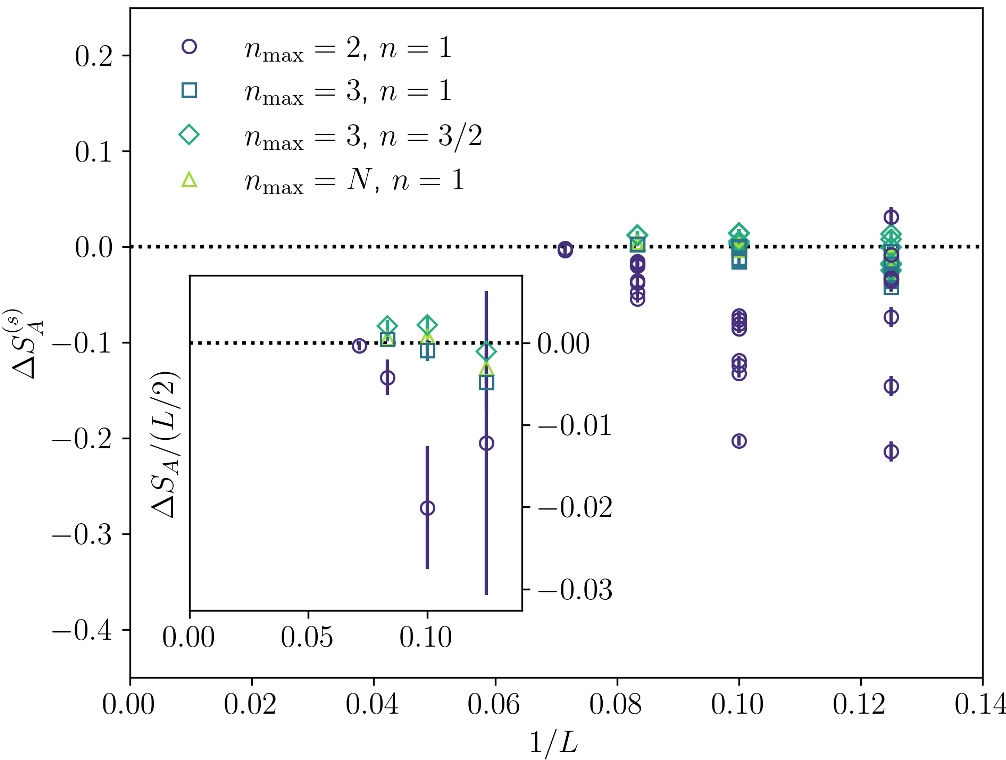 Figure 1: Comparison between Translationally Invariant (TI) and Disordered models. The deviation vanishes as , proving that translational symmetry doesn't change the volume-law coefficient in interacting systems.
Key Insights from Experiments (Numerical ED)
1. The Role of Translational Invariance
Unlike non-interacting (quadratic) systems where translational invariance modifies the volume-law, the authors found that in interacting Bose-Hubbard models, the volume-law is surprisingly robust. Whether the system is clean or disordered, the "chaos" of interactions washes out the lattice-specific features.
2. The Universal Correction
When particle number is not conserved (the "Generalized" Bose-Hubbard model), the authors observed a distinct shift in the entanglement distributions.
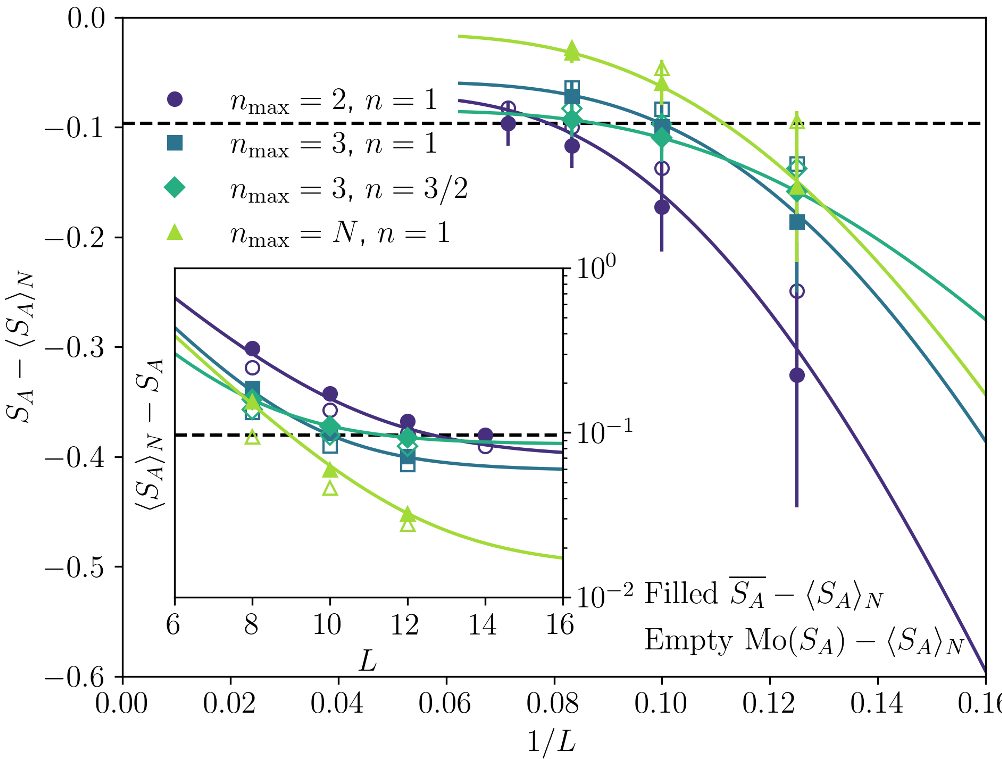 Figure 2: Finite-size scaling of the term in the absence of particle-number conservation. The data approaches a constant value , supporting the hypothesis of a universal correction due to energy conservation.
3. Symmetries and Subtle Differences
In systems where particle number is conserved, the behavior is more nuanced. The term depends on the local cutoff . Specifically, at the "dominant sector" (where particle density ), the system behaves most like its fermionic counterparts, but deviations persist, suggesting that bosonic systems are a more complex "playground" for quantum information.
Critical Analysis & Conclusion
This work provides a rigorous bridge between abstract quantum information theory (Page curves) and realistic condensed matter models (Bose-Hubbard).
Takeaway: The study confirms that the leading entanglement behavior is largely determined by the local Hilbert space dimension and basic conservation laws. However, the term—often ignored as "noise"—actually carries the signature of the system's underlying symmetries.
Limitations: The study is limited to 1D chains and relatively small due to the exponential growth of the bosonic Hilbert space. Future work using Matrix Product States (MPS) or larger-scale simulations could verify if these trends hold in higher dimensions or for truly "limitless" bosons.
Keywords: Bose-Hubbard Model, Entanglement Entropy, Quantum Chaos, Page Curve, U(1) Symmetry.