
The paper investigates codimension-one "End-of-the-World" (ETW) curvature singularities in gravitational scalar flows that explore infinite field-space distances. It evaluates these singularities against established criteria (Gubser, Maldacena–Nuñez) and proposes a new geometric criterion based on the scaling of the Ricci scalar in dynamical cobordisms.
TL;DR
Not all singularities are created equal. This paper revisits the co-dimension one "End-of-the-World" (ETW) branes that appear in dynamical cobordisms. By testing these against the established Gubser and Maldacena-Nuñez criteria, the authors reveal that standard "potential" criteria are too restrictive for string theory. They propose a new geometric bound on the Ricci scalar and introduce a "Finite Temperature Distance Conjecture" based on the scaling of black Dp-branes.
Problem & Motivation: The "Bad" Singularity Dilemma
In the Swampland program, we often encounter spacetime singularities where scalar fields travel to infinite distance. But how do we know if a singularity is a physical "End-of-the-World" brane (good) or an unphysical pathology (bad)?
Previously, Gubser's potential criterion suggested that the scalar potential must be bounded above near the singularity. However, the authors find that well-known, UV-complete solutions like EFT strings and D7-branes violate this when reduced to codimension-one flows. This implies that our current diagnostic tools for "admissible" singularities are failing to capture valid string theory physics.
Methodology: Geometrizing Admissibility
The core insight of this paper is to shift the focus from the dynamics (the scalar potential ) to the geometry (the Ricci scalar ).
1. The Moduli Space Flow
The authors analyze flows where is constant (moduli space). They find these flows represent geodesics in field space. While they fail Gubser’s "horizon criterion" (they cannot be easily "heated up" to cloak the singularity), they pass the Maldacena-Nuñez criterion in specific duality frames.
2. A New Criterion
Drawing from the theory of Dynamical Cobordisms, the authors propose: This bound effectively "geometrizes" Gubser's intuition, allowing for positive potentials that were previously rejected while still filtering out truly pathological cases like the massive Type IIA strong-coupling singularity.
 Figure: The general domain wall flow ansatz used to analyze these singularities.
Experiments & Results: The Heat of the End
One of the paper's most forward-looking results involves Black Dp-branes. By analyzing near-extremal solutions, the authors found a universal thermodynamic scaling:
At zero temperature, this reduces to the standard Swampland Distance Conjecture (SDC). However, at finite temperature , the "energy" of the tower corresponds to the temperature itself. This suggests that the thermodynamics of ETW-branes are intrinsically linked to the light towers of states (KK modes or strings) predicted by the SDC.
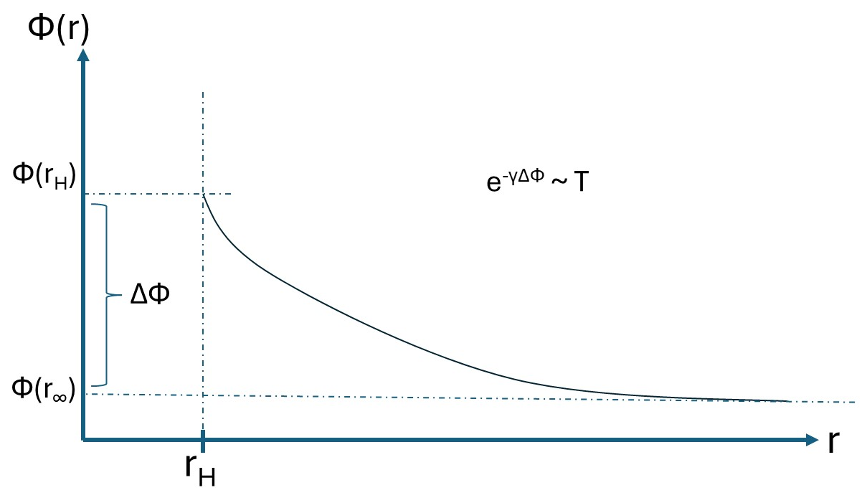 Figure: The flow of scalars towards the horizon at finite temperature, illustrating the finite field distance covered.
Critical Analysis & Conclusion
Takeaway
The paper successfully broadens the scope of "good" singularities. By showing that D7-branes and EFT strings—essential components of string compactifications—fail older criteria, they prove that the Swampland needs a more nuanced, geometric approach to cobordisms.
Limitations
- Frame Dependence: The Maldacena-Nuñez criterion still shows a sensitivity to the chosen duality frame, which remains a technical hurdle.
- UV Resolutions: As seen in the Klebanov-Tseytlin vs. Klebanov-Strassler comparison, "resolving" a singularity often involves changing the field-space destination entirely.
Future Prospect
The proposed Finite Temperature Distance Conjecture opens a new door: Can we use the temperature of a black ETW-brane to predict exactly what kind of tower (strings vs. KK modes) appears at the boundary of the moduli space? This "Species Thermodynamics" is likely the next frontier in quantum gravity.