
This paper introduces Quantum Oracle Sketching, a novel framework that enables exponential quantum space advantages in Big Data processing tasks such as linear system solving, binary classification, and dimension reduction. By processing classical data samples "on the fly" to construct coherent quantum queries, the authors demonstrate that a quantum computer with only polylogarithmic qubits (e.g., <60 logical qubits) can outperform exponentially larger classical machines.
TL;DR
Researchers from Google Quantum AI and Caltech have cracked one of the most stubborn problems in Quantum Machine Learning (QML): the data loading bottleneck. They introduced "Quantum Oracle Sketching," an algorithm that allows a quantum computer with fewer than 60 qubits to process datasets that would require classical machines millions of times larger. Unlike previous speedups that were "dequantized," this exponential space advantage is information-theoretically unconditional.
The Problem: The "Memory Wall" and the QRAM Trap
In the classical world, we are hitting a "memory wall." AI models are growing exponentially faster than our ability to store and access memory. In the quantum world, the solution was supposedly QRAM (Quantum Random Access Memory). However, QRAM is a theoretical nightmare: it requires hardware to access data points, effectively neutralizing the very advantage quantum computers are supposed to provide.
The fundamental question was: Can a small quantum machine learn better than an exponentially larger classical machine? Most experts were skeptical because of Holevo’s bound (which limits how much classical info a qubit can store) and the fear that pumping raw, noisy classical data into a quantum system would destroy its coherence.
Methodology: The Magic of Quantum Oracle Sketching
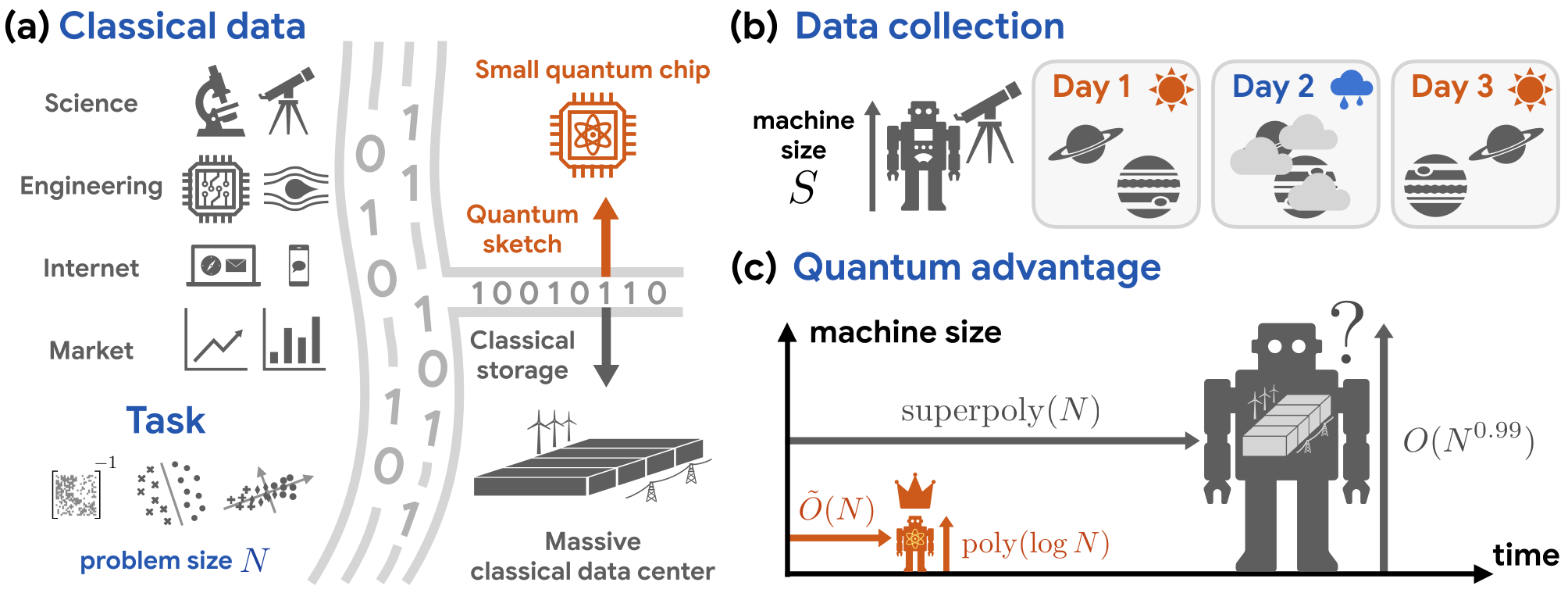
The authors circumvent the storage problem entirely. Instead of loading the whole dataset, they process samples on the fly.
1. Evading Decoherence
Normally, randomly sampling data to drive a quantum evolution causes "decoherence" similar to noise. The authors' brilliant insight was to design incremental rotations where the contributions accumulate coherently. Because the data-driven Hamiltonians associated with distinct classical samples act on mutually orthogonal subspaces, the errors don't pile up as they would in a generic system.
2. The Algorithmic Pipeline
- Oracle Sketching: Converts classical data streams into coherent quantum queries.
- QSVT (Quantum Singular Value Transform): Uses these queries to perform complex linear algebra (matrix inversion, PCA).
- Interferometric Classical Shadows: A new readout technique that extracts signs and inner products (critical for SVM classifications) into a compact classical model.
Real-World Evidence
The team didn't just stay in the realm of math; they tested this on IMDb sentiment analysis and single-cell RNA sequencing.
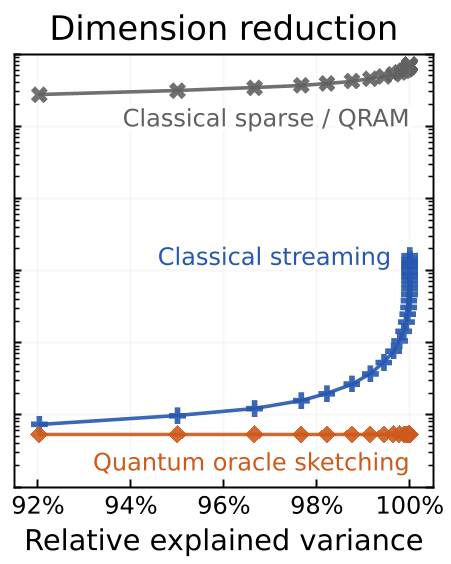
As shown in Figure 2, to achieve high accuracy, the memory required by classical streaming and sparse algorithms (blue and gray lines) grows exponentially. Meanwhile, the memory for Quantum Oracle Sketching (orange line) remains nearly flat. They demonstrated a 1,000,000x reduction in machine size for classification tasks.
Why It Matters: Classical Hardness
The most profound part of this paper is the proof of unconditional classical hardness. By connecting machine size to "query complexity," the authors proved that if an oracle problem is hard for a classical machine to query, a classical machine must be exponentially larger than a quantum one to solve the learning version of that problem.
This advantage persists even if the classical machine is given infinite time. It is a pure space advantage rooted in the exponential dimensionality of the Hilbert space.
Critical Analysis & Conclusion
Takeaway
This work shifts the focus of Quantum Advantage from Time (Shor's algorithm) to Space (Memory). It proves that quantum computers are uniquely suited to distill information from massive classical datasets into succinct models that classical computers cannot even hold in memory.
Limitations
- Runtime: While the space is polylogarithmic, the total running time still scales with the number of samples (), meaning you still have to wait to see all the data.
- Precision: The algorithm assumes high-fidelity logical qubits, which are still a few years away in the "Megaquop" era.
Future Outlook
This paves the way for "Quantum-Enhanced Sensing" and "Data Scouting" where quantum processors act as real-time filters for massive data generators like the Large Hadron Collider or the Square Kilometre Array telescope.