
This study re-evaluates the future of the Local Group using the latest and most precise Gaia-based proper motion (PM) measurements for M31 and M33. Utilizing a four-body semi-analytic framework (MW, M31, M33, LMC), the authors report a 90% probability of an MW–M31 merger within the next 10 Gyr, with a median merger time of 6.5 Gyr.
TL;DR
For decades, astronomers believed our galaxy was on a collision course with Andromeda (M31). Recent data had cast doubt on this "inevitable" fate, suggesting the odds were a mere 50/50 toss-up. However, a new study using corrected Gaia astrometry and a sophisticated four-body dynamical model (including the LMC and M33) has restored the classical picture: there is a 90% probability we will merge into a single elliptical galaxy, with the first major "brush" occurring in roughly 5.3 billion years.
Background: A Galactic Tug-of-War
The fate of the Local Group (LG) is governed by the orbital dance between its two giants: the Milky Way (MW) and Andromeda. While we have known about their radial approach for a century, their transverse velocity (sideways motion) remained elusive. If this velocity is high, they miss each other; if it is low, they collide.
The recent scientific "drama" began when Gaia EDR3 data suggested a higher transverse velocity for M31, potentially allowing the galaxies to bypass each other. Moreover, the massive Large Magellanic Cloud (LMC) has recently arrived, acting as a heavy anchor that pulls the Milky Way, complicating our orbital calculations through barycentric reflex motion.
Methodology: Correcting the "Gaia Bias"
The authors identified that the discrepancy in previous studies stemmed from systematic offsets between Gaia’s 5-parameter (5p) and 6-parameter (6p) solutions. By correcting these, they derived a more precise M31 transverse velocity of 46.7 ± 24.0 km/s, significantly smaller than some previous Gaia-based estimates.
The Four-Body Framework
The researchers didn't just look at two points in space. They modeled:
- The Milky Way (MW)
- Andromeda (M31)
- The Triangulum Galaxy (M33)
- The Large Magellanic Cloud (LMC)
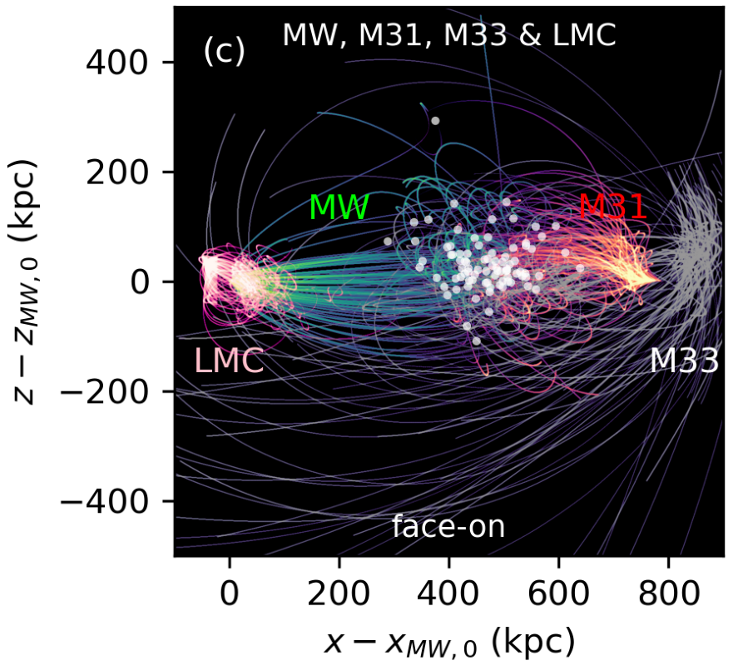
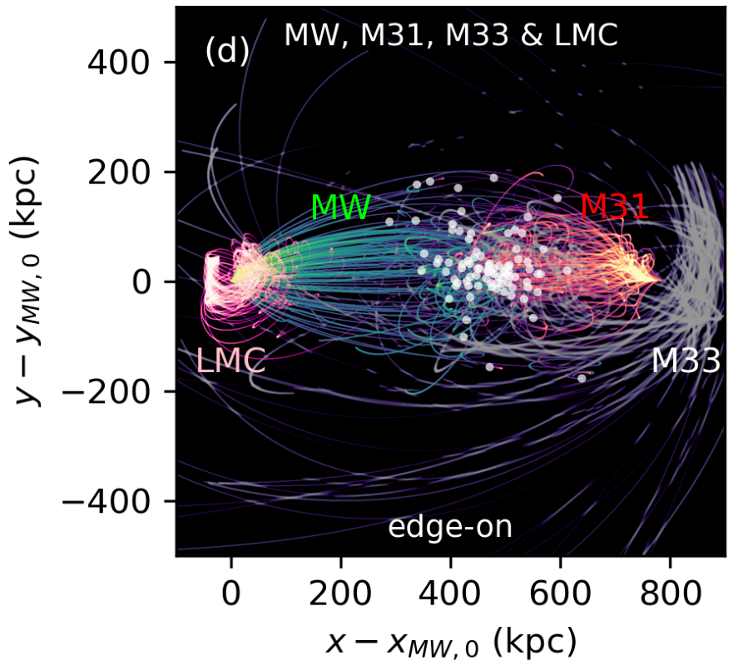 The figure above illustrates the orbital tracks: note how the inclusion of satellites (right panels) leads to more complex, yet ultimately more radial, trajectories compared to the simple two-body model (left).
The "LMC Effect": Catalyst for Collision
One of the study's most profound insights is the role of the LMC. Previously, some argued the LMC's gravity might "save" us from Andromeda by pulling us out of the collision path. This study proves the opposite: given the updated PMs, the LMC-induced reflex motion actually enhances the radial component of our velocity toward M31. The LMC is effectively "pushing" us into Andromeda's arms.
 Statistical breakdown of merger times: the median merger occurs at 6.5 Gyr, well before the sun's expected end.
Sensitivity: Why We Aren't 100% Sure
Despite the 90% confidence, the "Fate of the Milky Way" remains a sensitive calculation. The authors conducted a "Grid Test" on M31's proper motion.
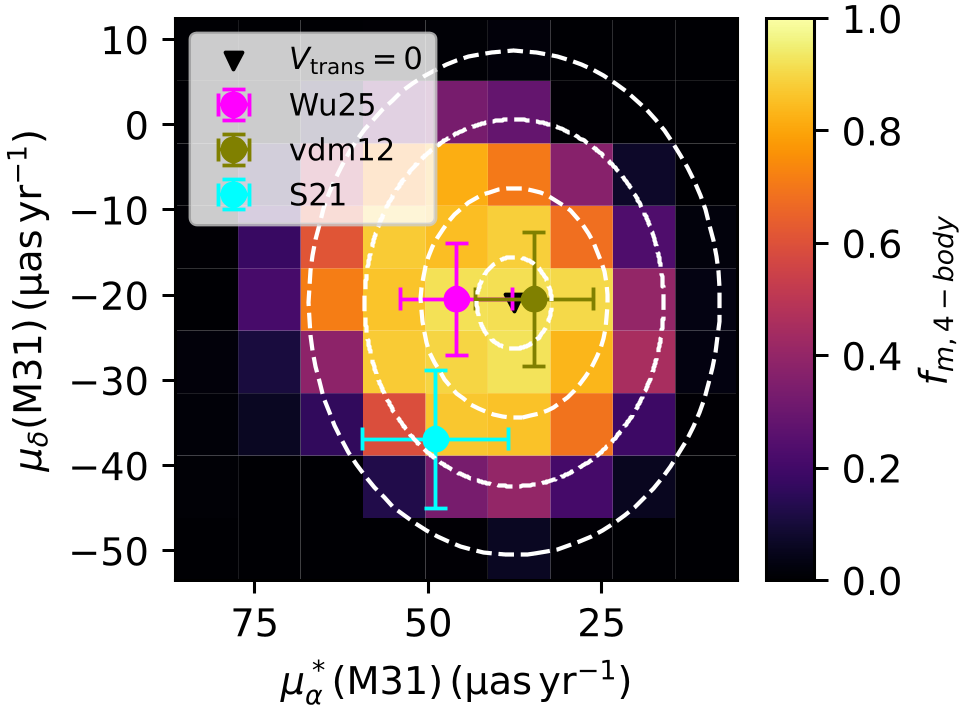 As seen in the bottom panel, the "hot zones" (red) indicate where mergers are certain. Most modern measurements (magenta point) fall squarely in this high-probability zone.
The study reveals a geometric trap: M31’s proper motion determines the orientation of our orbital plane. This plane then dictates whether the LMC’s pull helps or hinders the merger. Currently, the data favors a merger, but a small shift in measured sideways motion could still change the result.
Critical Insight & Future Outlook
This paper effectively "broadly restores the classical picture" of a future merger, but with a warning. We are at the limits of current astrometry. To reach a "decisive" conclusion (reducing the probability variance to <10%), we need precision of ≲ 2 µas/yr.
Future milestones to watch:
- Gaia DR4: Expected to further refine stellar motions.
- CSST (Chinese Space Station Telescope): Its wide-field surveys will provide a longer baseline for M31’s satellite motions.
- HST Ongoing Programs: Long-baseline observations remain the gold standard for extra-galactic proper motions.
Ultimately, while the cosmic "car crash" is 90% likely, we are still waiting for the next generation of telescopes to confirm if we are looking at a head-on collision or a cosmic near-miss.