
This paper constructs a novel family of nested Calderbank–Shor–Steane (CSS) quantum LDPC codes using a "stacked" ensemble of Hsu–Anastasopoulos (HA) and MacKay–Neal (MN) codes. The proposed construction achieves non-vanishing coding rates and is rigorously proven to reach the quantum Gilbert–Varshamov (GV) bound at finite degrees.
TL;DR
Researchers have achieved a significant milestone in quantum information theory: constructing Quantum Low-Density Parity-Check (QLDPC) codes that reach the Gilbert–Varshamov (GV) bound using finite check-node degrees. By nesting Hsu–Anastasopoulos (HA) and MacKay–Neal (MN) codes within a "stacked" matrix framework, the authors prove that sparsity does not have to come at the expense of optimal distance-to-rate trade-offs.
Motivation: The Search for "Good" Sparse Codes
In the classical world, LDPC codes are celebrated for their ability to approach the Shannon limit with linear-time decoding. In the quantum realm, the stakes are even higher. We require CSS codes—defined by two classical codes $C_X$ and $C_Z$ satisfying $C_Z^\perp \subseteq C_X$—that are simultaneously "sparse" (to minimize error propagation) and "good" (possessing linear distance $d = \Theta(n)$).
Prior breakthroughs like Hypergraph Products or Quantum Tanner Codes established that asymptotically good codes exist, but often they are complex to construct or their performance relative to the GV bound is only understood in the limit of infinite degrees. This paper asks: Can we hit the theoretical distance limit while keeping the graph simple and the degrees small?
Methodology: The Power of Nesting and Stacking
The authors move away from the standard "dual pair" approach (which often results in a zero quantum rate) and instead propose a nested regular sparse family.
1. The Stacked Architecture
Instead of a single homogeneous matrix, the X-side parity-check matrix $A_X$ is "stacked": $$A_X = \begin{bmatrix} A_Z \ A_\Delta \end{bmatrix}$$ Where $A_Z$ and $A_\Delta$ are independent regular LDPC matrices. This ensures the nested condition $ ext{Row}(A_Z) \subseteq ext{Row}(A_X)$ is satisfied by design.
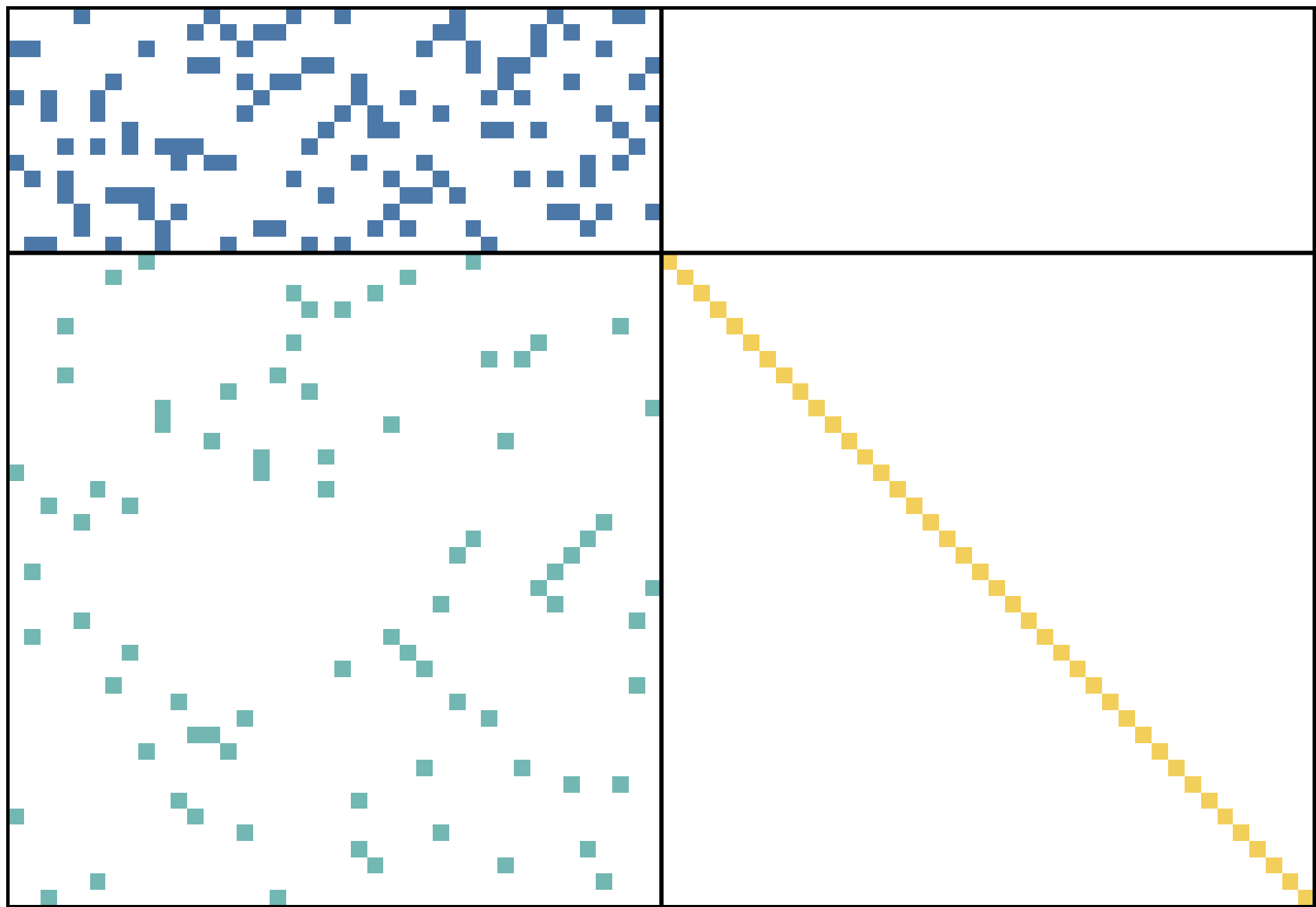 Figure 1: The Z-side extended parity-check matrix $H'_Z$, showing the interaction between the outer code $A_Z$ and the inner map $B$.
2. The HA/MN Duality
By utilizing the relationship between Hsu–Anastasopoulos (high-rate capacity-achieving) and MacKay–Neal codes, the authors create a balanced system. The "hidden variable" representation allows them to define the codes $C_Z$ and $C_X$ through a sparse map $B$, ensuring that the graphical complexity remains bounded—a crucial requirement for actual hardware implementation.
Results: Rigorous Certification of the GV Bound
The paper's heavy lifting lies in its distance analysis. For the MN-side, the "stacked" nature of $A_X$ means it doesn't follow standard LDPC weight distributions. The authors developed a Refined Enumerator to count codewords accurately.
Key Finding: The Balanced Triples
The team identified seven specific degree configurations, termed Balanced Triples $(j_Z, j_X, k)$, that rigorously attain the GV bound. For example, the $(4, 6, 10)$ triple achieves the distance predicted by the GV curve at finite degrees.
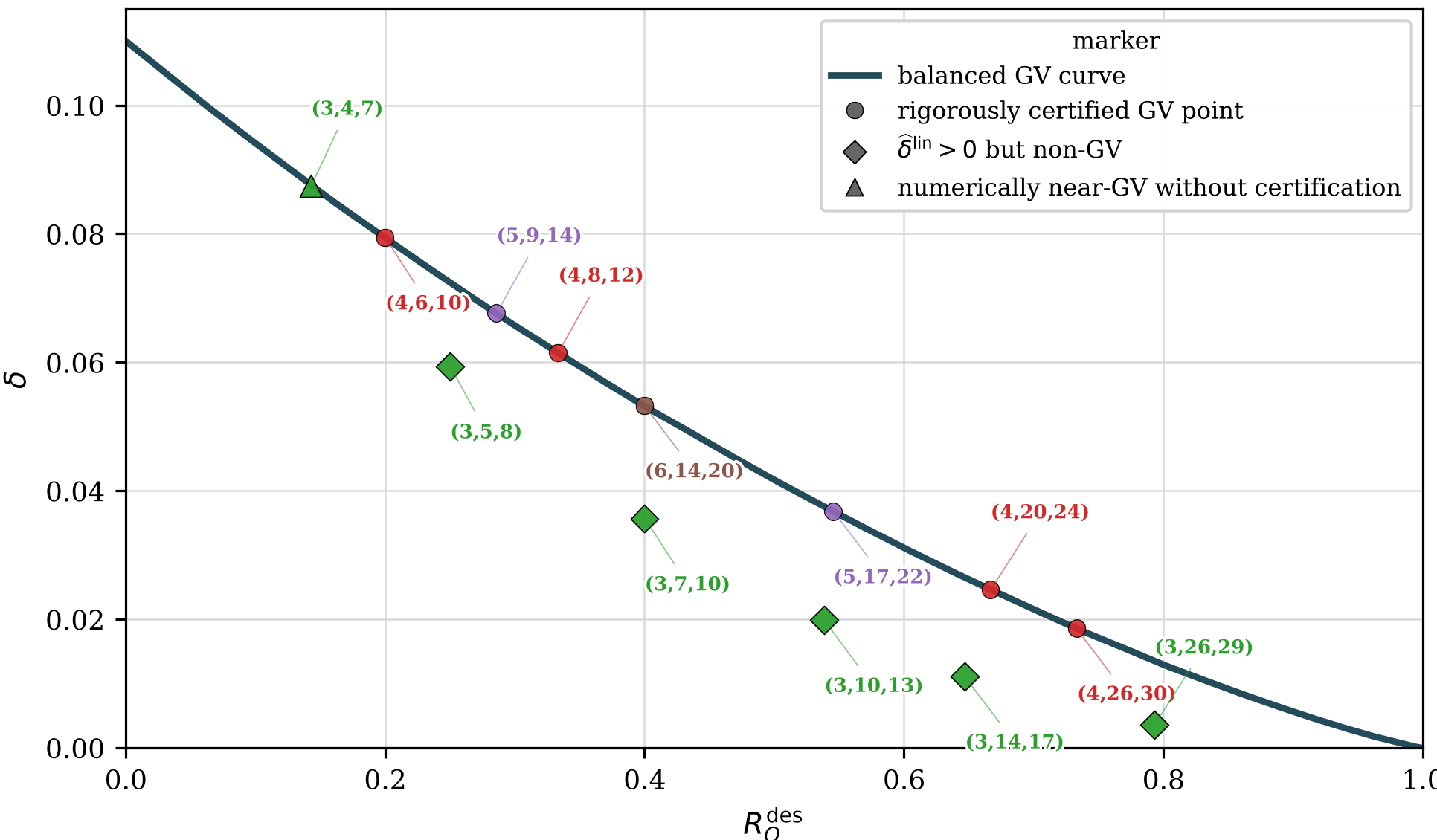 Figure 2: Numerical proxy versus the CSS GV curve. Circular markers represent the "Triples" that are rigorously certified to reach the bound.
Quantitative Achievements:
- Linear Distance: Proven with high probability that $d(C) = \Omega(n)$.
- Rate Convergence: Demonstrated that actual coding rates converge to design rates $R_{des}$ as $n o \infty$.
- Decodability: While a "perfect" decoder isn't the focus, they show the syndrome equations can be represented as Sparse Affine Systems, paving the way for Belief Propagation (BP) variants.
Critical Analysis: Impact and Limitations
Why this matters: This work breaks the "orthogonality barrier." It shows that we don't need exotic, complex complexes to reach the GV bound. We can use the familiar tools of classical LDPC theory (HA and MN codes) if we structure them correctly.
Limitations: The current study is primarily an asymptotic and distance-theoretic guarantee. While the matrices are sparse, the syndrome measurement process currently involves a "dense" step to form syndrome representatives. As the authors note, future work in Spatially Coupled (SC) versions of these codes will likely be required to make them practically decodable near the capacity limit.
Conclusion
By bridging the gap between classical sparse graph codes and quantum CSS constraints, this paper provides a rigorous foundation for the next generation of QLDPC codes. It proves that hitting the Gilbert–Varshamov bound is possible even with the strictest sparsity constraints, provided the "nesting" and "stacking" are handled with mathematical precision.