
This paper provides a comprehensive mathematical foundation for Schrödinger Bridges (SB) as a unifying principle for modern generative modeling, including diffusion models and flow matching. It develops the theory from static entropic optimal transport to dynamic path-space optimization, offering a toolkit for constructing bridges via stochastic differential equations (SDEs) and continuous-time Markov chains (CTMCs).
Executive Summary
TL;DR: This work provides a PhD-level deep dive into the mathematical scaffolding of Schrödinger Bridges (SB), positioning them as the unifying theoretical framework beneath diffusion models, flow matching, and stochastic optimal control. By framing generative modeling as an entropy-regularized optimal transport problem in path space, it offers a rigorous toolkit for constructing continuous and discrete-time generative models from first principles.
Background Positioning: This is a foundational synthesis and extension. It moves beyond "vanilla" diffusion by treating the forward process as a controllable variable, effectively maping the academic coordinates of generative AI from heuristic-driven noise injection to principled path-space optimization.
Problem & Motivation: The Fragmentation of Generative AI
Traditional generative frameworks often rely on specific reference dynamics—most notably, standard Brownian motion reverting to a Gaussian. However, this creates several bottlenecks:
- Structured Priors: Many real-world tasks (like image-to-image translation) benefit from informative priors, not just white noise.
- Physical Constraints: Biological systems exhibit branching and mass variation (unbalanced transport) that standard Markovian diffusion cannot capture.
- Mathematical Instability: Differentiating through full SDE trajectories is memory-intensive and often divergent.
The author's intuition is that by looking at the Schrödinger Bridge Problem, we can view all these models as "minimal entropy deviations" from a reference law. This allows us to handle arbitrary marginals and with the same mathematical elegance previously reserved for Gaussian noise.
Methodology: The Hopf-Cole Transform and Forward-Backward SDEs
The core difficulty in SB is the coupling of the Hamilton-Jacobi-Bellman (HJB) and Fokker-Planck (FP) equations. These nonlinear operators describe how the optimal "value" of a trajectory and the "density" of particles interact.
1. Linearizing the Dynamics
The master stroke is the Hopf-Cole Transform. By setting and , the paper transforms a complex nonlinear system into a pair of linear PDEs. This reveals that the optimal marginal density at any time is simply the product of two potentials—one propagating forward and one backward.

2. Forward-Backward SDEs (FBSDEs)
To make this trainable, the author maps these potentials to stochastic processes. Generative modeling then becomes a task of learning the forward control drift and the backward corrector . This architecture allows for Adjoint Matching, which provides a "simulation-free" path to the optimal control without requiring explicit samples from the target distribution—a critical feature for sampling molecular Boltzmann distributions.

Variations: From Gaussians to Branching Cells
The paper proves the versatility of the SB framework through specialized variants:
- Gaussian SB: Provides a rare closed-form solution on the Bures-Wasserstein manifold, where the covariance evolution follows a Riemannian geodesic.
- Unbalanced SB: Introduces a growth rate into the Fokker-Planck equation, allowing mass to be created or destroyed—perfect for modeling cell proliferation.
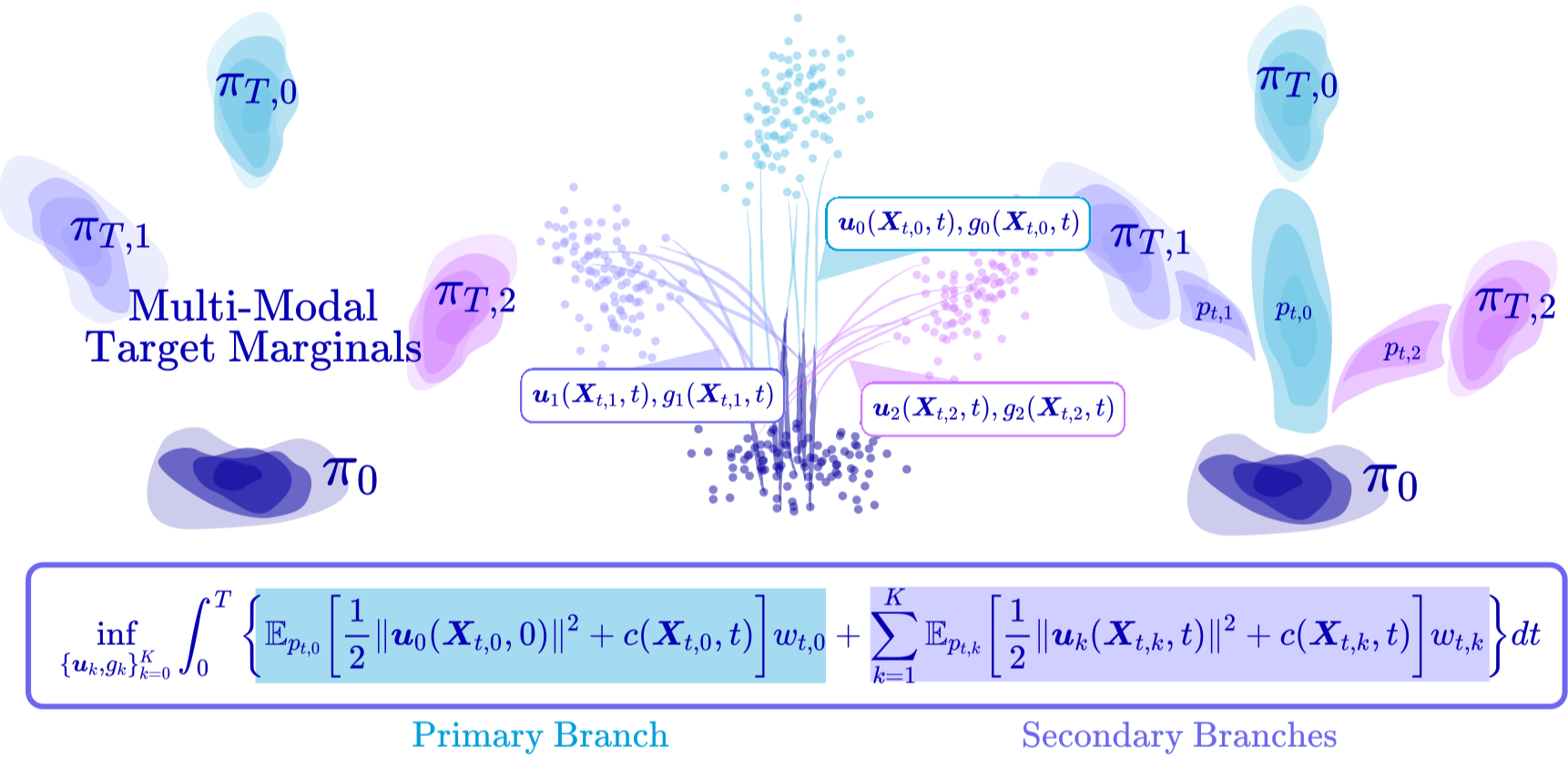
- Branched SB: Enables a single prior to diverge into multiple terminal modes, solving the chronic "mode collapse" issue in standard generative models.
Experiments & Results: Efficient Sampling
The guide showcases that by utilizing Adjoint Sampling and Corrector Matching, we can optimize generative drifts locally. This prevents the need for backpropagating through long solver chains. In the context of Boltzmann Sampling, the SB approach demonstrates the ability to capture multi-modal energy landscapes with significantly fewer energy evaluations than traditional MCMC or SMC methods.
Critical Analysis & Conclusion
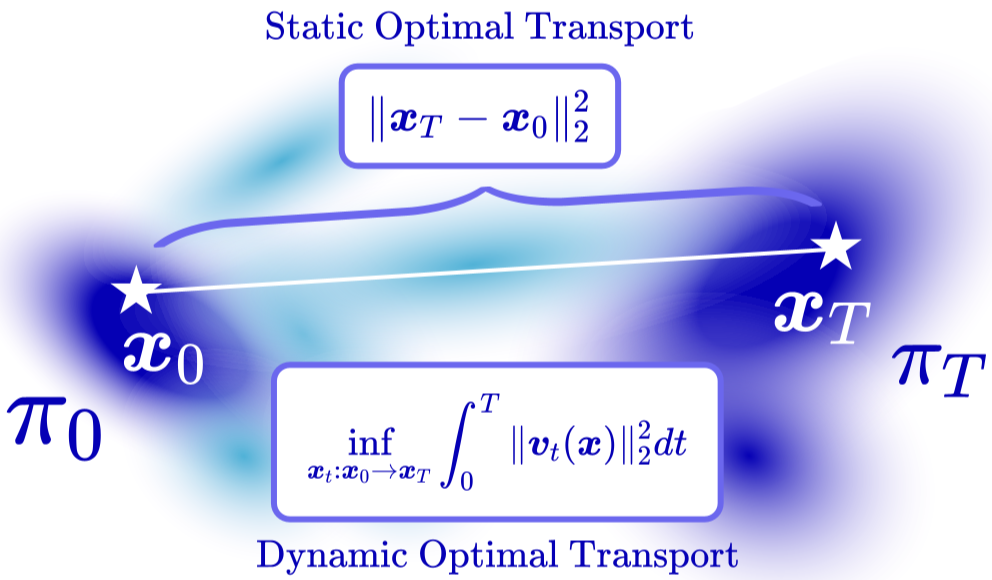
Takeaway: The Schrödinger Bridge is not just another generative model; it is the mathematical foundation that unifies the space of path measures. It elegantly connects the "What" (Optimal Transport) with the "How" (Stochastic Optimal Control).
Limitations: While the theory is robust, the discrete-state-space extensions (CTMCs) still face high computational costs when the state space is very large (e.g., vast vocabularies in LLMs), requiring further research into sparse generator approximations.
Future Work: The next frontier involves Fractional SB, which integrates non-Markovian memory into the generation process, potentially revolutionizing how we model time-series data with long-range dependencies.