
This study evaluates the capability of NASA’s future Habitable Worlds Observatory (HWO) to characterize Earth-like surfaces using the POSEIDON retrieval code. By simulating reflected-light observations of modern Earth models, the authors assess the potential to detect life-related surface features like the "red edge."
Executive Summary
TL;DR: While NASA’s upcoming Habitable Worlds Observatory (HWO) is designed to catch the faint glint of Earth-like planets, a new study reveals that "seeing" the surface is much harder than expected. Using the POSEIDON retrieval framework, researchers found that while we can detect life's fingerprints (like the chlorophyll red edge), our measurements of the planet's size and surface pressure are often masked by a complex "shell game" played by clouds and surface materials.
Positioning: This work serves as a critical feasibility study for the HWO mission, shifting the focus from "can we see the planet?" to "can we actually trust what the spectral retrieval tells us about its surface?"
The Problem: The Planetary Shell Game
In the hunt for Habitability, the community has long eyed the Red Edge—a sharp increase in reflectivity of vegetation around 750 nm. However, prior work often simplified the planetary surface as a mirror with a single, flat color.
The core difficulty lies in Degeneracy. In reflected light, the flux we receive follows the relationship $F_p/F_s \propto R_p^2 A_g(\lambda)$. This creates a fundamental ambiguity: Is it a small, very bright planet (high albedo) or a large, dark planet (low albedo)? Without knowing the radius $R_p$ perfectly, your interpretation of the surface material—and thus the presence of life—becomes a guess.
Methodology: Simulating the Modern Earth
The authors didn't just use a simple "Blue Marble" model. They tested three levels of complexity:
- POSEIDON Consistent: Models where the "truth" perfectly matches the retrieval assumptions.
- MODIS-Derived: Using actual satellite data from Earth's 11-year history to create a realistic surface mix.
- MYSTIC 3D: A high-fidelity Monte Carlo radiative transfer model that includes 3D cloud structures.
The HWO Instrument Model
The study utilized the EAC 5 design, a 10-meter class behemoth equipped with a Vector Vortex Coronagraph.
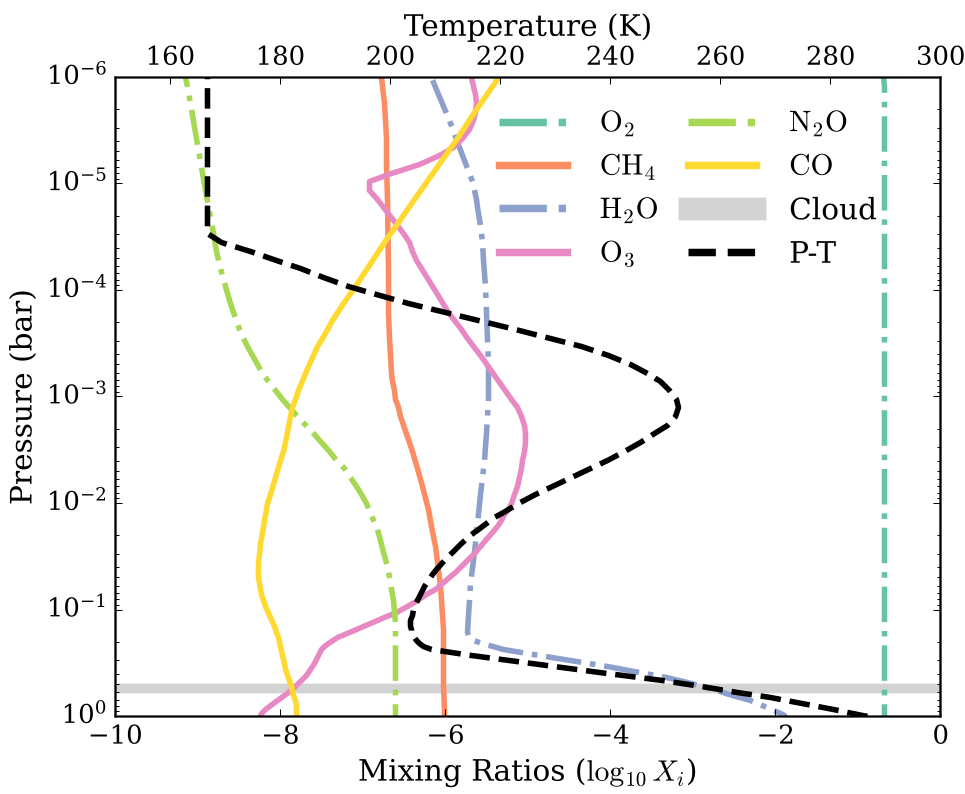 Figure 2: The simulated 10m segmented aperture (inset) and the wavelength-dependent throughput of the optical system.
The "Cloud" Paradox
One of the most striking insights is the dual role of clouds.
- The Good: Clouds provide a bright, high-albedo continuum. This actually helps detect atmospheric gases like Oxygen ($O_2$) and Ozone ($O_3$) because the absorption lines are "etched" more clearly against a bright background.
- The Bad: Clouds act as a screen, physically blocking photons from reaching the surface. For a planet like Earth (approx. 50% cloud cover), the retrieval often struggles to distinguish between a cloudy ocean and a clear desert.
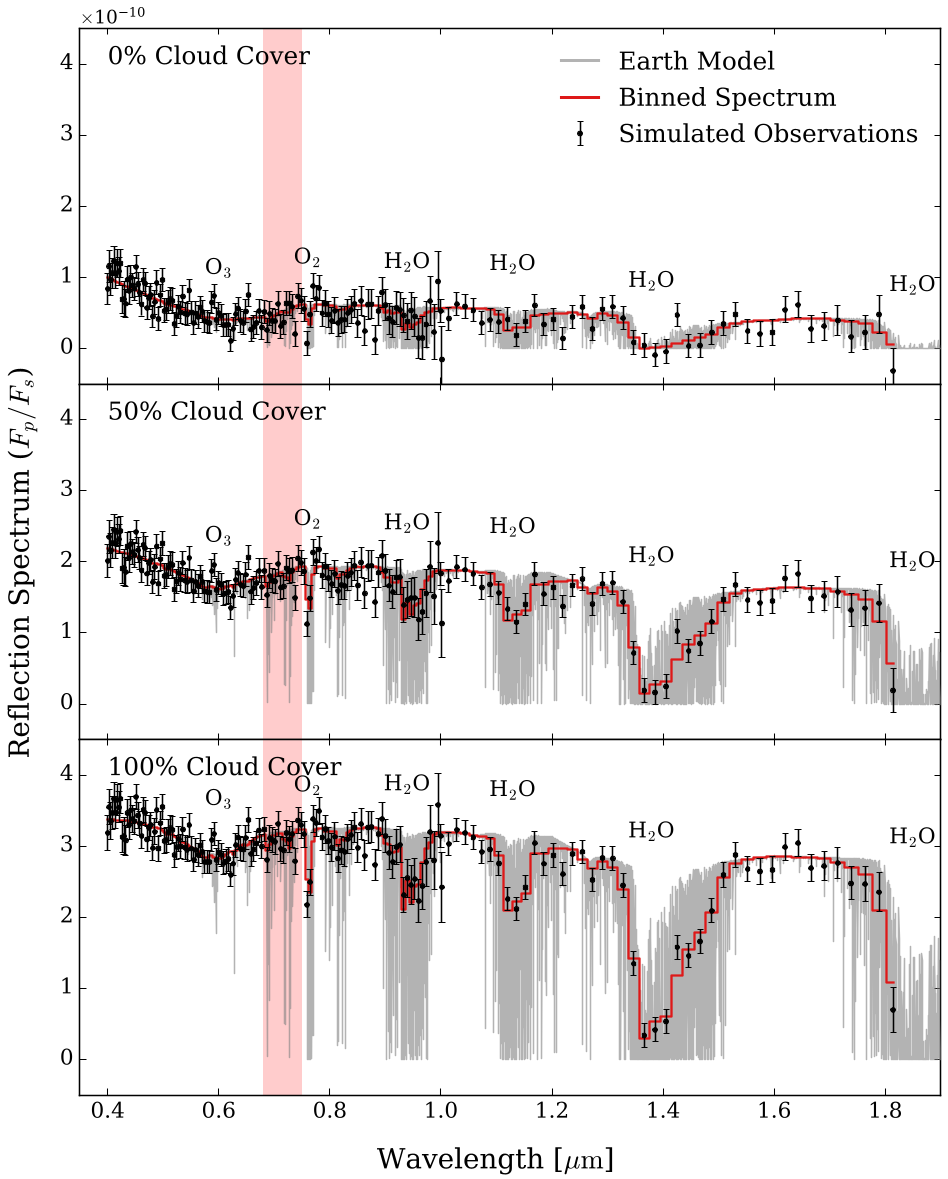 Figure 4: Simulated 100-hour HWO observations. Note how the red edge (marked by the red bar) competes with atmospheric absorption bands from $O_2$ and $H_2O$.
Results: Can we identify Forests?
Surprisingly, Forest coverage was the most robustly detected feature. Due to the unique "jump" in the spectrum caused by chlorophyll, POSEIDON consistently retrieved a forest fraction of $\sim 22%$, even when other parameters were off.
However, the Ocean coverage was almost always underestimated. Because deep water is dark (low albedo), the retrieval algorithm often "preferred" to shrink the planet's radius and fill the surface with sand or snow to match the observed brightness.
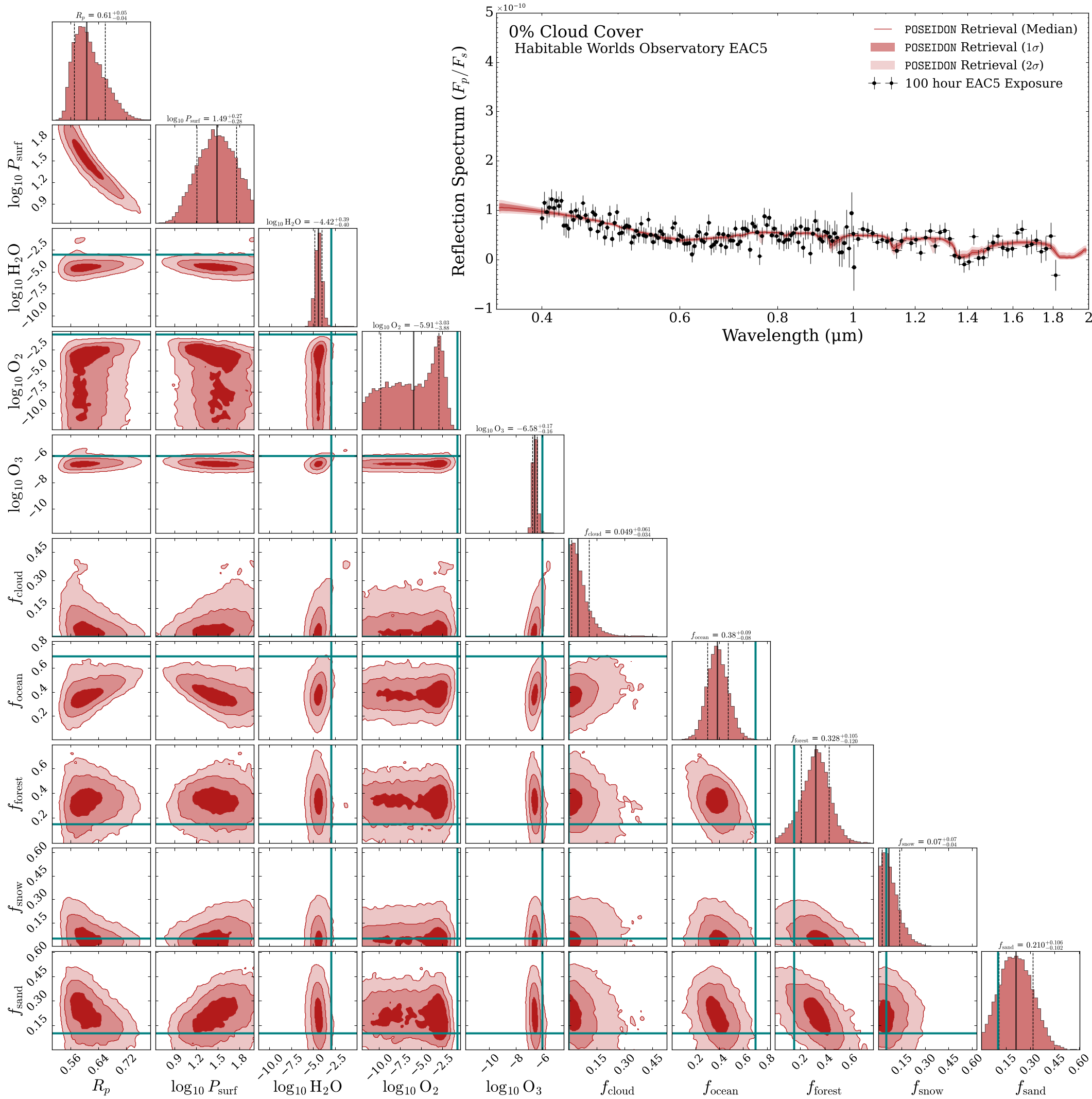 Figure 7: Corner plot showing the degeneracy. Notice the slanted correlation between planetary radius ($R_p$) and surface fractions—as one goes down, the other must go up.
Critical Insight & Future Outlook
The study concludes with a sobering reality check: A single visit is not enough. To truly characterize an Earth-twin, we need:
- Prior Radius Knowledge: We must constrain the planet's size through long-term orbital tracking before doing deep spectroscopy.
- Multi-Epoch Observations: Viewing the planet at different phases (crescent vs. gibbous) to see how clouds move and how different continents rotate into view.
- Agnostic Hybrid Models: Starting with simple models to find "features" and then moving to complex lab-based albedos for confirmation.
As we build the Habitable Worlds Observatory, our biggest challenge won't just be the 10⁻¹⁰ contrast—it will be the mathematical fog of degeneracies that Earth-like complexity creates.