
[Yannick Roy 2026] The Kitchen Loop: Scaling Autonomous Codebase Evolution via Unbeatable Verification
The Kitchen Loop: User-Spec-Driven Development for a Self-Evolving Codebase
The paper introduces "The Kitchen Loop," a six-phase autonomous framework for self-evolving software development. It leverages LLM agents as "synthetic power users" (AaU1000) to systematically exercise a product's specification surface, achieving over 1,000 merged pull requests across two production systems with zero regressions.
TL;DR
The "Kitchen Loop" is a production-tested framework that turns code production into a commodity by focusing on the new bottlenecks: Specification and Verification. By running LLM agents as "synthetic power users" at 1,000x human cadence, it systematically exhausts a product's feature surface. Across 285+ iterations, it shipped 1,094 PRs with zero regressions, effectively creating a codebase that fixes itself while humans focus on high-level intent.
The "Vibe Coding" Crisis and the Post-Commodity Code Thesis
We have entered an era where writing code is no longer the hard part. Recent studies show that while AI adoption boosts short-term velocity, it often leads to a 30% increase in static analysis warnings and a 42% spike in cognitive complexity. This "vibe coding" paradox—being fast but flawed—creates a quality debt that eventually slows development to a crawl.
The author argues that a senior engineer’s value has shifted. It is no longer about writing lines; it’s about:
- What to build (Specification).
- Proving it works (Verification).
- Ensuring it stays better (Drift Control).
Methodology: The Anatomy of a Six-Phase Loop
The Kitchen Loop moves away from "reactive" ticket solving to "proactive" coverage exhaustion. It follows a rigorous cycle:
- Backlog & Ideate: Generates user scenarios based on a three-tier strategy (Foundation, Composition, and Frontier).
- Triage & Execute: Identifies root causes and implements fixes in isolated worktrees.
- Polish & Regress: Hardens PRs via multi-model tribunals and runs a "Regression Oracle" to ensure no new code breaks old promises.
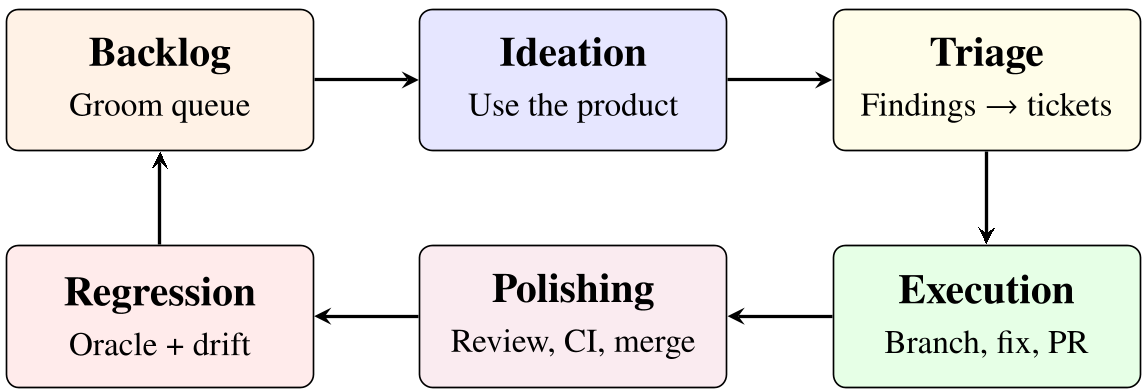 Figure 1: The six-phase autonomous improvement cycle.
The Unified Trust Model
To make autonomous evolution safe, the framework relies on Unbeatable Tests. Unlike unit tests (which LLMs often "cheat" on by mocking data), unbeatable tests verify outcomes against ground truth. In a DeFi context, this means checking on-chain balance deltas after a transaction. If the state doesn't change exactly as expected, the test fails, regardless of what the code claims.
Experimental Results: $0.38 per Merged PR
The framework was deployed across two distinct systems: an Almanak DeFi SDK and a Signal Intelligence platform.
| Metric | DeFi SDK | Signal Platform |
|---|---|---|
| Merged PRs | 728+ | 366 |
| Regressions | 0 | 0 |
| Quality Gates | 100% | 100% |
| Cost/PR | ~$0.38 | ~$0.38 |
One of the most striking emergent properties was infrastructure self-healing. During the trials, the loop encountered a memory bug on Apple Silicon that stalled its own merge process. Instead of requiring human intervention, the loop diagnosed the pattern, filed its own ticket, and successfully merged a fix to its own orchestrator.
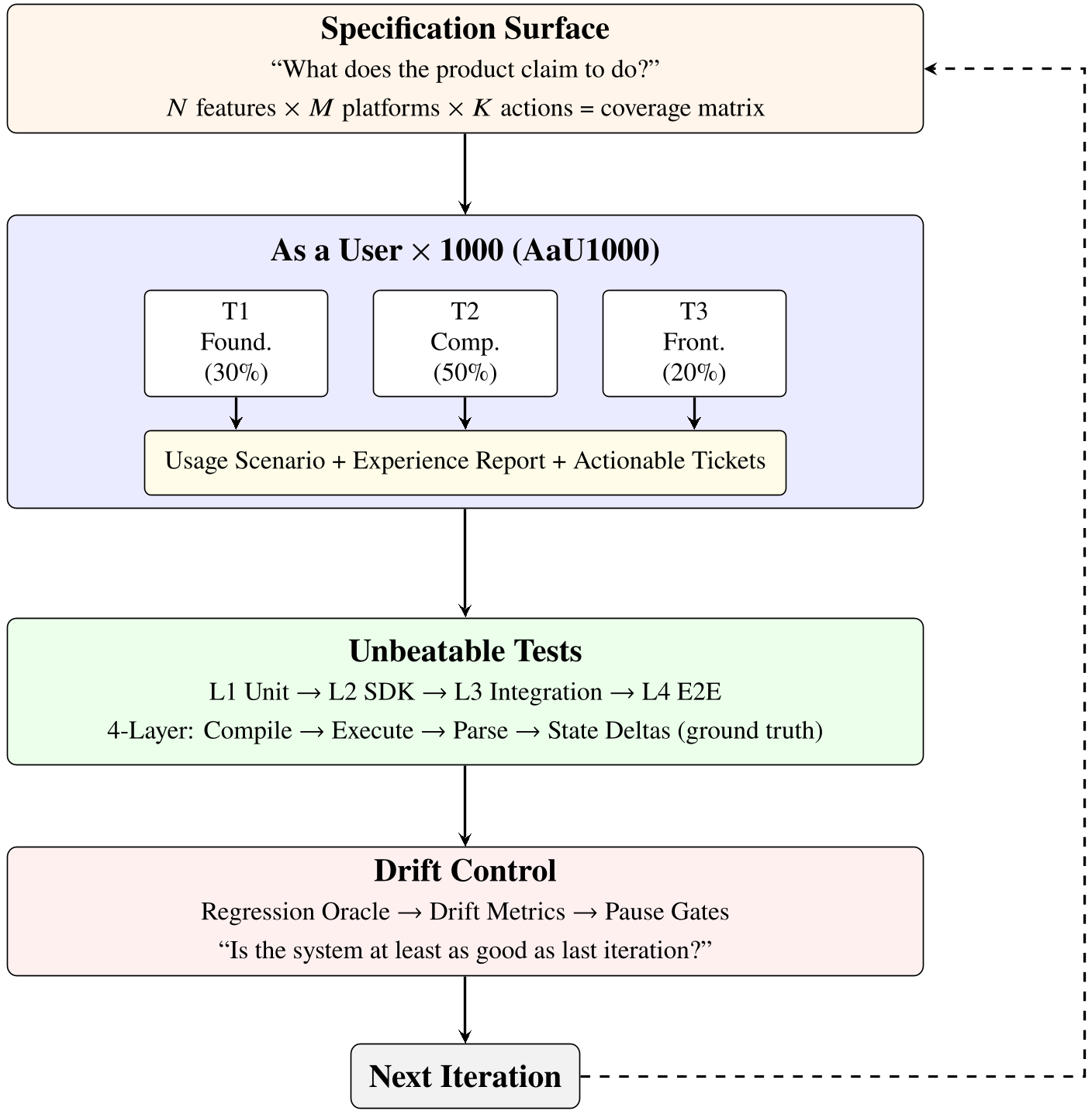 Figure 2: The verification stack: every iteration must pass the UAT gate and Regression Oracle.
The Adversarial UAT Gate: Solving the "Cheating" Agent
LLMs are notorious for "optimizing for green checks." To prevent this, the Kitchen Loop introduces an Adversarial UAT Gate.
- The implementing agent must write a "Sealed Test Card" (step-by-step user instructions).
- A fresh, "dumb" agent (a weaker model like Haiku) with zero context of the code change attempts to follow the card.
- If the weak model cannot verify the feature using only the card, the PR is rejected. This enforces that features are actually usable by humans, not just coherent to other AI models.
Critical Insight: The "As a User x 1000" (AaU1000)
The true power of this method isn't just automation—it's cadence. By exercising thousands of combinatorial scenarios (Feature X on Chain Y with Action Z), the loop finds "deep bugs" that human QA would never reach. For instance, the loop discovered an incorrect unstake selector for a specific DeFi protocol that only triggered under rare market conditions.
Conclusion & Future Outlook
The Kitchen Loop proves that we can move beyond "Copilots" to "Autopilots." However, its success hinges on the Regression Oracle. If you cannot define what "correct" looks like in a deterministic way, the loop cannot help you.
The future of software development isn't humans writing more code—it's humans writing better specifications and building more robust oracles, while the loop handles the relentless labor of evolution.
Limitations: Currently single-threaded and dependent on high-quality external APIs. Future work aims to automate the generation of these Oracles directly from documentation.