
MosaicMem is a hybrid spatial memory framework for video diffusion models that combines explicit 3D geometric lifting with implicit attention-based conditioning. It achieves SOTA consistency in long-horizon video generation and precise camera control by treating video patches as the fundamental unit for 3D localization and retrieval.
TL;DR
MosaicMem introduces a hybrid "Patch-and-Compose" spatial memory that bridges the gap between explicit 3D geometry and implicit latent representations. By lifting video patches into a persistent 3D space and re-aligning them using Warped RoPE, it enables minute-level consistent video navigation, complex scene editing (like "Inception-style" world stitching), and real-time interaction at 16 FPS.
Background: The Persistence Paradox
In the quest to create "World Simulators" (like OpenAI's Sora or Google's Genie), researchers face a fundamental trade-off:
- Explicit Memory: Use 3D structures (point clouds/Gaussians). Pros: Perfect geometry. Cons: Static; can't handle a cat running across the room.
- Implicit Memory: Store past frames as context. Pros: Handles dynamics and "vibes." Cons: The world "drifts" and melts as you move the camera.
MosaicMem breaks this paradox by treating the Patch as the atomic unit of memory—lifting it into 3D for localization, but retrieving it via the model's native attention to stay flexible.
Methodology: The Patch-and-Compose Interface
MosaicMem's pipeline follows an "Explicit-Lifting, Implicit-Conditioning" logic.
1. Geometric Lifting & Alignment
When a frame is generated, its patches are associated with depth and camera poses, effectively "pinning" them in 3D space. When the camera revisits this area, the model retrieves these patches. However, simple retrieval isn't enough due to VAE compression. MosaicMem introduces:
- Warped RoPE: Instead of standard 2D positions, it re-projects coordinates (u, v) through the camera transform to provide the transformer with pixel-accurate correspondence.
- Warped Latents: Differentiable bilinear sampling of features to physically align the "memory" with the "query" view.
2. PRoPE Camera Control
The authors incorporate Projective Positional Encoding (PRoPE). Unlike simple MLP-based camera injections, PRoPE injects relative frustum geometry directly into the self-attention blocks, allowing the model to "understand" the 3D relationship between views.
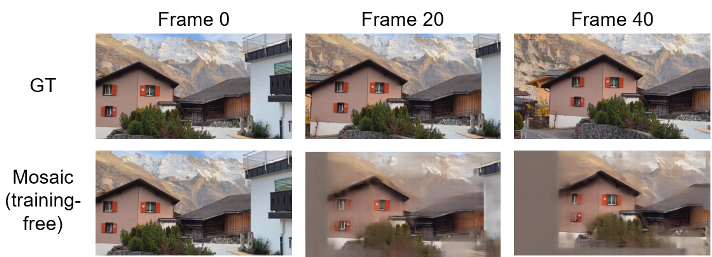 Fig 1: The MosaicMem hybrid pipeline—lifting patches for localization and aligning them for generation.
Experiments & SOTA Results
The model was stress-tested on a new benchmark, MosaicMem-World, featuring long trajectories and frequent revisits in complex environments like Cyberpunk 2077 and Unreal Engine 5.
- Geometric Fidelity: MosaicMem achieved a Rotation Error of 0.51°, compared to ~4.6° for purely implicit models.
- Dynamic Modeling: Unlike explicit models (GEN3C) which produce static "cutouts," MosaicMem successfully generates new dynamics (e.g., a knight riding a horse into a scene) while keeping the background anchored.
- Real-time Interaction: The "Mosaic Forcing" variant enables interactive world exploration at 16 FPS.
 Table 1: MosaicMem vs. SOTA. Note the massive jump in Consistency Scores (SSIM/PSNR) over implicit methods.
Revolutionary Capabilities: Scene Editing & Navigation
Because the memory is "deletable and manipulable," users can:
- Delete/Duplicate Objects: Remove a building or triple the number of trees by modifying the patch-space.
- Scene Stitching: Connect a "Medieval World" to a "Cyberpunk World" horizontally. By walking through the transition, the model generates a geometrically continuous bridge between disparate styles.
- Inception Effects: Register a street memory "in the sky" to create surreal, vertically connected worlds.
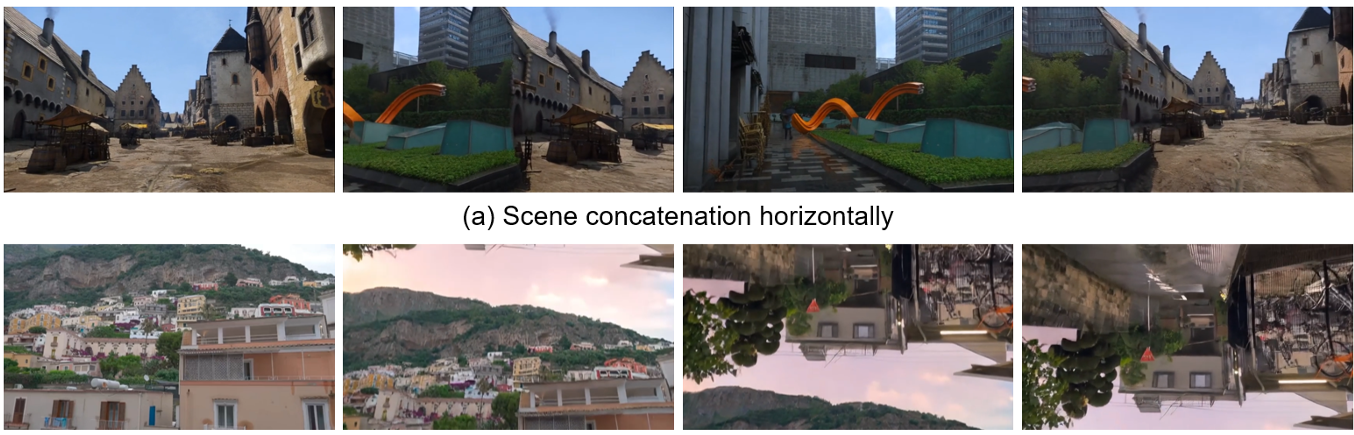 Fig 2: Vertical and horizontal scene stitching via MosaicMem manipulation.
Critical Insight & Conclusion
MosaicMem proves that for a video model to act as a true simulator, it must "understand" that the world is 3D even if it lives in a 2D latent space. The transition from Frame-level memory (redundant and vague) to Patch-level 3D-aligned memory is a significant step toward solving the "drifting world" problem in generative AI.
Future Outlook: While MosaicMem currently relies on off-the-shelf depth estimators, the next logical step is an end-to-end framework where the 3D structure is learned jointly with the generation, further reducing reliance on external geometric scaffolds.